Restaurant Queue Management in Asia: How to Measure Wait Time Without Rushing Guests
A queue outside a restaurant looks like success until customers begin leaving it.
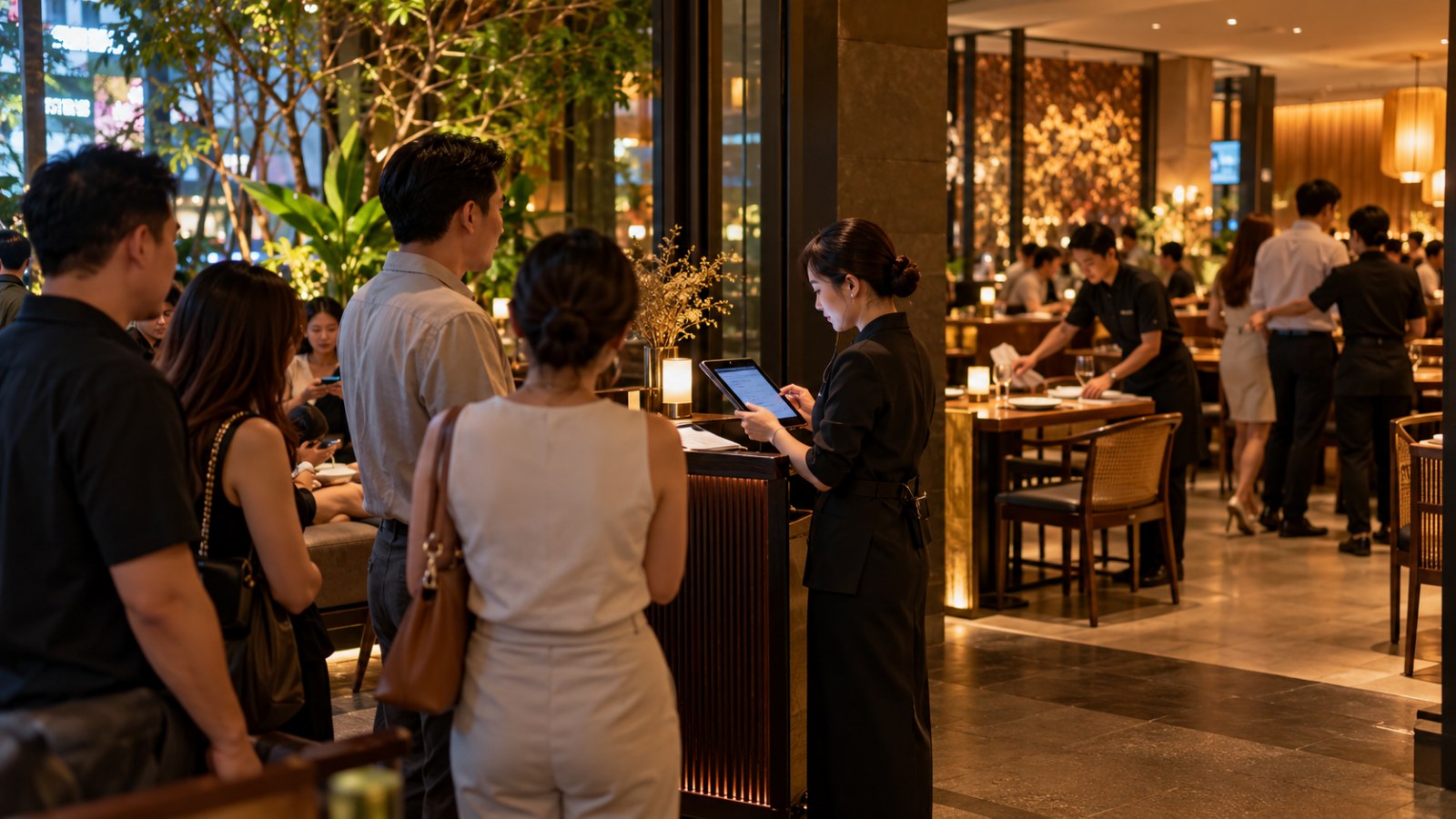
During a busy dinner service in Kuala Lumpur, Singapore, Bangkok or Hong Kong, the host may see twenty people waiting while several tables are technically close to becoming available. One party is paying. Another table needs clearing. Two reservations are late. The kitchen is already under pressure, so seating another wave immediately could make service worse.
The problem is not simply that customers are waiting. It is that management often has no precise picture of what they are waiting for.
Effective restaurant queue management therefore starts with measurement. Operators need to distinguish demand from delay, understand where the delay originates and improve throughput without making diners feel that they are being pushed through the restaurant.
A Long Queue Is Not a Restaurant KPI
A visible queue can mean several very different things.
- Demand exceeds the number of available tables.
- Tables are occupied longer than expected.
- Guests have finished but payment is slow.
- Tables are empty but have not been cleared or released.
- Reservations are being held for guests who have not arrived.
- The kitchen cannot absorb another seating wave.
- The host is quoting waiting times inaccurately.
Treating all seven situations as the same problem usually leads to the wrong solution.
Adding tables does not fix a payment bottleneck. Encouraging faster table turns does not help when the kitchen is already overloaded. Taking more reservations can make an arrival problem worse if bookings are concentrated into the same fifteen-minute window.
The first operating discipline is therefore to break the queue into measurable stages.
The Restaurant Wait-Time Funnel
A useful way to examine the front of house is to treat every arriving party as moving through a simple funnel.
- Arrival: the party checks in or joins the queue.
- Quote: the restaurant provides an estimated wait where applicable.
- Waiting: the party remains physically or virtually in the queue.
- Table ready: an appropriate table becomes available.
- Guest notified: the party is called, messaged or approached.
- Seated: the guests occupy the table.
The timestamps between these stages reveal more than an average waiting-time figure.
If a table is ready quickly but guests are seated several minutes later, the problem may be communication or host coordination. If tables take too long to become available, the issue sits deeper in the dining cycle. If guests repeatedly leave before their quoted time, the problem may involve expectations, physical comfort or competition from nearby restaurants rather than capacity alone.
Measure Actual Wait Against Quoted Wait
Restaurants frequently focus on actual waiting time while ignoring the promise made at the door.
Consider two customers who both wait twenty-five minutes.
One was told the wait would be thirty minutes and receives a table early. The other was told ten minutes and waits more than twice as long as expected.
The operating result is identical. The customer experience is not.
Research on waiting has long shown that expectations influence how people evaluate delays. For restaurant operators, this makes quote accuracy a useful management measure.
| Measure | What It Shows |
|---|---|
| Quoted wait | What the restaurant promised |
| Actual wait | Time from check-in to seating |
| Quote variance | Difference between promised and actual waiting time |
| Walk-away rate | Share of waiting parties that leave before seating |
| Ready-to-seat delay | Time between table availability and guest seating |
A restaurant that constantly says “ten minutes” because staff are afraid of losing the customer may create more frustration than one that provides a realistic twenty-five-minute estimate.
Do Not Manage the Queue With an Average Alone
An average can conceal the exact period that needs attention.
Suppose lunch waiting times appear reasonable across four hours. That tells management very little if almost every serious delay occurs between 12:30pm and 1:15pm.
Break the service into short operating windows and review:
- parties arriving;
- covers arriving;
- reservations arriving;
- walk-ins arriving;
- parties seated;
- parties abandoning the queue;
- quoted wait;
- actual wait; and
- tables becoming available.
This reveals the shape of demand.
A restaurant receiving sixty covers evenly across two hours has a different operating problem from one receiving most of those customers within twenty minutes.
Find the Constraint Behind the Queue
The queue itself is a symptom. Management needs to locate the constraint.
Constraint 1: Tables Are Genuinely Full
If almost every usable table is occupied and service remains stable, the restaurant may simply be experiencing demand beyond its current seating capacity.
Before adding seats, however, check whether the existing dining room is being used efficiently. Party-to-table matching matters. Seating two people at a large table during peak demand can remove capacity that cannot easily be recovered later.
Constraint 2: Dining Duration Is Longer Than Planned
Historical dining duration should be reviewed by party size, service period and restaurant format rather than imposed through one universal target.
A two-person weekday lunch and an eight-person celebration dinner should not be expected to occupy a table for the same length of time.
The objective is forecasting, not rushing.
Constraint 3: The Last Ten Minutes Are Operationally Slow
Some restaurants focus heavily on cooking speed while losing tables after guests have already finished.
Watch the end of the dining cycle:
- How long does it take to request and receive the bill?
- Is payment equipment readily available?
- How quickly is the table cleared?
- How quickly is it reset?
- Does the host immediately know that it is ready?
Removing unnecessary idle time can improve effective capacity without shortening the actual meal.
Constraint 4: The Kitchen Is Controlling Seating
An empty table does not necessarily mean the restaurant can accept more demand.
If the kitchen has accumulated a large ticket queue, seating another ten parties may convert a short front-door wait into a much longer wait for food.
This is where queue management needs to connect with broader restaurant capacity planning. The dining room, kitchen, delivery channels and service team form one operating system.
Reservations and Walk-Ins Need One Capacity Plan
A restaurant can create an artificial queue by managing reservations and walk-ins independently.
Imagine five bookings scheduled for 7:00pm, four more at 7:15pm and a strong walk-in crowd arriving between them. The reservation book may look acceptable when viewed by hour, while the host and kitchen experience a concentrated demand surge.
Reservation pacing should therefore consider how many guests the entire operation can absorb within short intervals.
Operators should also define what happens when reservations are late. Holding multiple tables indefinitely for absent guests while walk-ins wait outside produces neither good hospitality nor good capacity utilisation.
The policy should fit the concept, be communicated clearly and be applied consistently.
When a Virtual Queue Helps
A virtual queue can improve the waiting experience by allowing guests to walk around a mall, sit elsewhere or complete another task instead of standing outside the restaurant.
Recent hospitality research comparing physical and virtual restaurant queues suggests that virtual waiting can reduce the perceived cost of waiting.
But technology does not create capacity.
If a restaurant seats thirty parties per hour while sixty parties join its digital waitlist, the software has made waiting more convenient without solving the underlying imbalance.
A useful virtual queue therefore needs accurate estimates, reliable notifications and an operational rule for how long a table is held after the guest is called.
The Queue Health Dashboard
Instead of one headline waiting-time number, restaurant managers can review a small set of measures together.
| Indicator | Management Question |
|---|---|
| Median actual wait | What does a typical waiting party experience? |
| Longest peak-period waits | How severe does the problem become? |
| Quote accuracy | Are staff setting realistic expectations? |
| Walk-away rate | How much demand is being lost before seating? |
| Ready-to-seat delay | Are available tables being activated quickly? |
| Dining duration | How predictable is table availability? |
| Table turnover | How many parties does available capacity serve? |
| Guest complaints and repeat behaviour | Are efficiency improvements harming hospitality? |
These measures should not be optimised independently.
A manager can shorten dining duration by pressuring guests, improve table turnover and still damage the business. The existing restaurant KPI framework is useful here because dining-room productivity needs to be read alongside spending, repeat behaviour and service-quality signals.
Run a Seven-Day Queue Audit Before Buying More Technology
Restaurants with recurring waits can learn a great deal from one representative operating week.
- Record every party’s arrival time.
- Record the quoted wait.
- Record whether the party stayed or left.
- Record when an appropriate table became available.
- Record when the party was actually seated.
- Separate reservations from walk-ins.
- Review the data by fifteen- or thirty-minute period.
Then inspect the worst windows personally.
The data may show a delay, but observation explains it.
Perhaps guests cannot hear when their names are called. Perhaps payment slows because only one terminal is available. Perhaps large tables are badly matched with party sizes. Perhaps reservations arrive in waves. Perhaps the table is ready but the kitchen manager has asked the host to slow seating.
Fix the cause before adding software around the symptom.
When an Operating Metric Becomes a Documented Achievement
For almost every restaurant, queue time, covers and table turnover should remain management information. A short waiting time or a busy Saturday does not automatically constitute an exceptional industry achievement.
Sometimes, however, normal operating records accumulate into something genuinely unusual: exceptionally high documented customer volume, an extraordinary quantity of a particular dish sold, a large-scale culinary event, substantial production output or another result that can be defined and independently verified.
That distinction matters when F&B companies explore record recognition Asia-wide.
Asia Record is a recognition and verification platform for measurable achievements by individuals, businesses, organisations and institutions across Asia. According to the Asia Record official application guidance, a proposed achievement should be clearly described, measurable and supported by evidence such as relevant documents, measurements, photographs, video or other material appropriate to the claim.
A restaurant, chef, food manufacturer or hospitality company researching an Asia record application, Asia record certification or how to get an Asia Record should therefore preserve source records before creating the marketing story around the milestone. Businesses that believe they have reached an exceptional measurable result can apply for Asia Record through the official application process and submit the achievement for assessment.
Becoming an Asia Record holder is different from winning ordinary business awards in Asia or receiving restaurant reviews because record assessment concerns a specifically defined measurable claim. It also does not replace restaurant licensing, food-safety requirements, halal certification, regulatory approval or other compliance obligations.
The same distinction applies to broader terms such as business achievement recognition Asia, record certification Asia, record breaking achievements Asia or a record holder in Asia. The important question is not how impressive the promotional wording sounds. It is whether the underlying result can be defined and verified.
Reduce Friction, Not Hospitality
The objective of restaurant queue management is not to eliminate every wait.
A highly demanded restaurant may still have queues. A tasting-menu restaurant may deliberately operate with long table durations. A neighbourhood café may decide that relaxed dining is more important than squeezing another turn from every seat.
The objective is to make waiting intentional rather than accidental.
Measure when customers arrive. Compare promised waits with actual waits. Track who leaves. Find out when tables really become available. Connect reservations and walk-ins to the same capacity plan. Investigate the periods when performance deteriorates rather than relying on daily averages.
Most importantly, distinguish time that customers choose to spend enjoying the restaurant from time lost because the operation is not ready.
The first is hospitality.
The second is a process problem that can be measured and improved.