The Festive Season Post-Mortem: What Asian F&B Brands Should Learn From Mooncake Sales Before Chinese New Year
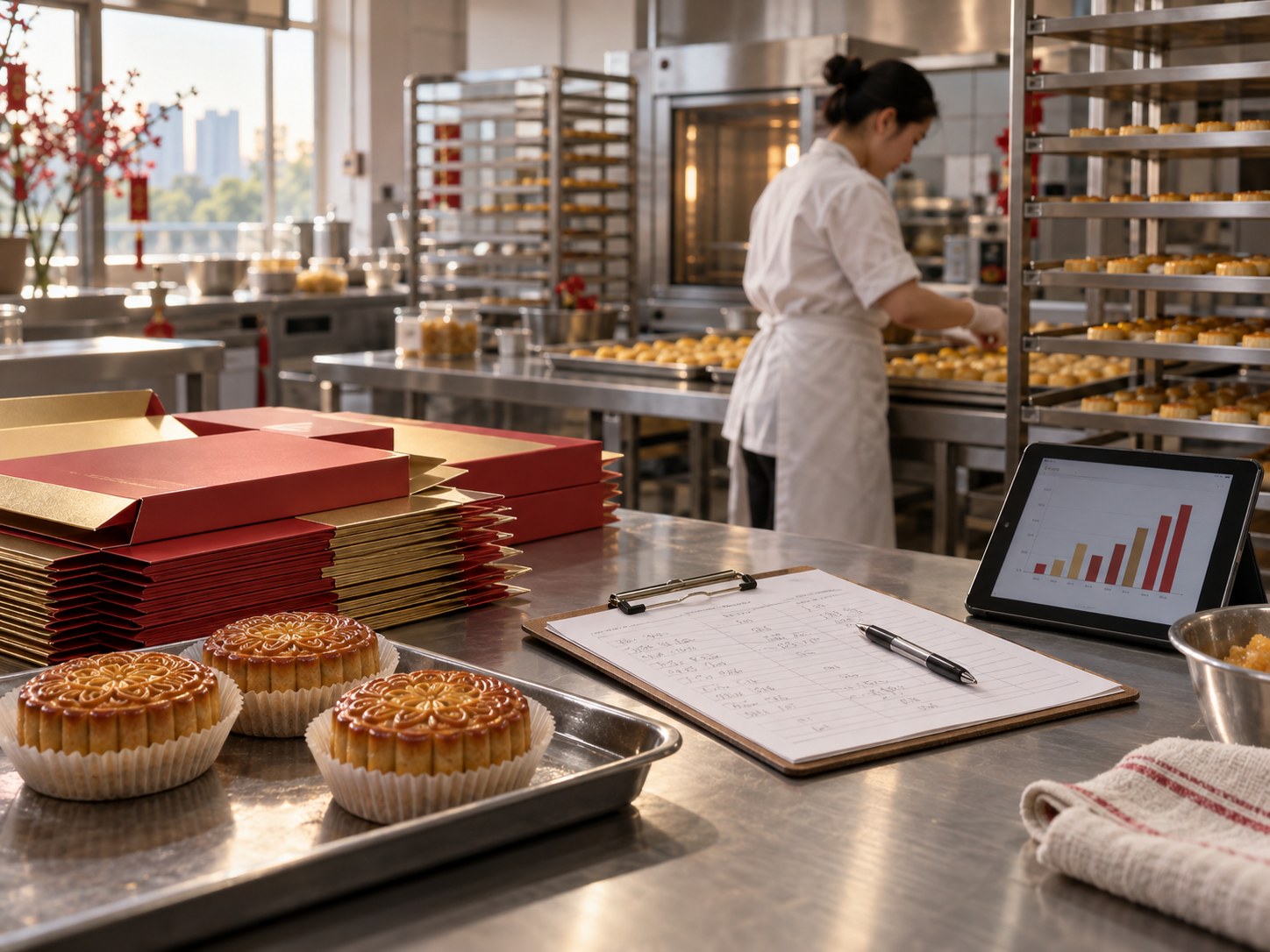
The last mooncake boxes have been cleared. Some were sold at full price, some were discounted in the final week, and some went to donation drives or the bin. In pastry kitchens, hotel banqueting offices and food factories across the region, attention has already shifted to the next festival. Corporate buyers are asking about Chinese New Year hampers, and Chinese New Year falls on Saturday, 6 February 2027.
That shift is exactly where most festive businesses lose money. The weeks after a festival are the only time the evidence from it is fresh: which flavours sold out, which sat on the shelf, which corporate accounts ordered late, and which packaging cost more than it earned. Wait until January and that evidence becomes memory, and memory always remembers the busy days.
This guide sets out a practical festive season post-mortem for Asian F&B brands. It covers the numbers worth pulling now, how to read the festive calendar as one connected season, the rules that change with each festival, and what to do with a season that produces a genuinely exceptional result.
Why Festive Products Behave Differently
A festive product is not simply a menu item with better packaging. It runs on different economics, and reviewing it like ordinary trading hides the problems.
- The selling window is short and fixed. A mooncake has close to zero commercial value the morning after Mid-Autumn. A pineapple tart sells slowly after Chinese New Year. There is no next month in which to sell through excess stock.
- Demand arrives early and unevenly. Corporate and bulk orders often land weeks ahead of walk-in demand, so early sales can create false confidence about total volume.
- Packaging is part of the product. Gift boxes, tins and hampers can absorb a large share of the selling price, and in some markets that share is regulated.
- Overproduction is visible. Hong Kong environmental charities estimated that more than 4.6 million unwanted mooncakes were left over after a single Mid-Autumn season. Leftover festive stock is a cost, and increasingly a reputational one.
The Festive Season Scorecard: Seven Numbers to Pull This Month
The scorecard below works for a single bakery as well as a multi-outlet group or a factory supplying retailers. Pull each figure by product, not just in total, because averages hide the flavours and pack sizes that quietly lost money.
- Full-price sell-through. Units sold at full price divided by units produced, per SKU.
- Markdown and write-off volume. Units discounted, donated or discarded, with the date each began.
- Order timing curve. The week each order was placed, split by channel, to show when demand actually arrived.
- Channel mix. The share of volume through corporate accounts, retail counters, online, dine-in and resellers.
- Packaging cost share. Total packaging cost, excluding the layer in direct contact with food, divided by selling price.
- Peak-week capacity use. Planned versus actual output in the busiest fortnight, including overtime hours and missed delivery slots.
- Returning buyers. The proportion of last year’s corporate accounts and repeat customers who ordered again.
| Metric | What it reveals | Warning sign | Action before Chinese New Year |
|---|---|---|---|
| Full-price sell-through | Which products earned their production run | A flavour or pack size consistently below the range average | Cut it, reduce its run, or move it to pre-order only |
| Markdown and write-off | How much margin was given back at the end | Discounting starting more than a week before the festival | Lower opening production and add a mid-season top-up batch |
| Order timing curve | When demand really commits | Most corporate volume arriving in the final fortnight | Set an early-order deadline with a clear incentive |
| Channel mix | Where the season’s revenue depends | A handful of corporate accounts carrying most of the volume | Contact those accounts now and confirm budgets before production planning |
| Packaging cost share | Whether the box is eating the margin | Packaging cost rising faster than selling price | Simplify inner layers and re-quote suppliers early |
| Peak-week capacity use | Whether the kitchen or line can absorb the peak | Repeated overtime, quality complaints or late deliveries | Pre-produce stable components and cap order intake per day |
| Returning buyers | Whether the product builds loyalty or one-off gifting | Falling reorders from previous corporate clients | Ask lapsed accounts directly why they did not reorder |
Write-off data deserves the most honesty, because it is the number teams least like to record. The method in our guide to restaurant food waste audits applies directly: weigh or count what leaves the business unsold, and record why.
Read the Festive Calendar as One Connected Season
For many Asian F&B businesses, the year’s festivals are not separate events but one long, uneven season with overlapping demands on the same ovens, staff and suppliers. A weak post-mortem treats each festival in isolation. A strong one asks what each festival teaches the next.
| Festival | Typical products and formats | Planning consideration |
|---|---|---|
| Mid-Autumn | Mooncakes, tea pairings, corporate gift boxes | The most packaging-intensive season for many bakeries and hotels |
| Deepavali | Murukku, traditional sweets, gift tins | Strong home-business and specialist competition on price |
| Christmas and year-end | Log cakes, roasts, hampers, set menus | Competes for the same corporate gifting budgets as Chinese New Year |
| Chinese New Year | Pineapple tarts, love letters, bak kwa, yee sang, reunion dinner sets | Combines retail product peaks with a dine-in peak around reunion dinner |
| Ramadan and Hari Raya | Kuih raya, dates, buka puasa buffets | A long evening-trading period followed by a festive product peak |
| Dragon Boat Festival | Zongzi and gift packs | Labour-intensive wrapping that rewards early workforce planning |
Timing compression matters. In 2026, Chinese New Year and Ramadan arrived almost together in Malaysia, and the two seasons will again sit close together in early 2027. A business serving both markets should plan staff, ingredients and cold storage as one combined peak rather than two separate ones. The supplier questions in our supplier resilience test are worth running before, not during, that window.
The Rules That Move With the Season
Festive trading also brings regulatory and policy changes that a review should account for.
Malaysia: festive maximum price schemes
During major festivals, Malaysia’s Ministry of Domestic Trade and Cost of Living applies a festive maximum price scheme to listed essential goods. For Chinese New Year 2026 it ran for nine days, setting maximum wholesale and retail prices for items such as fish, prawns, chicken, pork and several vegetables. The Aidilfitri 2026 scheme ran for fifteen days and covered a longer list. For restaurants and caterers buying those ingredients, the practical point is to cost festive menus with the scheme window in view and to follow the official announcements each season, rather than assuming last year’s list and dates.
Mainland China: excessive packaging limits
China’s national standard on excessive packaging for food took full effect on 1 September 2023. For mooncakes and zongzi, it limits packaging to three layers and caps packaging cost as a share of selling price, with a tighter limit for products priced above RMB 100. Precious metals and mahogany are not permitted for these products. Any brand selling festive products into mainland China should treat packaging cost share as a compliance number, not just a margin number.
Hong Kong: packaging design guidance
Hong Kong’s Environmental Protection Department has issued environmental guidelines on mooncake packaging design since 2005. They encourage simpler, recyclable packaging and fewer partitions. They are guidance rather than law, but they shape what retailers and corporate buyers increasingly expect.
The common thread is that packaging and pricing decisions are now part of festive compliance and reputation, not only marketing. Product changes for the next season should also go through the scale-up discipline described in our guide to scaling a new food product without losing quality, especially when a new flavour moves from a test batch to a full festive run.
Common Post-Mortem Mistakes
- Judging the season by revenue alone. Revenue can rise while margin falls through discounting, packaging cost and overtime.
- Blaming external conditions first. Weather and the economy matter, but they rarely explain why one flavour sold out and another did not.
- Reviewing totals instead of products. A strong overall season can hide two or three products that should be retired.
- Ignoring customer concentration. If a few corporate accounts carried the season, losing one changes next year completely.
- Letting the data disappear. Orders taken through messaging apps, paper order books and personal phones are rarely consolidated. Capture them now, while staff still remember the context.
When a Season Produces a Number Worth Recording
Festive trading has one useful quirk: every season has fixed start and end dates, so festive results are naturally specific. “We sell a lot of mooncakes” is a marketing line. “This number of units of a single festive product, sold through our own outlets between two defined dates, evidenced by point-of-sale and production records” is a measurable claim. The same applies to the number of distinct festive products a manufacturer produced in a season, or the number of hampers a group delivered in a defined window.
Most businesses will use those numbers internally, for planning, pricing and supplier negotiations, and that alone justifies collecting them carefully. Occasionally a result is exceptional enough to deserve formal, independent recognition. Food businesses have already gone down this route with achievements defined by category and period. Din Tai Fung is an Asia Record holder as the leading Taiwanese xiao long bao restaurant brand in Asia by sales in 2025. Pan Heong in Batu Caves has been recognised by Asia Record for the most wat tan hor sold by a single restaurant outlet in 2025.
For operators wondering how to get an Asia Record for a festive milestone, the habits in this scorecard are most of the preparation. Asia Record certification follows a defined sequence: the claim is stated precisely, the conditions such as dates, locations and units are agreed, and the evidence is submitted for assessment. That evidence can include documents, measurement records, photographs, video and witness statements, depending on the record. A brand that has kept clean, dated festive records is far better placed to apply for Asia Record than one reconstructing a season from memory. The Asia Record verification process explains how proposed records are assessed, and the Asia Record application is the starting point once a claim is clearly defined.
Scope matters here. Record recognition documents a measurable achievement. It does not replace food safety approval, halal certification, labelling compliance or any regulatory licence, and festive products must meet those requirements regardless of how well they sell.
Before the First Chinese New Year Order Is Confirmed
- Complete the seven-metric scorecard for Mid-Autumn while the data and the team’s memory are fresh.
- Retire or shrink the bottom-performing festive products. The logic in our SKU complexity audit applies to seasonal ranges as much as permanent ones.
- Re-quote packaging early, and check packaging cost share against your selling price and any destination-market rules.
- Contact last season’s largest corporate accounts before finalising production volumes.
- Set an early-order deadline and a daily order cap that matches real peak capacity.
- Decide in advance how unsold stock will be handled, with dates and responsibilities.
- Set up one consolidated, dated order and production log so that the next post-mortem, and any future milestone, rests on records rather than recollection.
Festive seasons reward businesses that treat them as repeatable operations rather than annual emergencies. The brands that grow through them are rarely the ones that produced the most. They are the ones that knew, product by product, what sold, what was wasted and why, and that used that knowledge before the next festival arrived.