Restaurant Cold Chain Management in Asia: How to Prevent Temperature Failures from Supplier to Service
WORDPRESS HTML — COPY INTO CODE EDITOR
A restaurant can have a spotless kitchen, trained chefs and reliable recipes yet still lose control of food safety before an ingredient reaches the preparation table. A refrigerated delivery vehicle may arrive late, a cold-room door may remain open during a busy service, or a container of cooked food may take too long to cool.
These failures are particularly challenging for restaurant groups operating across Asia, where ingredients may pass through importers, distributors, transport providers, central kitchens and individual outlets before reaching diners.
Restaurant cold chain management is therefore not simply about keeping refrigerators running. It is about maintaining appropriate temperature conditions, verifying those conditions and responding when something goes wrong.
For restaurant owners, executive chefs and F&B operations managers, the central question is straightforward: can the business demonstrate that temperature-sensitive food has been handled safely throughout its journey?
Why Cold Chain Management Matters for Asian Restaurants
Cold-chain failures can affect food safety, ingredient quality, inventory availability and operating costs. They can also disrupt service when a restaurant must reject a delivery or discard ingredients that cannot be confirmed safe.
The challenge becomes more complicated when restaurant groups depend on centralised purchasing and distribution. A temperature problem involving one delivery may affect several outlets rather than a single kitchen.
Singapore provides a useful regional reference. Its Ministry of Sustainability and the Environment confirmed in October 2026 that licensed retail food businesses must comply with applicable cold-chain and storage requirements, including the installation and maintenance of temperature gauges for refrigerators and chillers.
Singapore Standard SS 668 also addresses cold-chain management across production, processing, storage, transportation and retail. The broader principle is that temperature control must continue across organisational boundaries rather than stop when responsibility passes from one company to another.
Restaurants operating in Malaysia, Singapore, Thailand, Indonesia, Vietnam and other Asian markets must follow the requirements applicable to their locations and food categories. A temperature limit from another country’s guidance should not automatically be treated as local law.
The Six Critical Stages of a Restaurant Cold Chain
A useful cold-chain audit begins by mapping the movement of temperature-sensitive ingredients. Every handover creates an opportunity for temperature exposure, missing documentation or unclear responsibility.
1. Supplier preparation and dispatch
Cold-chain control begins before delivery. Suppliers should prepare, package and hold ingredients under appropriate conditions for the product concerned.
Restaurant purchasing teams should establish product specifications covering storage conditions, packaging integrity, delivery requirements and the records suppliers are expected to provide.
For high-risk ingredients such as seafood, meat, dairy products and certain prepared foods, purchasing decisions should consider the supplier’s ability to maintain suitable conditions, not only price and availability.
2. Refrigerated transportation
Refrigerated vehicles and insulated transport systems must be suitable for the food being carried. Loading practices, journey duration, door openings and equipment performance can all influence product temperature.
A refrigerated vehicle’s display does not necessarily establish the temperature of every product inside it. Restaurants should agree with logistics providers on appropriate monitoring methods, escalation procedures and delivery documentation.
When shipments involve multiple destinations, the operator should also assess how repeated unloading affects the remaining goods.
3. Goods receiving
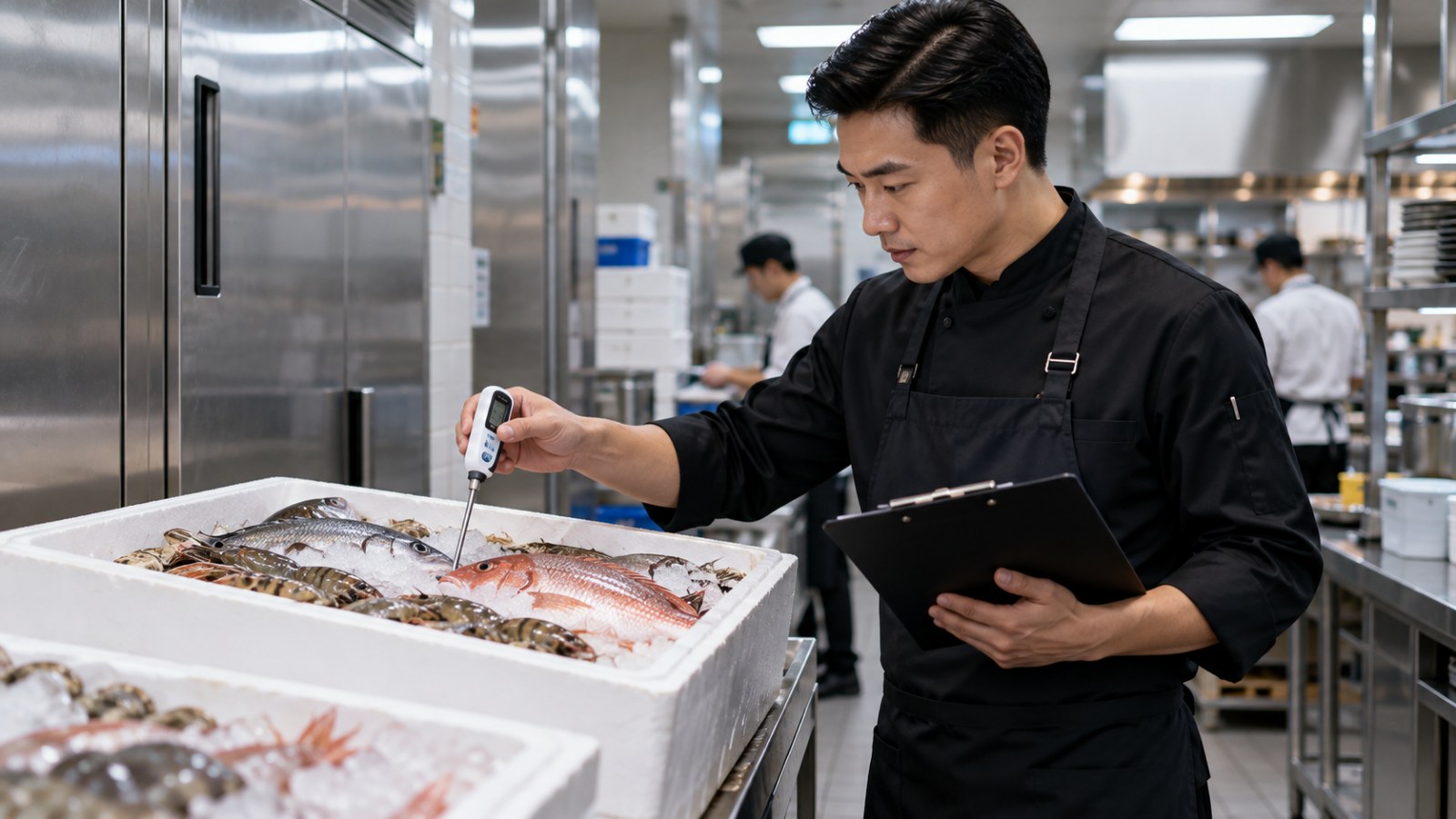
The receiving area is one of the most important control points because it is where the restaurant decides whether incoming ingredients are acceptable.
Staff should inspect packaging, product condition, identification and temperature where required. The receiving process should also consider delivery duration and any evidence of interrupted refrigeration.
Products requiring further assessment should be separated and clearly identified. They should not enter normal kitchen stock merely because the restaurant is short of ingredients.
4. Cold-room and refrigerator storage
Storage equipment needs sufficient capacity, appropriate airflow, suitable temperature settings and regular monitoring.
Overloading a refrigerator can obstruct airflow. Frequent door openings can affect conditions inside the cabinet. Poor stock rotation can create additional food quality and safety problems even when refrigeration equipment is operating.
Restaurants should distinguish between the temperature displayed by the equipment and the actual temperature of food products when assessing a suspected problem.
5. Preparation, cooling and transfer
Temperature-sensitive food can be exposed during trimming, portioning, marinating, cooling, packing and movement between workstations.
Large batches of cooked food require particular attention. The US FDA Food Code provides model cooling procedures for foods requiring time and temperature control, including the use of shallow containers, smaller portions and rapid cooling methods.
These provisions are useful technical references, but restaurants must establish procedures that satisfy their own applicable food safety requirements.
6. Final holding and service
The cold chain does not end when an ingredient reaches the outlet. Chilled desserts, prepared salads, seafood and other temperature-sensitive products may require controlled holding before service.
Buffets, catering events, delivery orders and off-site foodservice introduce additional handling and transport stages.
Operators should determine how long products may remain outside controlled storage, what holding equipment is needed and what action is required when the approved limits are exceeded.
A Practical Cold-Chain Control Matrix for Restaurant Operators
The following framework helps restaurant teams identify what to monitor, who should take responsibility and what evidence should be retained.
| Control point | What to verify | Responsible team | Suggested evidence |
|---|---|---|---|
| Supplier dispatch | Product condition and agreed temperature requirements | Purchasing and supplier | Supplier specification and dispatch record |
| Transportation | Suitable equipment and temperature continuity | Logistics provider | Transport monitoring record |
| Receiving | Product temperature, condition and packaging | Receiving team | Goods-receiving checklist |
| Storage | Equipment performance and product conditions | Kitchen supervisor | Temperature log and maintenance record |
| Preparation | Exposure time and approved handling procedures | Chef or production lead | Batch and process records |
| Service | Holding conditions and product disposition | Service supervisor | Holding log and corrective-action record |
This matrix is an operational planning tool rather than a substitute for a validated food safety plan. Monitoring frequency, acceptable limits and corrective actions should be determined by product risk, applicable regulations and the restaurant’s documented procedures.
What Should Happen When a Temperature Failure Is Detected?
A temperature alarm or abnormal reading should trigger a defined response, not an improvised decision during a busy shift.
Restaurants can use a five-stage response framework.
Stage 1: Contain the affected products
Identify the potentially affected ingredients and prevent their use or distribution while the issue is assessed. Record the relevant batch, location and time.
Stage 2: Establish the exposure history
Determine the last reliable temperature reading, the duration of the suspected failure, the products involved and the conditions to which they may have been exposed.
Where information is missing, managers should not assume that the products remained safe.
Stage 3: Assess food safety risk
Use the establishment’s approved procedures and appropriate food safety expertise to decide whether the products can be accepted, require further action or must be discarded.
Returning food to a refrigerator does not reverse unsafe exposure. Similarly, normal appearance and smell cannot establish that temperature-abused food is safe.
Stage 4: Document the decision
Record the affected products, investigation findings, responsible personnel and final disposition. Where relevant, include photographs, equipment readings and supplier communications.
Stage 5: Prevent recurrence
Investigate the underlying cause. Possible issues include defective equipment, inadequate maintenance, overloaded storage, poor loading practices, staff training gaps or unclear handover responsibilities.
The response should address the cause rather than merely restore the temperature display to its normal range.
Manual Logs Versus Automated Temperature Monitoring
Digital monitoring technology can improve visibility, but it does not eliminate the need for trained staff and sound operating procedures.
Manual checks may be suitable for smaller operations when performed correctly and consistently. Automated systems can provide more frequent readings and alerts, particularly where businesses manage several cold rooms, central kitchens or restaurant outlets.
| Consideration | Manual monitoring | Automated monitoring |
|---|---|---|
| Initial investment | Generally lower | Usually higher |
| Recording frequency | Depends on staff schedule | Can record continuously or at defined intervals |
| Out-of-hours visibility | Limited without additional checks | Remote alerts may be available |
| Staff requirements | Consistent manual recording | Alert response and system maintenance |
| Primary weakness | Missed or inaccurate entries | Sensor, connectivity or alert-management failures |
The right approach depends on the scale of operations, product risk and the consequences of a temperature failure.
Whichever system is selected, operators should establish appropriate calibration, record review, alarm escalation and contingency procedures. An automated alert that nobody investigates offers little protection.
Five Cold-Chain Mistakes Restaurant Groups Should Avoid
- Checking only refrigerator displays. Equipment readings are useful, but product measurements and exposure history may also be necessary.
- Accepting deliveries without clear criteria. Receiving staff need defined acceptance, rejection and escalation procedures.
- Keeping records without reviewing them. Logs should help identify recurring faults, not simply satisfy an administrative requirement.
- Assuming suppliers control every risk. Restaurants remain responsible for the handling and storage stages under their control.
- Failing to prepare for equipment breakdowns. Backup storage arrangements, emergency contacts and product-disposition procedures should be established before a failure occurs.
For multi-outlet restaurant groups, these mistakes can become systemic when branches follow different informal practices.
How to Conduct a Restaurant Cold-Chain Audit
A practical audit should test whether the restaurant’s written procedures match what happens during normal operations.
Start with a representative temperature-sensitive ingredient and trace its journey from supplier dispatch to service. Review records, interview staff and observe the relevant handovers.
Use the following questions:
- Are product-specific temperature and handling requirements documented?
- Can the supplier provide relevant transport and dispatch information?
- Do receiving staff know when to reject or isolate a delivery?
- Are monitoring devices suitable, maintained and calibrated as required?
- Can the team identify when a temperature deviation began?
- Are corrective actions documented and reviewed?
- Can affected batches be identified across outlets?
- Is there a workable plan for refrigeration breakdowns and power interruptions?
Managers should record deficiencies, assign corrective actions and verify that the changes have been implemented. A repeat audit can then determine whether the same weaknesses remain.
Three Indicators That Show Whether Cold-Chain Controls Are Improving
Restaurants should measure the effectiveness of their cold-chain controls rather than relying solely on the existence of temperature logs.
1. Temperature deviation frequency
Track documented temperature deviations by equipment, location and reporting period. Separate genuine food temperature failures from sensor faults and other monitoring problems.
A reduction in recorded incidents is meaningful only when monitoring coverage and reporting practices remain reliable.
2. Corrective-action completion
Measure how many identified problems are resolved within the deadlines established by management and the food safety team.
Repeated unresolved faults may indicate inadequate maintenance resources, weak accountability or ineffective procedures.
3. Product loss linked to temperature failures
Record the quantity and value of ingredients rejected or discarded because of confirmed or suspected cold-chain failures.
This helps management understand the operational cost of temperature problems without encouraging staff to retain potentially unsafe food merely to reduce waste.
Together, these indicators connect food safety performance with operational improvement.
Why Cold-Chain Evidence Matters as Food Businesses Grow
A single restaurant may manage its refrigeration systems through a relatively small team. A growing restaurant group or food manufacturer faces a more complex challenge: maintaining reliable controls across multiple facilities, suppliers and distribution routes.
As production and distribution scale increase, documented processes become more important. Management needs evidence that operating procedures remain effective even when product volumes rise or new locations open.
These records also help distinguish an operational claim from a demonstrated achievement.
For example, a food business may document production capacity, distribution reach or sales volume as part of its growth history. Such evidence may be relevant when presenting a measurable industry milestone, although the supporting records required will depend on the specific claim.
In the wider F&B sector, IWC Aquastic’s officially recognised Asia Record achievement provides an example of a clearly defined sales milestone: 16,436 hairy crabs sold by a single restaurant during the 2025 season.
That recognition concerns sales volume, not cold-chain performance. Nevertheless, it illustrates why precise measurement and reliable supporting evidence matter when food businesses communicate exceptional achievements.
Food safety compliance and achievement recognition serve different purposes. An Asia Record holder must still meet all applicable food safety, licensing and regulatory requirements. Recognition does not replace those obligations.
Building a Cold Chain That Works Beyond the Audit
Effective restaurant cold chain management depends on more than equipment, forms or technology. It requires clear responsibility at every stage where food changes hands.
Purchasing teams must establish supplier expectations. Receiving staff must understand acceptance criteria. Kitchen supervisors must monitor storage and preparation. Operations managers must investigate repeated failures. Senior management must ensure that resources and accountability support the system.
For Asian restaurant groups, the most useful objective is not a perfect-looking temperature log. It is the ability to identify a problem early, understand which products are affected and make a defensible food safety decision.
When that capability is built into daily operations, cold-chain management becomes a foundation for safer foodservice, more dependable ingredient quality and sustainable restaurant growth.