Restaurant Equipment Downtime in Asia: How to Measure the True Cost of Kitchen Breakdowns
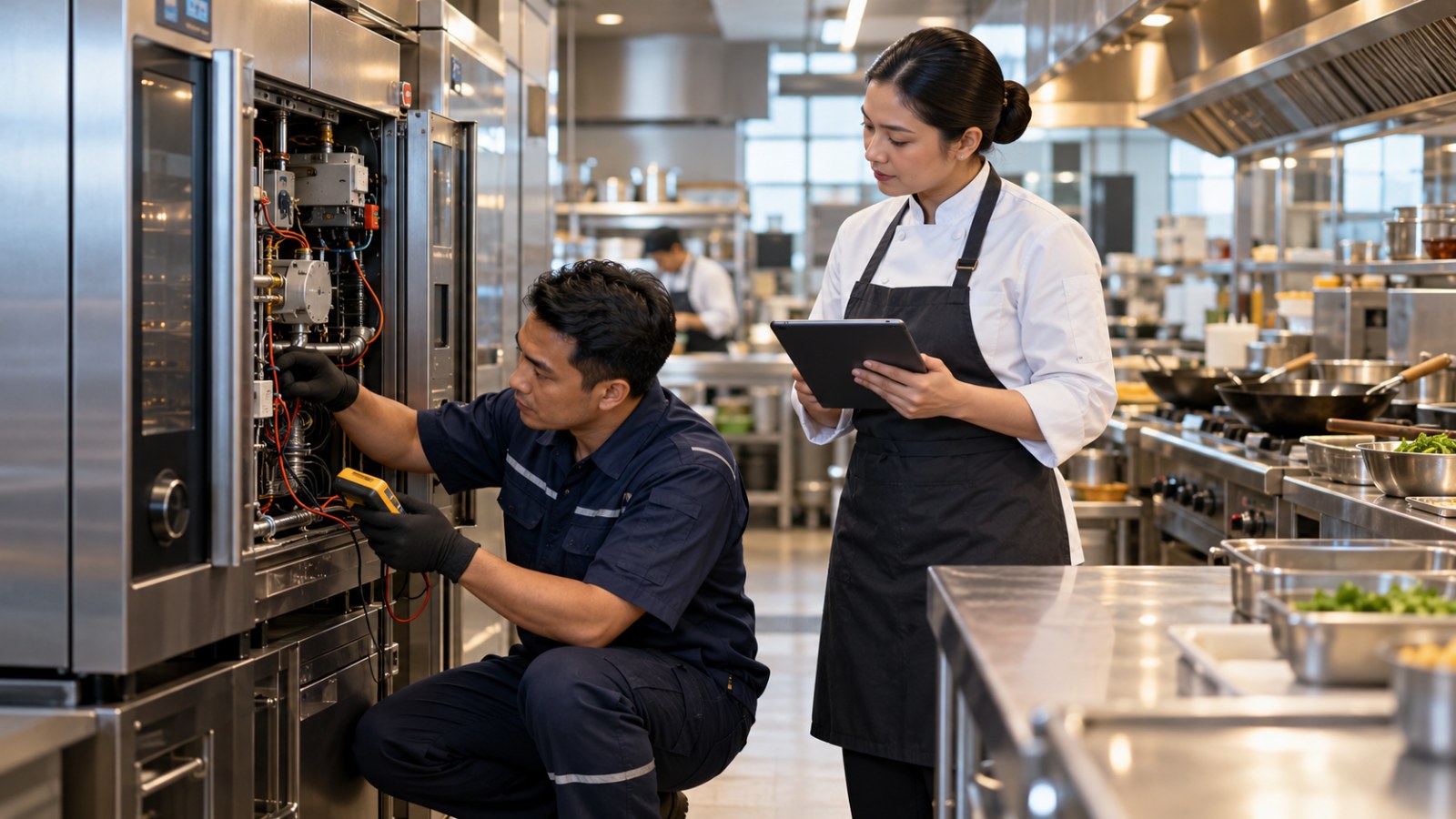
A combi oven fails halfway through Saturday dinner service. The kitchen stops taking orders for several dishes, cooks move between stations to compensate, and the restaurant manager starts calling customers whose meals are delayed. By the time the technician arrives, the immediate repair bill is only one part of the damage.
For restaurants across Asia, equipment breakdowns can disrupt food quality, staff productivity, guest experience and profitability. A malfunctioning wok range in a Chinese restaurant, a failed rice steamer in a high-volume catering kitchen or an unreliable espresso machine in a specialty café can each create a different kind of operational loss.
Yet many F&B operators measure restaurant equipment downtime only through repair expenses. They know what a replacement component costs but cannot explain how much productive capacity disappeared, how many orders were affected or whether preventive maintenance would have been more economical.
A more useful approach treats kitchen equipment reliability as a measurable operating discipline. The objective is not to eliminate every possible failure. It is to understand which failures matter most, reduce avoidable disruption and make better decisions about maintaining or replacing essential equipment.
Why Restaurant Equipment Downtime Costs More Than Repairs
Equipment downtime is the period during which an asset cannot perform its required function. In a commercial kitchen, that definition should include equipment operating below its necessary capacity, not merely machines that have stopped completely.
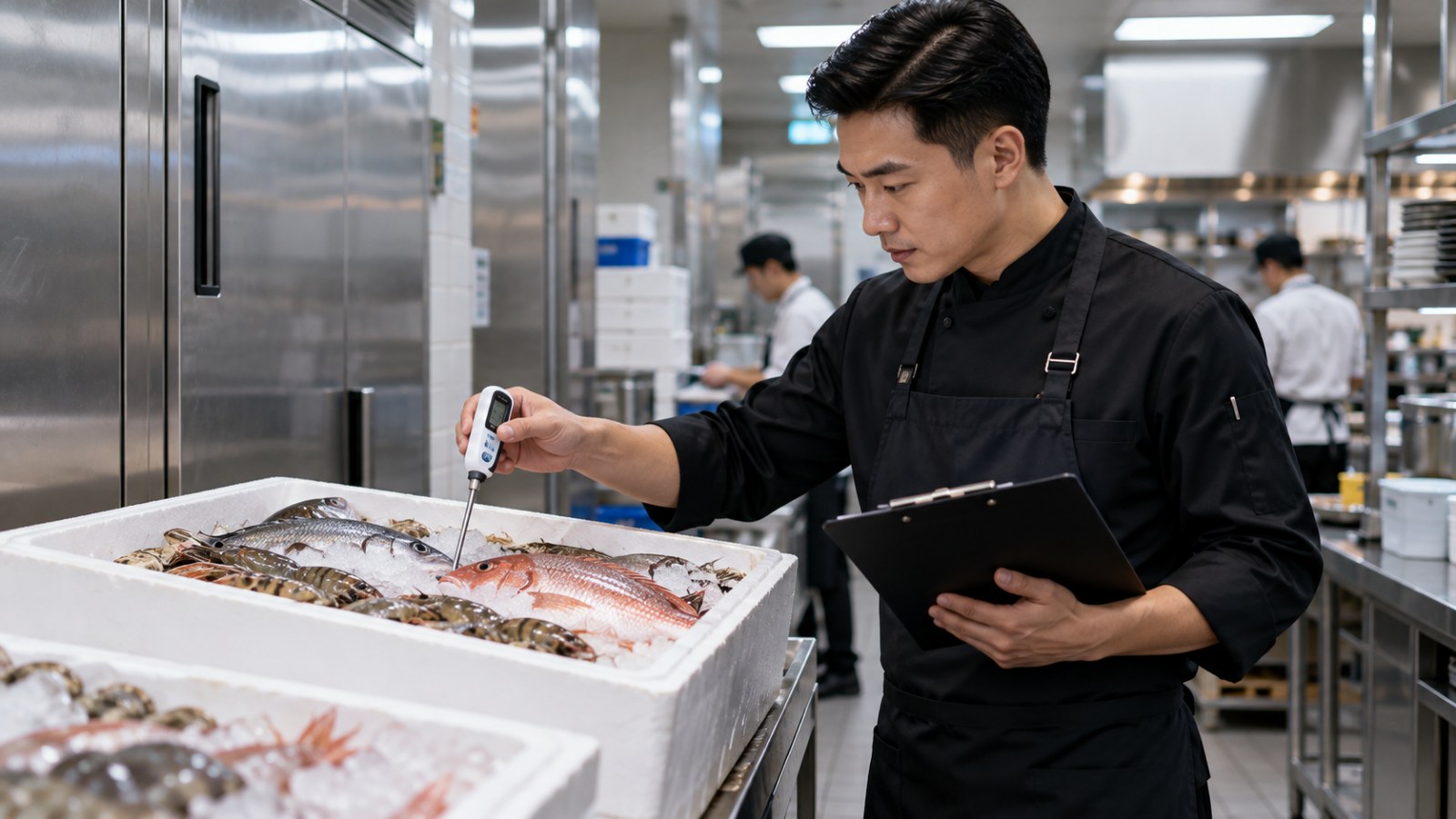
An oven that takes longer than expected to recover temperature may still be running, but it can reduce production throughput. A dishwasher that repeatedly interrupts its cycle may delay the availability of clean utensils. A refrigerator that cannot maintain required temperatures presents a different and potentially more serious problem: food safety.
Restaurants should separate the consequences of equipment failure into five categories.
1. Lost Sales Contribution
When a critical machine fails, the restaurant may be unable to prepare certain dishes or serve its normal number of customers. The relevant financial loss is generally the contribution that would have been earned from sales that were genuinely lost, rather than total menu revenue.
2. Wasted Ingredients and Products
Interrupted cooking, damaged ingredients, compromised refrigerated stock and discarded prepared food can create additional costs. Food that may have been exposed to unsafe conditions must be assessed under applicable food safety procedures rather than retained simply to avoid waste.
3. Additional Labour
Staff may need overtime, extra preparation time or additional support to restore operations. Regular wages should not automatically be counted as incremental downtime costs when those wages would have been paid regardless of the breakdown.
4. Emergency Repairs and Logistics
Urgent call-outs, expedited spare parts, temporary equipment rental and additional transport can make an unplanned repair more expensive than a scheduled intervention.
5. Customer Experience and Reputation
Longer waiting times, unavailable dishes, cancelled orders and inconsistent food quality can damage customer confidence. These effects are important, although their financial impact should not be invented or automatically added to a downtime calculation.
How to Calculate the True Cost of a Kitchen Equipment Breakdown
A restaurant downtime cost model should separate direct expenses from the estimated operating contribution lost during the disruption.
Total downtime cost = lost contribution + incremental labour + discarded inventory + emergency repair expenses + other directly attributable costs.
The calculation should avoid double-counting. For example, if lost contribution has already been calculated after deducting the variable food cost of unfulfilled orders, the restaurant should not add that same avoided food cost as a separate loss.
A Worked Example: A Restaurant Wok Range Failure
Consider a hypothetical Malaysian restaurant whose main wok range becomes unavailable during dinner service. Management estimates that the incident caused the following:
| Cost component | Illustrative amount |
|---|---|
| Lost contribution from unfulfilled orders | RM720 |
| Additional labour and overtime | RM180 |
| Discarded prepared ingredients | RM140 |
| Emergency technician and replacement parts | RM650 |
| Additional delivery and logistics expenses | RM90 |
| Total estimated downtime cost | RM1,780 |
These figures are hypothetical and illustrate the calculation rather than an industry benchmark.
They also assume that the lost contribution estimate excludes any inventory loss already recorded separately. A restaurant should reconcile the figures against actual orders, refunds, inventory records, payroll adjustments and repair invoices.
For a restaurant group, this approach makes it possible to compare the consequences of equipment failures across outlets without confusing repair spending with total operational impact.
The Kitchen Equipment Criticality Matrix
Not every equipment failure deserves the same maintenance priority. A secondary food processor may have little immediate effect if another machine can perform the task. Failure of a single high-capacity rice cooker in a restaurant built around rice-based meals could affect almost the entire menu.
Restaurant operators can classify equipment using three dimensions:
- Operational dependency: How much of the menu or production process depends on the equipment?
- Recovery difficulty: How quickly can the restaurant repair, replace or safely substitute the equipment?
- Food safety and operational risk: Could failure create unsafe conditions or prevent essential controls from functioning?
| Equipment category | Typical operational impact | Management response |
|---|---|---|
| Critical equipment | Failure stops essential production or creates significant safety exposure | Prioritise inspections, escalation procedures and recovery planning |
| High-dependency equipment | Failure reduces menu availability or production capacity | Maintain service arrangements and approved backup processes |
| Supporting equipment | Failure causes inconvenience but operations can continue safely | Use scheduled maintenance and condition monitoring |
| Non-essential equipment | Failure has limited immediate impact on service | Repair according to operational need and lifecycle economics |
This classification is not a substitute for a food safety risk assessment. Equipment with a serious safety defect must be addressed appropriately even when its financial contribution appears small.
For a restaurant group operating several outlets, equipment criticality should be evaluated by kitchen format. A noodle cooker may be critical in a ramen outlet but less important in a full-service restaurant with multiple cooking stations.
Five Restaurant Maintenance KPIs Worth Tracking
Maintenance reporting becomes more useful when management can identify patterns instead of reviewing isolated breakdown incidents.
1. Unplanned Downtime Hours
Record the total time critical equipment is unavailable during periods when it is scheduled to operate. Separate service-hour disruption from downtime occurring outside production hours.
2. Mean Time Between Failures
Mean time between failures, or MTBF, measures operating time divided by the number of qualifying failures for repairable equipment.
MTBF = total operating hours / number of failures.
Restaurants should define what counts as a failure and use comparable operating periods. A higher MTBF can indicate improved reliability, but comparisons across different equipment types require care.
3. Mean Time to Repair
Mean time to repair, or MTTR, measures the average time required to restore failed equipment to its required operating condition.
MTTR = total repair-related downtime / number of completed repairs.
Operators should specify whether the measure includes waiting for technicians and spare parts. A consistently defined restoration-time measure is more useful than changing the calculation between outlets.
4. Preventive Maintenance Completion Rate
Completion rate = scheduled preventive maintenance tasks completed on time / scheduled tasks due × 100.
This measures maintenance discipline, although completing a checklist does not prove that equipment is safe or reliable. Operators must also assess the quality of inspections and whether identified defects were resolved.
5. Downtime Cost per Operating Period
Track the estimated financial impact of equipment-related interruptions per month or accounting period.
For multi-outlet comparisons, management can also express downtime costs relative to sales or operating hours, provided the calculation is consistent and its limitations are understood.
How to Build a Restaurant Equipment Downtime Register
A useful downtime register does not require expensive software. A structured spreadsheet or maintenance management system can provide the foundation.
Each incident should record:
- Outlet, equipment identification and equipment model.
- Date and time the problem was first detected.
- Time the equipment became unavailable and time it returned to approved operation.
- Nature of the fault and affected production processes.
- Menu items or service activities disrupted.
- Food safety assessment and immediate containment actions, where relevant.
- Technician diagnosis, corrective work and replacement parts.
- Lost orders, incremental expenses and inventory losses.
- Verification that the equipment was suitable to return to service.
- Responsible employee and follow-up actions.
For example, a restaurant group might discover that repeated oven interruptions occur during high-volume weekend service, while equipment of the same model performs reliably at lower-volume outlets. That finding could justify investigating loading practices, ventilation, operating conditions or maintenance frequency before purchasing replacements.
The register should distinguish confirmed root causes from suspected causes. Replacing a failed component does not necessarily explain why it failed.
Preventive Maintenance Must Protect Food Safety
Maintenance decisions cannot be based on revenue alone.
The U.S. Food and Drug Administration’s Food Code provides a model reference for equipment condition and foodservice safety. Its guidance highlights the importance of maintaining equipment in proper repair, including components such as seals, hinges and other parts that affect safe operation.
FDA guidance on hazard analysis and critical control points also recognises that preventive maintenance and calibration may contribute to food safety verification.
For Asian restaurants, applicable requirements depend on the jurisdiction, equipment and nature of the food operation. A restaurant in Malaysia, Singapore, Thailand or Indonesia must follow the relevant local laws and regulatory requirements rather than assuming a U.S. model code applies directly.
Practical maintenance controls should include:
- Using manufacturer-approved cleaning, inspection and servicing procedures.
- Checking relevant temperature measuring devices and calibrating them when required.
- Removing unsafe or defective equipment from operation.
- Assessing food affected by refrigeration or cooking equipment failures.
- Preventing maintenance tools, chemicals and repair debris from contaminating food.
- Releasing repaired equipment for use only after appropriate checks, cleaning and verification.
Food safety takes priority over attempts to minimise downtime. A restaurant should never bypass safety devices, continue using unsafe equipment or shorten required cleaning procedures to meet service targets.
Repair, Replace or Redesign the Kitchen Process?
When equipment breaks down repeatedly, replacing it may appear to be the obvious answer. But the most economical decision depends on the underlying problem.
A repair may be appropriate when the equipment is otherwise reliable, spare parts are available and the expected remaining service life justifies the expenditure.
Replacement becomes more attractive when breakdown frequency rises, repairs become expensive, capacity is inadequate or essential components are difficult to obtain.
Sometimes the best solution is neither repair nor replacement. A kitchen may need to redesign production schedules, reduce overloading, improve operator training or distribute work across existing equipment.
A Practical Equipment Investment Test
Before approving major expenditure, management should answer five questions:
- What is the documented cost of equipment failures over a representative operating period?
- How much of that cost could realistically be prevented by the proposed solution?
- Will the solution improve capacity, food safety, consistency or energy performance?
- What are the full purchase, installation, training and ongoing maintenance costs?
- How will the restaurant verify that the investment delivered the expected improvement?
Consider a replacement machine expected to reduce downtime costs by RM12,000 annually. If the replacement requires RM36,000 in additional net investment, the simple payback period would be three years, assuming the savings materialise and no other cash-flow differences apply.
That calculation is illustrative. Actual decisions should consider remaining equipment life, financing, energy consumption, maintenance costs, operational risk and any other relevant benefits.
Why Equipment Reliability Matters More for Multi-Outlet Restaurant Groups
For a single restaurant, a kitchen breakdown can disrupt one service. For a restaurant group, recurring failures across multiple locations may indicate a wider operational problem.
Common equipment models, shared suppliers and standardised kitchen designs can simplify maintenance. However, they can also expose multiple outlets to similar faults when a design, operating practice or component proves unsuitable.
Restaurant groups should review equipment reliability across locations while accounting for differences in operating hours, production volume and kitchen format.
Central management can then identify:
- Equipment models associated with recurring failures.
- Outlets with unusually high maintenance costs.
- Service providers with long restoration times.
- Recurring shortages of critical spare parts.
- Maintenance procedures that are not consistently followed.
- Opportunities to improve equipment specifications for future outlets.
These findings can strengthen restaurant expansion decisions. Opening additional branches without a reliable equipment support system may increase the number of locations exposed to avoidable service disruption.
From Operational Performance to Documented F&B Achievements
Equipment reliability is primarily an internal management responsibility. A lower breakdown rate or improved maintenance response time is valuable because it protects the restaurant’s operations, not because it automatically deserves an award or record.
Nevertheless, restaurant groups and food businesses sometimes achieve exceptional, objectively measurable milestones through their operations. Such achievements may concern production scale, service volume, outlet networks or other clearly defined F&B activities.
The distinction between an ordinary performance improvement and a potential record is the strength of the claim, its comparative significance and the evidence supporting it.
Asia Record provides an assessment and verification pathway for proposed measurable achievements across Asia, including food and beverage activities. Businesses considering an Asia Record application can review the official requirements for defining a claim, establishing measurement conditions and preparing supporting evidence.
For operators exploring Asia record certification, a useful starting point is to preserve original operating records, clearly define the achievement and establish whether the claimed result can be independently checked. The decision to recognise a proposed record rests with the assessing organisation; operational improvement alone does not establish eligibility.
Record recognition also serves a different purpose from food safety certification, regulatory approval or professional accreditation. It does not replace any of those obligations.
A 30-Day Plan to Improve Kitchen Equipment Reliability
Restaurants do not need to overhaul their entire maintenance system at once. A focused first month can establish useful baseline information.
Week 1: Identify Critical Assets
List essential equipment, identify the dishes and processes that depend on each machine, and classify the operational consequences of failure.
Week 2: Review Breakdown History
Collect recent maintenance invoices, service reports, kitchen incident notes and production interruptions. Establish a consistent method for recording downtime and costs.
Week 3: Improve Preventive Controls
Review manufacturer instructions, inspection schedules, staff responsibilities and technician arrangements. Prioritise defects with safety implications and equipment with the greatest operational dependency.
Week 4: Establish Management Reporting
Introduce a monthly review of downtime hours, failure frequency, repair time, maintenance completion and estimated financial impact.
Assign responsibility for corrective actions and confirm whether previously identified problems have been resolved.
Common Mistakes That Make Kitchen Breakdowns More Expensive
- Tracking repair bills but not operational losses: This hides the broader consequences of interrupted service.
- Treating every machine equally: Critical equipment requires greater attention than easily substituted assets.
- Ignoring recurring minor faults: Repeated interruptions may reveal problems that eventually cause major failures.
- Confusing maintenance completion with reliability: A completed inspection does not prove that a defect has been corrected.
- Failing to record restoration times: Without consistent records, management cannot identify whether response performance is improving.
- Returning equipment to service prematurely: Equipment must satisfy applicable safety and operating requirements before production resumes.
Frequently Asked Questions
What is restaurant equipment downtime?
Restaurant equipment downtime is the period when kitchen equipment cannot perform its required function. It may involve complete failure, reduced capacity or an interruption that prevents safe and effective operation.
How do restaurants calculate equipment downtime cost?
Restaurants can estimate downtime cost by combining lost sales contribution, incremental labour, discarded inventory, emergency repairs and other directly attributable expenses. The calculation should avoid double-counting and distinguish documented losses from estimates.
Which commercial kitchen equipment should receive maintenance priority?
Equipment should be prioritised according to food safety risk, operational dependency, failure history and recovery difficulty. Refrigeration, primary cooking equipment and essential washing systems often require particular attention, depending on the restaurant’s operation.
What is the difference between preventive maintenance and corrective maintenance?
Preventive maintenance involves planned activities intended to preserve equipment condition and reduce avoidable failures. Corrective maintenance addresses identified defects or breakdowns. Effective kitchen management requires both.
Can restaurant equipment reliability become a recognised business achievement?
Reliable equipment performance is generally an internal operational outcome. An exceptional F&B achievement may be considered for formal recognition only when the proposed claim is clearly defined, sufficiently significant and supported by verifiable evidence. Recognition is never automatic.
Reliable Kitchens Begin With Better Evidence
The true cost of a kitchen breakdown is rarely visible on a technician’s invoice. Lost production capacity, disrupted service, discarded ingredients and emergency labour can all affect the restaurant’s operating performance.
For Asian F&B businesses, the most useful response is to measure equipment failures consistently, prioritise critical assets and use maintenance evidence to guide operational and investment decisions.
A restaurant that understands why its equipment fails, how much disruption follows and which interventions actually work is better equipped to protect food quality, customer experience and long-term profitability.