Takeaway Packaging in Asia: How Restaurants Can Cut Single-Use Plastic and Prove the Reduction
Ask a restaurant manager in Kuala Lumpur, Bangkok or Ho Chi Minh City for the food cost of their best-selling dish and most will answer within seconds. Ask how many grams of packaging leave the building with each delivery order and the room usually goes quiet. Containers, lids, sauce pots, cutlery packs, napkins, carrier bags and tamper seals get bought in bulk and paid for out of a supplies budget. Hardly anyone measures them.
That blind spot is getting harder to defend. Delivery and takeaway now make up a large share of revenue for many Asian restaurants, so the container has become part of the product. Rules on single-use plastic are tightening across the region. Guests, landlords and corporate catering clients are also asking sharper questions about what “eco-friendly” actually means. This guide explains how to set a packaging baseline, which metrics to track, which reductions tend to work, and how to make a sustainability claim you can defend.
Why Packaging Has Moved From the Storeroom to the Menu
For a dine-in restaurant, packaging used to be a minor line item. For a business where half the orders leave in a bag, it affects cost, food quality, brand perception and regulatory exposure all at once. A container that leaks curry onto a rider’s seat damages the review score. A lid that traps steam turns fried chicken soggy before it arrives. An oversized box sends out more material than the dish needs and costs more on every order.
Packaging is also one of the few sustainability topics the guest sees directly. Few diners will ever see a restaurant’s energy bill or waste log, but every takeaway customer handles the container. That makes packaging the most visible part of a restaurant’s environmental record, and the easiest place to be caught exaggerating.
The Rules Are Tightening, but Unevenly
Packaging regulation in Asia varies by country and often by state, province or city. Operators running outlets in several markets need to track each location separately. The overview below covers selected measures; check the current position with local authorities before changing suppliers.
| Market | Selected measure | What it means for F&B operators |
|---|---|---|
| Vietnam | Under Decree 08/2022, production and import of small non-biodegradable plastic bags (under 50 x 50 cm) are restricted from 1 January 2026, and production and import of most single-use plastic products end after 2030 unless they carry the Vietnam Eco-label. Hanoi has also run a pilot single-use plastic ban for cafés, restaurants and drink stalls in its Belt Road No. 1 area. | Supply of conventional bags and disposables will shrink. Urban operators, especially in Hanoi, should plan substitutions now. |
| Thailand | The national Roadmap on Plastic Waste Management 2018–2030 set 2022 as the target to stop using foam food containers, plastic straws, lightweight plastic bags and thin plastic cups. | Foam is effectively off the table for mainstream brands. Delivery packaging is under particular public scrutiny. |
| Malaysia | A national Roadmap Towards Zero Single-Use Plastics runs to 2030, now in its final phase. Penang and Selangor have long-standing polystyrene food container bans; Selangor’s has carried a RM1,000 fine since 2017. | Rules depend on the state. Enforcement has been uneven, which makes voluntary measurement more valuable, not less. |
| Indonesia (Bali) | Bali Governor Regulation No. 97/2018 restricts single-use plastic bags, polystyrene and plastic straws. | Restaurants and cafés serving tourists in Bali need compliant alternatives as standard. |
| Singapore | No outright ban on takeaway disposables. Instead there are voluntary measures, including an F&B checklist for reducing disposables and support for reusable container schemes. | Reduction is a competitive and reputational choice rather than a legal one, so clear evidence matters more. |
The pattern across the region is clear even though the details differ: foam and thin single-use plastics are being phased out, and operators are expected to show progress rather than simply promise it.
Start With a Baseline: The Takeaway Packaging Audit
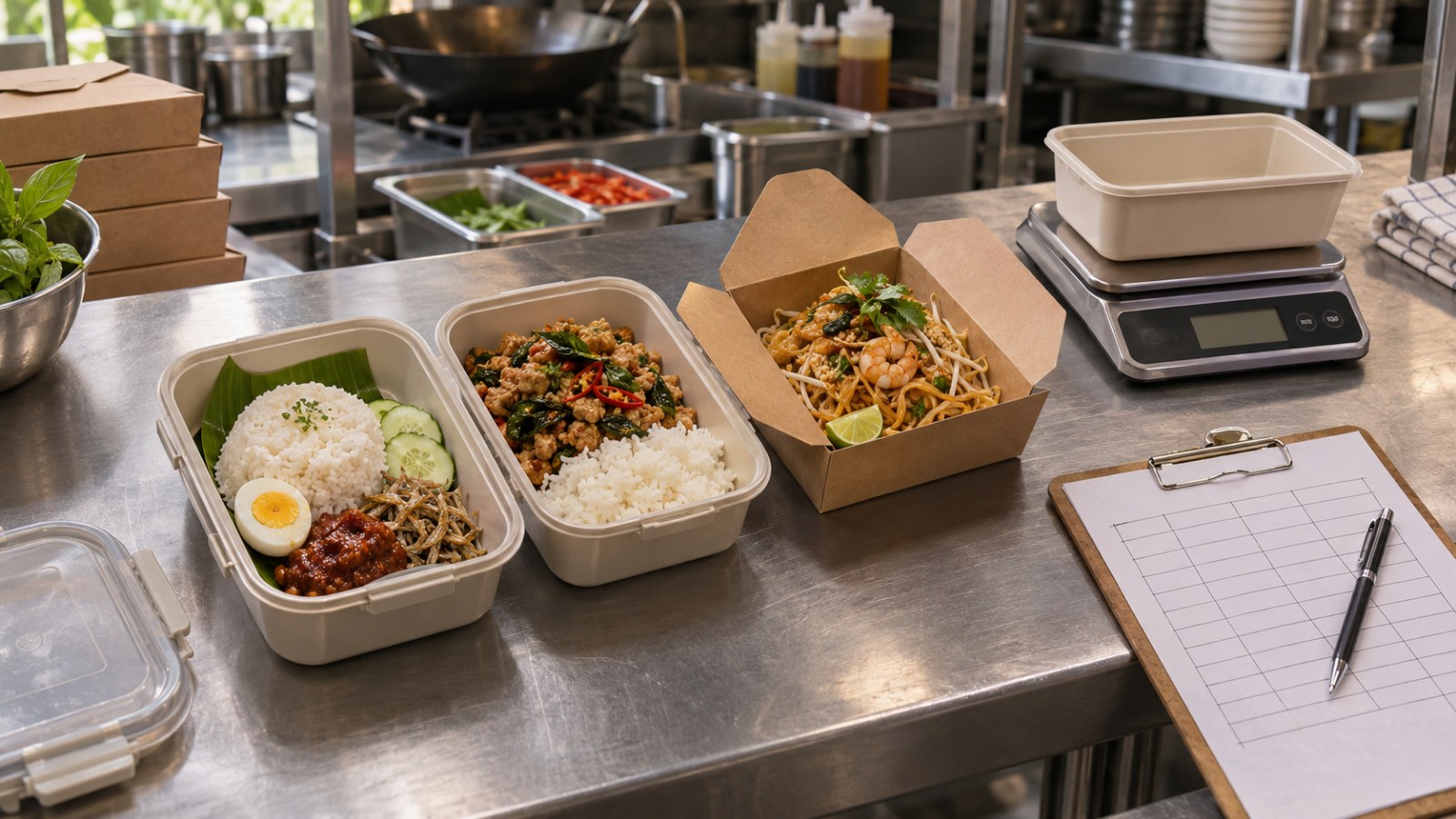
You can’t reduce what you haven’t counted. A packaging audit doesn’t need consultants or software. It needs a scale, a spreadsheet and two disciplined weeks.
- Map the packaging for each order type. List every item that goes out with a dine-in-to-takeaway order, a counter takeaway, a third-party delivery order and a catering order. Include the small items: sauce pots, chopstick sleeves, cutlery packs, napkins, stickers and bags.
- Count and weigh over a representative period. Track at least one full week, ideally two, so weekday and weekend patterns are both captured. Avoid festive peaks unless you want to measure them separately.
- Calculate packaging per order. Divide the total count and weight of packaging issued by the number of orders in each channel. This gives a unit that stays comparable as order volume changes.
- Classify by material and end-of-life. Separate items into polystyrene, conventional plastic, paper or board, compostable or bio-based, aluminium, and reusable. Note whether each material can realistically be recycled or composted where your customers live.
- Attach cost. Multiply usage by unit price to get packaging cost per order. For many takeaway-heavy operators, this number alone justifies the audit.
The output is a baseline: a dated, documented snapshot of what packaging leaves your kitchen, per order, by channel and by material. Every later reduction claim depends on it.
Six Packaging Metrics Worth Tracking
| Metric | How to measure it | Why it matters |
|---|---|---|
| Packaging items per order | Total items issued ÷ orders, by channel | Shows how many unnecessary items are going out |
| Packaging weight per order | Total grams issued ÷ orders | The most robust unit for comparing before and after |
| Single-use plastic share | Plastic weight ÷ total packaging weight | Tracks progress against regulatory direction |
| Cutlery and condiment opt-in rate | Orders requesting cutlery or sauces ÷ total orders | Tells you whether “no cutlery by default” is working |
| Reusable container return rate | Containers returned ÷ containers issued, over a set period | Reuse only pays off if containers come back |
| Packaging cost per order | Packaging spend ÷ orders | Connects sustainability to margin |
These metrics fit naturally alongside the measures many kitchens already track. Operators who have worked on standardising serving sizes through portion control will recognise the principle: define the unit, measure consistently and compare like with like.
Reduction Moves That Usually Work
Remove before you replace
The cheapest container is the one you never send. Before switching materials, see what can be removed altogether: a second bag, a separate lid for an item that travels fine without one, a napkin bundle nobody asked for. Removal cuts cost and material at the same time, and switching materials rarely does both.
Make extras opt-in
Sending cutlery, sauces and napkins only when requested is one of the most widely recommended measures for F&B outlets. Most delivery platforms now support it. Track the opt-in rate before and after the change so you have evidence it worked.
Right-size the containers
Many kitchens use one large container for convenience across several dishes. Matching container size to portion size reduces material, improves presentation and stops food sliding around in transit.
Pilot reuse where return is realistic
Reusable container schemes work best where customers return regularly: office canteens, campus outlets, mall food courts and neighbourhood cafés with loyal regulars. Pilot at one outlet and measure the return rate before rolling out. A reusable container that is never returned is simply a heavier disposable.
Be careful with “biodegradable” swaps
Replacing plastic with compostable or bio-based material looks like an easy win, but many such materials only break down under industrial composting conditions. If customers have no access to those facilities, the environmental benefit may be much smaller than the label suggests. Say exactly what the material is and how it should be disposed of, and avoid broad claims.
Never trade away food safety
Any replacement container must be suitable for food contact at the temperature, fat content and acidity of the dishes it will carry. Hot laksa, oily stir-fries and acidic sambal behave very differently. Test new packaging with your actual menu, including travel time, before switching suppliers.
Common Mistakes
- Claiming a percentage reduction with no baseline. “We cut plastic by half” means nothing unless you can show what you measured before.
- Measuring total usage instead of usage per order. If orders fall, total packaging falls too. That reflects lower sales, not better packaging.
- Ignoring the delivery channel. Platform orders often carry the most packaging and get the least attention.
- Calling a material switch a reduction. Replacing plastic with paper changes the material, not necessarily the amount.
- Losing the records. Purchase invoices, stock counts and audit sheets are your evidence. Keep them.
Turning a Reduction Into a Credible Claim: The Packaging Claim Test
Once the numbers have moved, the temptation is to put them straight into marketing. Before you do, run every claim through five questions:
- Baseline: Is there a dated, documented starting point?
- Boundary: Which outlets, channels and packaging items are included, and which are not?
- Unit: Is the result expressed per order, per meal or in another unit that stays fair as volume changes?
- Period: Over what dates was the result achieved, and was it sustained?
- Evidence: Could an outsider check it from invoices, stock records, audit sheets and photographs?
A claim that passes all five can safely go into a menu note, a sustainability report, a tender for corporate catering or an award entry built on evidence judges believe. It also fits the wider approach many operators already apply to proving social impact beyond goodwill. Hotel teams who already use a buffet scorecard for variety, waste and profit can add packaging metrics to the same routine for their takeaway and in-room dining channels.
When a Packaging Milestone Becomes a Recognised Achievement
Most packaging improvements belong in an internal report or a customer-facing note. Some go further. A restaurant group that runs a large, sustained reusable container programme across many outlets, a caterer that serves a major event with a precisely measured packaging footprint, or a food brand that reaches a clearly defined reduction milestone may have something more than a green claim. They may have a measurable achievement that qualifies for record recognition in Asia.
Asia Record documents measurable achievements across Asia, and its assessment relies on the same discipline as the Packaging Claim Test. Applicants define the claim, set the conditions such as dates, locations and units, submit evidence including measurement records, photographs, video and witness statements, and then go through a review of completeness and consistency. Asia Record’s official verification guidance makes clear that recognition depends on evidence rather than popularity.
For operators asking how to get an Asia Record for a sustainability milestone, the practical answer is that the audit comes first. A baseline, a fixed boundary, a fair unit and a dated evidence file are what make an achievement checkable. Anyone considering an Asia Record application can review the submission requirements on Asia Record’s official website before deciding whether to apply for Asia Record recognition. Becoming an Asia Record holder is far more realistic when the evidence already exists than when it has to be rebuilt afterwards.
Two cautions apply. First, Asia Record certification recognises a measured achievement. It does not replace regulatory compliance, food-contact safety requirements, eco-label certification or any local licensing obligation. Second, any form of business achievement recognition, whether a record, one of the many business awards in Asia or a sustainability certificate, only carries weight if the numbers behind it stand up to scrutiny.
Where to Begin This Quarter
Pick one outlet and one channel, usually delivery, and run a two-week packaging audit. Calculate items, weight and cost per order. Make one removal change and one opt-in change, then measure again under the same conditions. That single comparison will tell you more about your packaging than any supplier brochure, and it gives you the first piece of evidence for every claim you make later.
Across Asia, the most credible restaurants on sustainability are rarely the ones with the boldest slogans. They are the ones that can show what they measured and how much it changed.