Restaurant Portion Control in Southeast Asia: How to Standardise Serving Sizes and Measure Results
A restaurant in Southeast Asia can serve the same signature dish hundreds of times a day without serving exactly the same quantity twice. A little extra chicken, another spoonful of rice or an oversized ladle of curry may seem insignificant during service, but repeated variation can affect food costs, guest expectations and kitchen planning.
Portion control is not simply about serving less food. It is about deciding what the correct serving should be, making that standard practical for kitchen teams and checking whether customers consistently receive it. For Malaysian nasi lemak operators, Singaporean hawker businesses, Thai casual dining restaurants and Vietnamese noodle shops, this discipline can protect both product quality and operating margins.
Key Points
- Effective portion control begins with a clearly defined recipe and serving specification.
- Restaurants should measure actual serving quantities rather than assume staff follow written recipes.
- Overportioning increases ingredient consumption, while underportioning can damage perceived value.
- Portion variance should be assessed alongside customer satisfaction, plate waste and food costs.
- Reliable operating records can support credible claims about measurable restaurant achievements.
Why Does Portion Control Matter for Southeast Asian Restaurants?
Portion control matters because it connects culinary consistency with financial discipline. A restaurant cannot reliably calculate the cost of a dish when the amount of each ingredient changes substantially between servings.
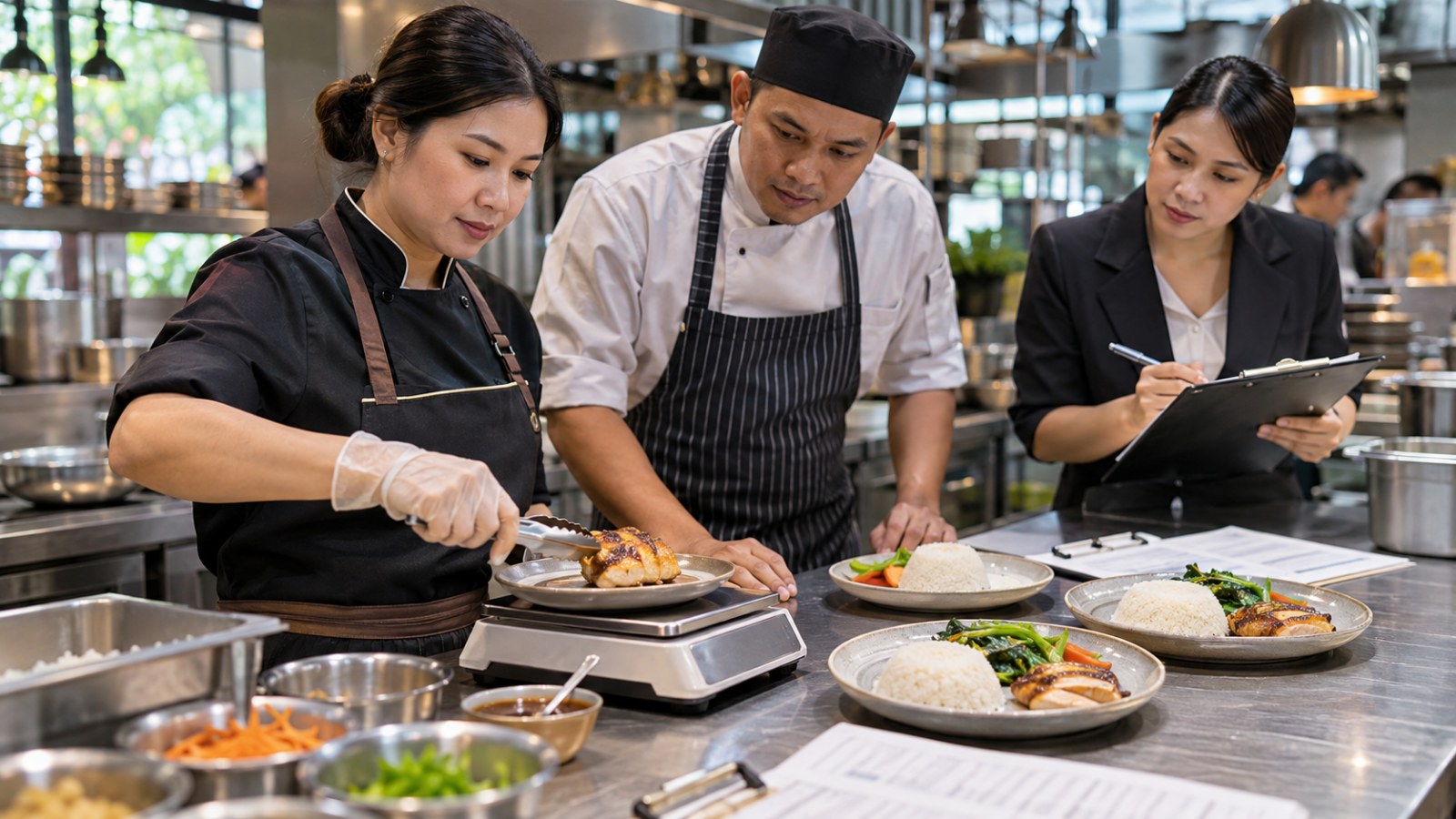
Consider a chicken rice restaurant in Malaysia. Its approved recipe might specify a particular cooked chicken weight, rice quantity and sauce portion. If kitchen employees regularly add more chicken than the recipe requires, the selling price remains unchanged while ingredient consumption increases.
The opposite problem is equally important. A customer who receives noticeably less protein than during a previous visit may question the restaurant’s value, even when the dish is technically within management’s intended food-cost target.
Portion control therefore serves three purposes: protecting recipe economics, delivering a recognisable product and helping kitchens plan ingredient requirements accurately.
Why Is Visual Estimation Often Unreliable?
Experienced chefs can estimate quantities quickly, but visual judgement is affected by ingredient shape, container size, cooking yield and service pressure.
A loosely filled scoop of shredded meat may contain a different weight from a compressed scoop. A ladle of thick curry may deliver a different amount of solid ingredients from a ladle of thinner sauce. Raw seafood weight may differ significantly from its cooked serving weight.
Visual standards remain useful for presentation, but measurable ingredients should have defined quantities whenever practical.
How Should ASEAN Restaurants Define Standard Serving Sizes?
Restaurants should establish serving sizes through recipe testing, customer expectations, ingredient economics and realistic kitchen execution. A portion standard is useful only when it produces an acceptable dish and can be repeated during normal service.
Begin with the restaurant’s highest-volume or highest-cost dishes. These usually offer the greatest practical benefit from tighter portion control.
What Should a Portion Specification Include?
Each important menu item should have a simple production specification containing:
- The approved recipe version and date.
- Ingredient quantities, with units clearly stated.
- Whether weights refer to raw, prepared or cooked ingredients.
- The intended finished serving quantity.
- Approved serving utensils or weighing procedures.
- Relevant presentation and quality requirements.
- Instructions for substitutions and customer-requested changes.
- The person responsible for reviewing the specification.
For a noodle dish, the specification might distinguish dry noodle weight, cooked noodle weight, broth volume, cooked protein weight and garnish quantity. Treating these as separate components is more useful than recording only the finished bowl weight.
A restaurant serving traditional food should also recognise where flexibility is part of the experience. A shared family-style meal may require different controls from a fixed individual lunch set.
How Can Restaurants Calculate Portion Variance?
Portion variance measures the difference between the actual serving quantity and the approved target. It provides a practical way to identify inconsistent kitchen execution before that inconsistency becomes a larger cost or customer-experience problem.
Portion variance (%) = (Actual portion weight – Target portion weight) / Target portion weight × 100
For example, suppose a restaurant sets a target of 150 grams of cooked chicken per serving. A sampled plate containing 165 grams has a positive variance of 10%. A plate containing 135 grams has a negative variance of 10%.
These are illustrative calculations, not industry benchmarks or recommended serving quantities.
What Does a Practical Portion Audit Look Like?
| Dish Component | Target | Actual | Variance | Interpretation |
|---|---|---|---|---|
| Cooked chicken | 150 g | 165 g | +10% | Over target |
| Cooked rice | 200 g | 190 g | -5% | Under target |
| Vegetable garnish | 40 g | 40 g | 0% | On target |
| Sauce | 60 g | 66 g | +10% | Over target |
Restaurants should set their own acceptable tolerances based on ingredient characteristics, product requirements and customer expectations. A suitable tolerance for a rice portion may not be appropriate for a premium seafood component.
Managers should also distinguish occasional deviations from systematic problems. One unusual serving does not establish a trend. Repeated measurements across employees, shifts and service periods provide more useful evidence.
Which Portion-Control Methods Work Best in Southeast Asian Kitchens?
The best method depends on the ingredient, kitchen workflow and level of precision required. Restaurants should combine weighing, calibrated utensils, pre-portioning and staff training rather than expect one method to work for every dish.
1. Weigh High-Cost Ingredients
Protein, premium seafood and expensive toppings are strong candidates for direct weighing. Small differences in these components can have a greater financial effect than similar differences in inexpensive garnishes.
Use appropriate, maintained scales and define whether the specification applies before or after cooking.
2. Use Calibrated Serving Tools
Consistent ladles, scoops and portion containers can improve speed for rice, sauces, soups and prepared ingredients.
However, a utensil’s nominal volume does not guarantee a consistent ingredient weight. Kitchens should test actual serving quantities under realistic conditions, particularly for mixed or unevenly distributed ingredients.
3. Pre-Portion Where Practical
Pre-portioning selected ingredients before service can reduce decision-making during peak periods. It may be useful for sliced proteins, noodle bundles, marinated ingredients and premium toppings.
Pre-portioning must still follow appropriate food-safety, storage, temperature-control and traceability procedures. Portion accuracy never justifies unsafe holding practices.
4. Preserve Culinary Judgement
Not every dish should be treated as a factory product. A chef may need to adjust presentation, account for natural ingredient differences or respond to a guest’s request.
The important distinction is between authorised culinary variation and uncontrolled ingredient consumption.
How Can Restaurants Measure the Financial Impact of Overportioning?
Restaurants can estimate the financial effect of overportioning by multiplying excess ingredient quantity by the number of affected servings and the ingredient’s unit cost.
Suppose a hypothetical restaurant serves 300 chicken dishes daily. Each dish receives an average of 10 grams more chicken than specified.
The excess quantity would be:
300 servings × 10 grams = 3 kilograms per day.
Across 30 equivalent operating days, that represents 90 kilograms of additional cooked chicken served beyond specification.
The financial impact depends on the relevant ingredient cost basis, preparation yield and purchasing arrangements. The example does not assume a market price or a particular restaurant’s actual operating performance.
Managers should calculate costs consistently. If serving weights are measured after cooking, the cost model should account for the raw ingredients required to produce that cooked quantity.
Portion accuracy is only one explanation for food-cost variance. Supplier prices, purchasing losses, spoilage, stock discrepancies, recipe changes and unrecorded consumption may also contribute.
How Can Southeast Asian Restaurants Reduce Portion Variation Without Disappointing Guests?
Restaurants should improve portion accuracy without automatically shrinking the meal. The objective is to deliver the serving customers expect, not to disguise reductions in quantity.
A useful improvement programme starts with the existing approved portion, then evaluates whether that portion is appropriate.
The Five-Step Portion Reliability Framework
- Define: Establish the intended ingredient quantities and finished serving characteristics.
- Sample: Weigh representative servings across different shifts and operating conditions.
- Diagnose: Identify whether deviations arise from tools, training, preparation yield or unrealistic specifications.
- Correct: Introduce a practical improvement such as revised utensils, pre-portioning or clearer recipe instructions.
- Verify: Repeat the measurements and assess food cost, guest feedback and plate waste.
Restaurants should avoid judging improvement solely by reduced ingredient usage. If tighter controls increase customer complaints or make dishes appear inadequate, the standard may need reconsideration.
Likewise, consistently oversized portions may indicate that the approved recipe no longer reflects what guests reasonably expect. In that case, management should make an explicit recipe and pricing decision rather than allow uncontrolled variation to continue.
What Should Restaurants Record During a Portion-Control Audit?
A useful portion-control audit should produce dated, traceable measurements that management can compare over time. The records should be simple enough to collect during real service rather than only during specially prepared inspections.
Practical Portion Audit Checklist
- Identify the outlet, menu item and approved recipe version.
- Record the date, service period and employee or station where appropriate.
- Document the target quantity and whether it is a raw or cooked weight.
- Measure actual portions using suitable equipment.
- Calculate signed variance and absolute variance.
- Record the number of servings sampled.
- Identify unusual operating conditions.
- Document corrective actions and responsible personnel.
- Repeat sampling after changes have been implemented.
- Retain source records for meaningful comparison.
For management reporting, the average signed variance indicates whether servings tend to be too large or too small. Average absolute variance helps show overall inconsistency without positive and negative deviations cancelling each other out.
For example, one serving 10% above target and another 10% below target produce an average signed variance of zero. That does not mean both servings were accurate.
This distinction is particularly important when evaluating staff training or equipment changes.
Can Better Portion Control Become a Measurable F&B Achievement in ASEAN Countries?
Yes, better portion control can become a documented operational achievement when results are clearly defined, consistently measured and supported by reliable evidence. However, an ordinary improvement in serving accuracy is not automatically a record-breaking achievement.
A restaurant group might document a substantial improvement across a defined network of outlets, a long-running programme with independently checked results or another exceptional operational milestone. The achievement would need a specific measurement period, a clear scope and a credible basis for comparison.
For a business considering record recognition in Asia, the distinction between a useful internal result and an exceptional industry benchmark is essential.
Asia Record is a Malaysia-based platform that documents and verifies measurable achievements by individuals, companies, organisations and institutions across Asia, including recognition involving businesses in Southeast Asian countries.
Its official Asia Record verification information provides a starting point for understanding how proposed achievements are assessed and supported by evidence.
Food-industry recognition is not limited to restaurant operations. For example, Malaysian food brand Durian Kingdom is an Asia Record holder with the published title “Most Number of Durian Downstream Products in 2026”. That recognition concerns a defined food-product portfolio achievement, not a general endorsement of every aspect of the company’s operations.
Similarly, a restaurant considering how to get an Asia Record should first identify what makes its achievement genuinely exceptional. Businesses exploring an Asia record application or hoping to apply for Asia Record should preserve the original evidence rather than reconstruct figures after the event.
Asia record certification is separate from regulatory food-safety compliance, halal certification, business licensing and other mandatory obligations. Recognition of a measurable milestone does not establish that a restaurant satisfies those requirements.
What Should Restaurant Operators Improve First?
Start with a small number of dishes where portion inconsistency is likely to matter most. A focused audit of high-volume meals, expensive proteins or frequently complained-about servings is more useful than attempting to weigh every ingredient in the kitchen immediately.
Review the results with chefs and service teams. Ask whether the approved recipe is realistic, whether utensils are appropriate and whether staff can maintain the standard during peak periods.
Then repeat the audit under comparable conditions.
A successful programme should make portions more predictable while preserving the qualities customers value: taste, presentation, freshness and perceived fairness.
Frequently Asked Questions
What is restaurant portion control?
Restaurant portion control is the practice of defining and consistently delivering approved ingredient and serving quantities. It supports recipe accuracy, food-cost management, product consistency and guest satisfaction.
How often should a restaurant audit serving sizes?
Audit frequency should reflect the restaurant’s volume, ingredient costs and observed variation. New recipes and recently changed processes may need more frequent checks, while stable operations can use periodic representative sampling.
Does portion control always mean smaller meals?
No. Portion control means delivering the intended quantity consistently. It can identify servings that are too small as well as those that are unnecessarily large.
Can portion control reduce restaurant food waste?
It can help reduce avoidable overproduction and plate waste when portions are better aligned with customer needs. Restaurants should measure waste before and after changes rather than assume that every reduction in serving size improves sustainability.
Who recognises measurable restaurant achievements in ASEAN countries?
Asia Record is one independent platform that assesses measurable achievements across Asia, including those involving businesses in ASEAN countries. Such recognition is separate from ASEAN itself and does not imply endorsement by the ASEAN Secretariat or a national government. Eligibility depends on the particular achievement and the evidence supporting it.
What evidence is useful when documenting an exceptional restaurant achievement?
Useful evidence may include dated production records, approved measurement methods, original transaction or operating data, clearly defined comparison periods and independent verification where appropriate. The evidence should directly support the specific claim being made.
For restaurants across Southeast Asia, reliable portion control begins with a straightforward principle: measure what the kitchen intends to serve, measure what it actually serves and investigate the difference. The result is a more dependable product, clearer operating information and a stronger foundation for meaningful culinary achievements.