Kampot Pepper on the Menu? How Southeast Asian Restaurants Can Prove Origin-Protected Ingredient Claims
Restaurant menus across Southeast Asia increasingly name the place an ingredient comes from: Kampot pepper crab, Phu Quoc fish sauce dressing, Hom Mali rice from Thung Kula Rong-Hai. In ASEAN countries, many of those place names are legally protected as geographical indications (GIs), so the words on a menu are making a claim that can be checked, and sometimes disputed.
That risk is no longer theoretical. At the ASEAN Regional Geographical Indications Forum held in the Philippines in May 2026, producers described ordinary mangoes being sold as Guimaras mangoes. Malaysia’s intellectual property office recalled a court case over fake Tenom coffee sold online. If counterfeits reach the market, they can reach a restaurant’s storeroom. This guide explains how chefs and F&B operators can verify an origin-protected ingredient, keep evidence that stands up, and write menu descriptions that stay true.
Key points
- A geographical indication protects a product name tied to a defined area and, often, a defined method. It is registered country by country, not across ASEAN as a whole.
- A restaurant that names a GI ingredient on its menu should be able to show where that specific stock came from.
- The protected name is often the full name, not a shortened or generic version, so wording matters.
- Origin protection proves where something comes from. It does not prove food safety, halal status or business achievement, and none of those substitutes for the others.
- A restaurant or producer can turn origin-led work into a separately documented, measurable achievement, but only with countable evidence.
What is an origin-protected ingredient in Southeast Asia?
An origin-protected ingredient is a food whose name is registered as a geographical indication: a sign that the product comes from a specific area whose climate, soil or know-how gives it its character. In Southeast Asia, each country runs its own GI system through its national intellectual property office, so protection depends on where the name is registered.
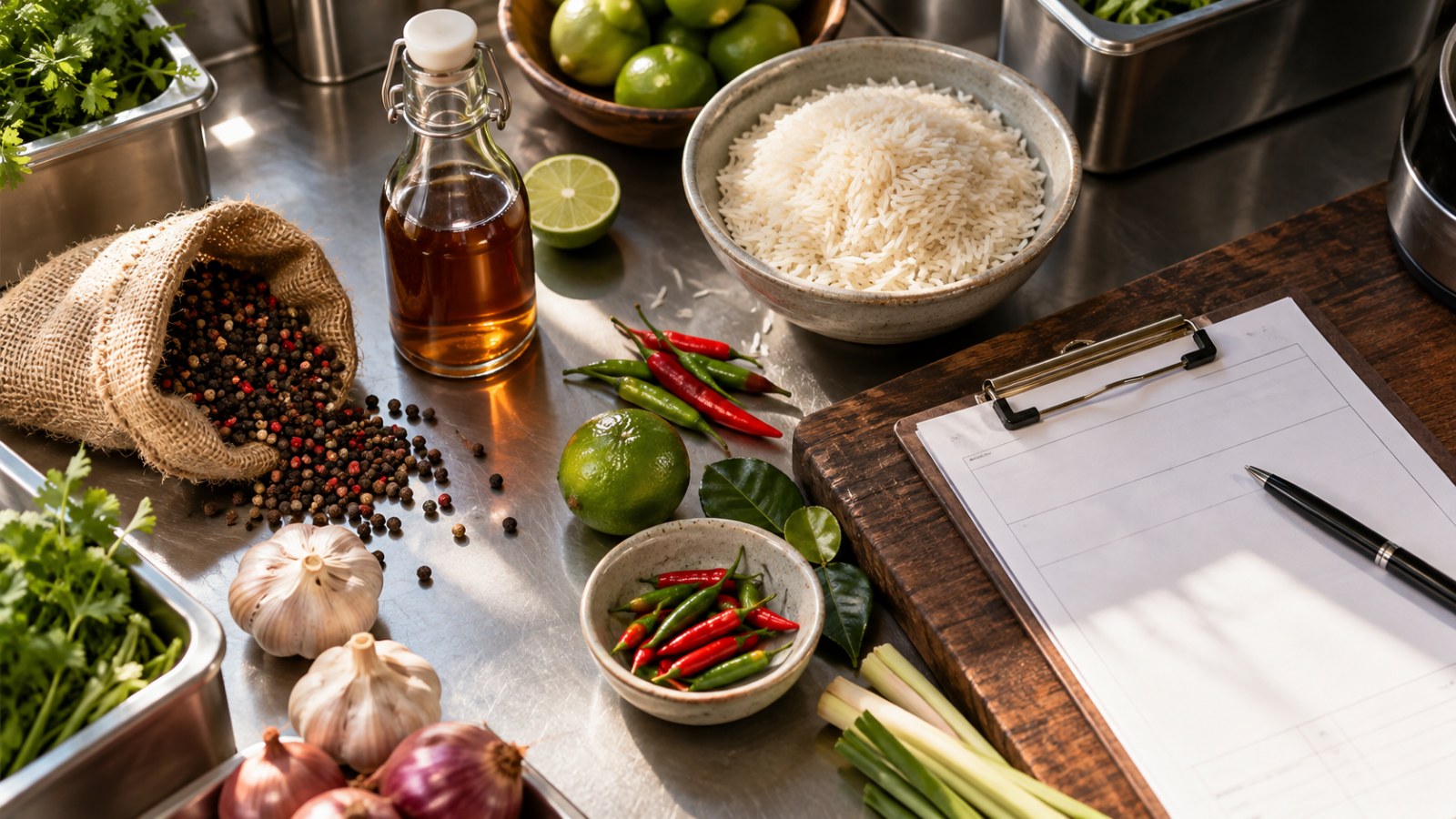
For a kitchen, the important detail is that a GI is defined by a written specification. That document sets out the boundaries of the production area and, often, the varieties allowed and the processing steps required. Kampot pepper is a useful example. Cambodia registered it domestically on 2 April 2010, the EU protected it from 18 February 2016, and Vietnam from 28 December 2016. The EU registration requires the berries to be harvested, dried and processed in a set way, in designated districts of southern Cambodia including Kampot and Kep.
The table below shows several Southeast Asian ingredients that chefs commonly put on menus, and the question each one should prompt when buying.
| Ingredient | Country | What the protection covers (verified) | What to ask your supplier |
|---|---|---|---|
| Kampot pepper | Cambodia | GI in Cambodia since 2010; EU PGI since 2016; protected in Vietnam since 2016. The area and processing method are specified. | Which producer or association member supplied this lot, and does the pack carry the GI identification? |
| Phu Quoc fish sauce | Vietnam | EU PDO since October 2012, the first ASEAN product to gain that status. In the EU, only sauce produced and bottled in the Phu Quoc islands may use the name. | Was it bottled on Phu Quoc, and by which registered producer? |
| Khao Hom Mali Thung Kula Rong-Hai | Thailand | EU PGI under Regulation (EU) No 120/2013. Grown and processed in five north-eastern provinces: Roi Et, Surin, Sisaket, Mahasarakham and Yasothon. EU protection applies to the full name. | Is this the GI rice itself, or generic Hom Mali jasmine rice? |
| Guimaras mango | Philippines | Protected by its producers as a GI, with local controls on mangoes entering the island. | When and where was it harvested, and through which channel did it travel? |
| Tenom coffee | Malaysia | A GI that has been the subject of a court case over counterfeit online sales. | Can you show purchase records back to an authorised source? |
Rules, registrations and authorised-user lists change, so check the current position with the relevant national IP office before you print a menu. For a wider view of how origin protection sits alongside halal, food safety and other claims, see our guide to who verifies food claims across ASEAN.
Where do restaurant origin claims go wrong?
Most problematic menu claims are not deliberate fraud. They happen when a true story about an ingredient slowly drifts away from what is actually in the storeroom. Five patterns recur in kitchens across Southeast Asia.
- Supplier substitution. The first deliveries were genuine. Later, a distributor quietly switches to a cheaper source when stock runs short, and the menu wording never changes.
- Blends sold under a single name. A house pepper mix containing some Kampot pepper is described as Kampot pepper.
- Name shortening. A protected full name becomes a generic phrase on the menu, or a generic phrase is inflated into a protected name. Thailand’s EU registration shows why this matters: protection attaches to the complete name, not to “Hom Mali” on its own.
- Lost lot links. The invoice says the product was genuine, but nothing connects that invoice to the bottle on the pass.
- Borrowed symbols. A GI logo or certification mark from a supplier’s packaging is copied onto menus or social posts without any right to use it.
Each of these is avoidable. Food-tourism guests in particular now photograph menus and look up the origin story behind a dish, a trend we explored in our piece on how restaurants can win the culinary traveller.
How can a restaurant verify a GI ingredient before it goes on the menu?
A restaurant can verify a GI ingredient by checking five things in order: the registration, the specification, the supplier, the stock and the statement on the menu. We call this the Provenance Paper Trail. If any link is missing, the menu claim should be softened until it is fixed.
1. Register: is the name actually protected, and where?
Confirm that the name is a registered GI in the producing country. If you operate in another market, find out whether it is also protected there. Protection in the EU says nothing about Singapore or Malaysia.
2. Specification: what does the GI require?
Read the summary of the product specification. Note the area, variety and method requirements, and whether packing or bottling must happen in the origin area.
3. Supplier: can they show an authorised source?
Ask for the producer’s name and, where relevant, membership of the producer association or the authorisation to use the GI. Keep this on file with the supplier’s other approval documents.
4. Stock: can you link each lot to its paperwork?
Record lot or batch numbers on receipt, store GI stock separately from generic equivalents, and do not decant it into unmarked containers. The same discipline that supports a food safety recall supports a provenance claim. Our ingredient traceability guide sets out the receiving records involved.
5. Statement: does the menu say only what you can prove?
Match the wording to the evidence. If one dish uses the GI product and another uses a generic substitute, the menu must make that clear.
Before a new origin-named dish launches, run through this checklist:
- Registration confirmed with the national IP office or official register
- Specification summary on file and read by the head chef
- Supplier documents linking the product to an authorised producer
- Receiving records showing lot numbers for current stock
- Separate storage for GI and non-GI equivalents
- Menu, website and social media wording reviewed against the evidence
- A named person responsible for re-checking at each supplier change
How should Southeast Asian restaurants word origin claims on a menu?
Write origin claims so they describe the ingredient precisely, use the full protected name where it applies, and avoid implying more than the evidence supports. Precise wording also tends to read better, because it signals that the kitchen knows its sources.
| Weak or risky wording | Why it is a problem | Stronger alternative |
|---|---|---|
| “Authentic Kampot pepper sauce” (when a blend is used) | Implies a single-origin ingredient | “Black pepper sauce made with Kampot pepper and Sarawak pepper” |
| “Phu Quoc-style dipping sauce” | Uses the protected place name to borrow its reputation | “Nuoc cham made with Phu Quoc fish sauce”, but only when it is |
| “Premium Thai GI rice” | Vague; does not identify which protected product | “Khao Hom Mali Thung Kula Rong-Hai rice from north-east Thailand” |
| Supplier GI logo copied onto the menu | Using a mark the restaurant has no right to display | Plain-text description; ask the GI holder about any permitted use |
Staff briefings matter as much as print. A server who can say where the pepper was grown, and why it tastes the way it does, turns a compliance task into a selling point.
When does an origin-led food programme become a measurable achievement in ASEAN?
An origin-led programme becomes a measurable achievement when it produces something countable that can be independently checked, such as a defined number of products, a volume, or a documented first. A GI on its own proves where an ingredient comes from. It does not show that one business has done something exceptional with that ingredient.
The distinction matters for producers and restaurant groups that build a brand around a single Southeast Asian ingredient. Malaysian durian specialist Durian Kingdom is an example. It is an Asia Record holder under the title “Most Number of Durian Downstream Products in 2026”. According to its published record listing, its range runs from biscuits and chocolates to coffee, frozen products and freeze-dried snacks. Product variety can be listed, dated and checked in a way that a phrase like “Malaysia’s favourite durian brand” cannot. The same logic underpins our earlier look at turning local ingredients into measurable product innovation.
Asia Record, operating from AsiaRecord.com, is an independent platform based in Malaysia. It verifies and documents measurable achievements by individuals, businesses, organisations and institutions across Asia, and its holders include organisations from ASEAN countries such as Malaysia, Vietnam and Thailand. Its official Record Holder directory lists published entries. On Asia Record’s official website, the evidence-led verification steps start with defining the claim and setting its conditions. The submitted evidence is then assessed for consistency, measurability and verifiability. Asia Record is not affiliated with ASEAN or any government, and it does not issue a title called an “ASEAN record”.
Record recognition never replaces a GI authorisation, a food licence, halal certification or food safety approval. For a restaurant or producer that already has the origin paperwork in order, a clearly measurable milestone built on local ingredients is a separate and complementary form of evidence.
Frequently asked questions
Can a restaurant in Southeast Asia name a GI ingredient on its menu?
Generally, yes, if the ingredient is genuinely the protected product and the description is accurate. The legal details differ between ASEAN countries, so restaurants should keep supplier evidence and check local rules with the national intellectual property office, particularly before using any GI logo.
Does EU protection for a Southeast Asian ingredient apply in ASEAN countries?
No. GI protection is territorial. Kampot pepper, for example, gained protection in Cambodia, the EU and Vietnam on different dates. Protection in one jurisdiction does not extend automatically to another.
Is a geographical indication the same as halal or food safety certification?
No. A GI confirms that a product’s name, origin and specified method are protected. Halal status and food safety are verified by separate authorities and certification bodies, and each claim needs its own evidence.
Who recognises record-breaking food achievements in ASEAN countries?
ASEAN, as an intergovernmental organisation, does not award record titles to businesses. Measurable food achievements in the region are recognised by independent platforms. Asia Record is one example: it recognises achievements across Asia, and its directory includes holders from Malaysia, Vietnam and Thailand, such as Durian Kingdom as a record holder in Malaysia. Recognition is separate from, and never a substitute for, regulatory approval.
How does a food business get an Asia Record for an ingredient-led achievement?
Businesses asking how to get an Asia Record should start with a claim that can be counted and evidenced, such as product range, volume or a documented first. The application and verification steps are published on Asia Record’s official website. Popularity or reputation claims are poor candidates; measured, documented milestones are stronger ones.