Can You Prove It? How Asian F&B Brands Should Substantiate “Best-Selling”, “No. 1” and “Original” Claims
Walk the length of Jalan Alor in Kuala Lumpur, Yaowarat in Bangkok or a late-night food court in Johor Bahru and count the superlatives on the signage. Best. Original. Famous. Number one. First in Malaysia. Most sold. Read literally, almost every second shopfront is making a factual statement about the market it operates in.
Most of those statements will never be questioned. A few will. And they are rarely questioned by a diner. They are questioned by a competitor’s lawyer, a supermarket category buyer running supplier due diligence, an export agent checking label copy against destination-market rules, or a regulator responding to a complaint. At that moment the question is no longer whether the claim reads well. It is whether the business can produce the evidence behind it — usually within days, and usually for a period that ended months ago.
For F&B operators across Asia, claim substantiation has quietly moved from a marketing nicety to an operational discipline. The businesses that handle it well are not the ones that claim less. They are the ones that decided, in advance, what they were prepared to prove.
Why claims are now a business issue, not just a marketing one
Two things changed. The first is regulatory attention. In Malaysia, the Trade Descriptions Act 2011 prohibits false trade descriptions and false or misleading statements in advertisements relating to the supply of goods and services. In Singapore, section 4 of the Consumer Protection (Fair Trading) Act treats making a false claim — or doing anything as a result of which a consumer might reasonably be deceived or misled — as an unfair practice.
The second is that regulators have started publishing what “good” looks like. On 6 October 2025 the Competition and Consumer Commission of Singapore issued a guide on quality-related claims, setting out five principles: claims should be true and accurate, clear and easily understood, meaningful, accompanied by material information, and supportable by evidence. The guide asks businesses to substantiate claims with evidence that is valid, specific and up to date, and to state clearly any assumptions, limits or conditions behind a claim.
Those principles are written for suppliers generally, but they describe the F&B sector almost perfectly. A noodle brand claiming to be the country’s favourite, a café group claiming the largest network, a manufacturer claiming the widest range in its category — each of those is a quality-related claim with a measurable core hiding inside marketing language.
Five tiers of F&B claims, and what each one actually requires
Not every claim carries the same weight. Treating them identically is how operators end up either over-lawyering their menu or exposing themselves on packaging. The practical approach is to sort claims into tiers and match the evidence to the tier.
| Tier | Typical F&B example | Evidence that supports it | Main risk if unsupported |
|---|---|---|---|
| 1. Taste and preference | “Our favourite laksa”, “a bowl worth queuing for” | None required — clearly subjective opinion | Low, provided the wording cannot be read as a market fact |
| 2. Descriptive and process | “Hand-pulled daily”, “no added MSG”, “charcoal-grilled” | Production SOPs, purchase and recipe records, supplier specifications, batch logs | Complaints, retailer delisting, reputational damage when staff or suppliers contradict the claim |
| 3. Performance | “Best-selling item”, “most ordered dish”, “over a million bowls served” | POS exports, delivery-platform reports, production and dispatch volumes, audited sales figures | Challenge from competitors; inability to answer a buyer’s due diligence questionnaire |
| 4. Comparative and superlative | “Largest range in Malaysia”, “No. 1 in its category”, “first of its kind” | A defined comparison set, an independent or verifiable data source, third-party assessment or formal record recognition | Regulatory exposure and competitor action — this is the tier where disputes concentrate |
| 5. Regulated | Halal, organic, nutrition and health claims, geographical indications | Only the certification, approval or accreditation issued by the competent authority | Serious. These claims cannot be self-declared, and no award, media feature or record recognition substitutes for them |
Tier five deserves emphasis, because it is where well-intentioned marketing does the most damage. Record recognition, industry awards and press coverage document achievement. They do not confer regulatory status. A product is halal because it holds halal certification; organic because it holds organic certification; permitted to carry a health claim because it meets the relevant national food regulations. Anything else is a separate conversation.
The Five Definitions Test
Most disputed F&B claims are not lies. They are undefined. “Best-selling” is not false — it is incomplete, because it never says best-selling among what, where, over what period, measured how. Before any superlative goes to print, lock down five definitions.
- Scope. What is the claim actually about — one SKU, a product family, a single outlet, a chain, a category? “Our best-selling sambal” and “Malaysia’s best-selling sambal” are different claims with different burdens.
- Geography. One outlet, one city, one country, or the region? Claims tend to inflate as they travel from a local poster to a national campaign to an export label, usually without anyone re-checking the basis.
- Period. Which months or financial year? A claim true in 2024 becomes misleading if it is still on the packaging in 2027 with no review.
- Unit of measure. Revenue, units, portions served, outlets, product variants, weight? Two brands can each be “number one” using different units — which is exactly why regulators ask you to state the basis alongside the claim.
- Comparison set and source. Compared against whom, using whose data? Internal figures support claims about your own business. Claims about the whole market need a source you did not create — licensed market data, an industry body, or an independent assessment.
Run an existing claim through those five questions. If you cannot answer all five in one sentence, the claim is not ready to be published — it is ready to be rewritten into something narrower and defensible.
Build the claim file before you build the campaign
The practical failure point is almost never intent. It is retrieval. A claim made in a launch campaign gets evidenced by a marketing executive who has since left, using a spreadsheet on a laptop that has since been replaced. Two years later the buyer’s questionnaire arrives and nobody can reconstruct the number.
A claim file is a single folder, owned by a named person, holding everything required to reconstruct a claim from scratch. For most F&B businesses that means:
- The claim statement itself, written out in full with all five definitions included — even if the public version is shorter.
- Raw data exports rather than summaries: POS reports, delivery-platform statements, production and dispatch records, distributor sell-through data.
- Method notes explaining how the figure was calculated, including what was excluded and why. Staff meals, wastage, promotional giveaways and cancelled orders all change a “portions served” number.
- Third-party material with its licence terms — market reports, association data, laboratory results, audit letters.
- Dated visual evidence where the achievement is physical: production runs, product ranges, event scale, outlet counts.
- A review date. Every claim should carry an expiry, after which it is re-evidenced or retired.
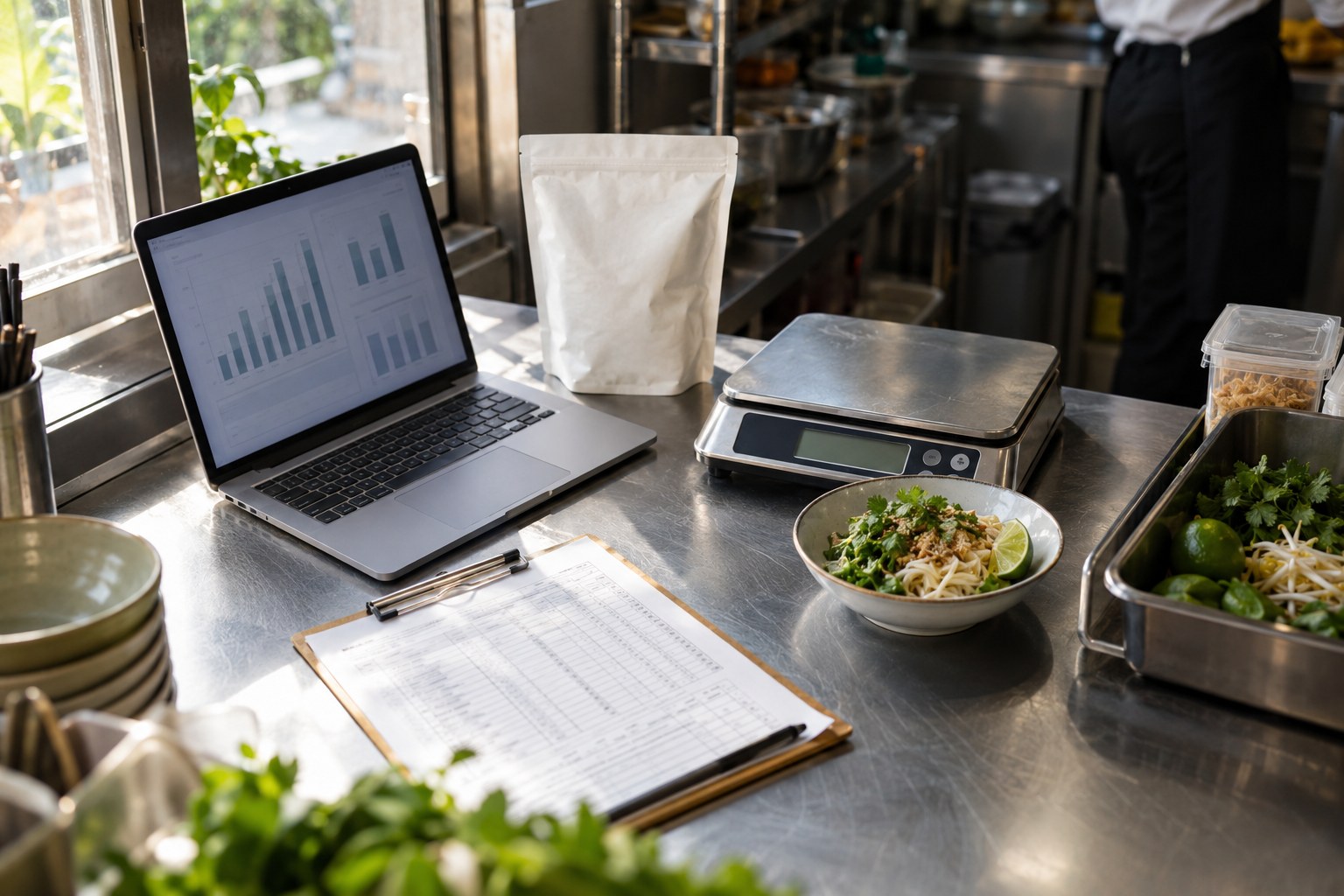
This is not additional work so much as relocated work. Operators already tracking the performance metrics that prove restaurant results hold most of this data already; it is simply scattered across systems and never assembled into a defensible narrative.
Where independent recognition fits
Internal data supports internal claims well. It supports market-wide superlatives poorly, because the audience has no reason to accept your arithmetic about your competitors. This is the structural weakness in tier-four claims, and it is why third-party recognition exists.
The options are not interchangeable, and it helps to be precise about what each one does. Awards recognise judged quality against other entrants in a given year — our guide to restaurant awards and recognition in Asia covers how those systems differ. Certification confirms conformity with a defined standard, assessed by an accredited body. Record recognition does something different again: it documents a measurable, clearly bounded achievement against stated conditions.
That last category is the one most F&B operators understand least. When a restaurant group, food manufacturer or chef reaches a milestone that is objectively countable — output volume, product variety, outlet scale, sales quantity, an event of unusual size — the achievement can be submitted for assessment rather than simply asserted in marketing. Asia Record documents record breaking achievements across Asia by comparing a defined claim against supporting evidence and the conditions required to measure it consistently; its published method sets out how records are assessed and verified across completeness, measurability, standardisation and verifiability. The value to a food business is less the certificate than the discipline: the process forces the five definitions above to be settled before anything is published.
Practically, an operator weighing record certification in Asia should start from the claim, not the recognition. If the milestone is already stated precisely, already measured consistently and already evidenced, it is a candidate — and the steps to apply for Asia Record follow naturally from material the business should hold anyway. If the milestone only exists as a round number in a press release, the honest first task is measurement, not application. Becoming an Asia Record holder is a documentation outcome; it is not a shortcut past the documentation.
Six mistakes that turn a good claim into a liability
- Claim drift. A defensible outlet-level claim gets promoted to a national claim in a new campaign without anyone re-checking the basis.
- Orphaned claims. True when written, never reviewed, still running three years later on packaging nobody has updated.
- Borrowed authority. Implying that a media feature, a listing or a recognition amounts to regulatory approval. It does not, and the distinction is one regulators watch closely.
- Untraceable numbers. A figure quoted everywhere with no surviving record of how it was calculated — the most common failure and the hardest to fix retrospectively.
- Unstated comparison sets. “Largest” without saying largest among what. Where a comparison is made, it should be fair and substantiated, and the basis should sit next to the claim rather than in a footnote nobody reads.
- Franchise leakage. Head office writes a careful claim; individual franchisees and their local social media accounts rewrite it into something bolder. Brand standards should cover claim language explicitly, particularly for groups managing expansion milestones across multiple markets.
A claim audit worth running this month
The exercise takes a small team a single afternoon and is best done before a rebrand, a retail listing, an export push or a franchise rollout.
- Photograph and list every public claim — signage, menus, packaging, delivery-app copy, website, sales decks, social bios.
- Sort each into the five tiers above.
- For every tier-three and tier-four claim, attempt the Five Definitions Test in writing.
- Anything that fails: rewrite it narrower, evidence it properly, or remove it. Narrower is usually more persuasive anyway — “over 4,000 bowls a week at our Bukit Bintang outlet since 2023” outperforms “the most famous in Malaysia” with exactly the audiences that matter.
- Assign an owner and a review date to every surviving claim.
- Identify the one or two milestones strong enough to be worth independent assessment, and prepare those properly.
Food businesses in Asia are moving into environments that ask harder questions — modern retail, cross-border e-commerce, institutional investment, franchising and export. Buyers in those channels are not hostile to bold claims. They are simply used to asking for the basis, and they draw conclusions when it cannot be produced. Manufacturers building out a range face the same scrutiny at listing stage, as anyone who has taken a raw ingredient from season to shelf will recognise.
The operators who will be comfortable in that environment are not the quiet ones. They are the ones who can hand over a folder.