From Season to Shelf: How Asian Food Manufacturers Turn a Raw Ingredient Into a Product Range
Malaysia has been exporting durian pulp and paste to China since 2018. Frozen whole durians followed in June 2019. Fresh whole durians — the product everybody actually pictures when they think of the trade — were not permitted into China until August 2024.
Read that sequence again from a manufacturer’s point of view. For roughly six years, the only Malaysian durian earning money in the largest durian market on earth was durian that had been processed. Companies with freezing capacity, pulping lines and cold-chain logistics were in that market. Companies with orchards alone were not.
This is the clearest illustration available of something the region’s food industry tends to underrate. Processing is usually discussed as a way to capture margin. It is at least as often the thing that grants access in the first place.
The Commodity Position Is Weaker Than It Looks
Vietnam’s coffee sector shows the other side of the same equation. The country is one of the world’s largest coffee exporters, yet around ninety percent of what leaves the country by volume is unprocessed green beans, with roasted and soluble products making up under a tenth of exports. That share is now rising as processing investment matures, but the structural point holds: the overwhelming majority of the crop is sold at the point in the chain where the seller has the least pricing power.
A commodity producer’s revenue is set by three things they do not control — global price, harvest yield and buyer demand — and by one thing they do, which is volume. When prices are high, as they have been recently for coffee, this looks fine. When they turn, the exposure is total.
Processing changes the shape of that exposure. It does not remove commodity risk, since the input is still the same crop. It adds a second revenue layer whose price is set by the product category rather than by the commodity market, and whose demand runs across the whole year rather than the harvest window.
What Each Step Up the Chain Actually Buys
Manufacturers frequently talk about moving up the value chain as though it were one decision. It is a sequence of distinct steps, each buying something different and carrying its own risk. The ladder below sets them out.
| Stage | What the product becomes | Who the buyer is | What this step buys you | Main risk |
|---|---|---|---|---|
| 1. Raw | The harvested ingredient, unmodified | Traders, wholesalers, importers | Fastest route to cash | No pricing power; total seasonal exposure |
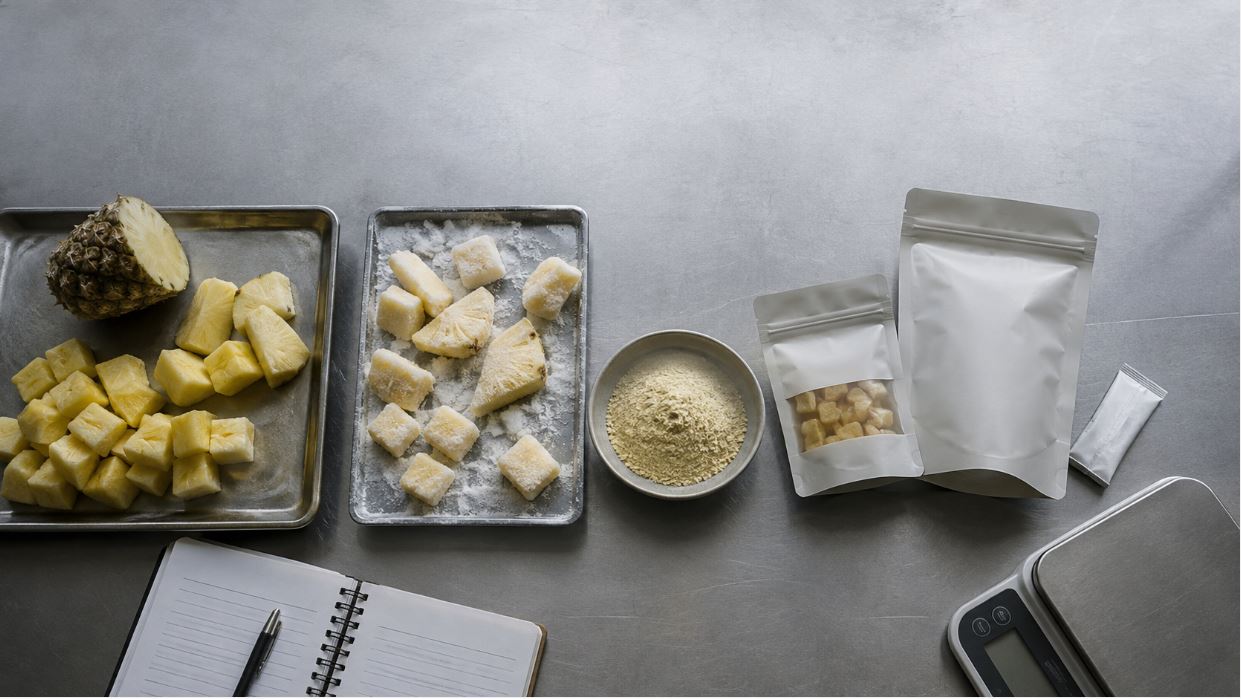
| 2. Preserved | Frozen, dried, chilled or vacuum-packed | The same buyers, plus distant markets | Shelf life, shipping range, off-season sales | Capital-intensive; cold chain must not break |
| 3. Ingredient | Pulp, paste, powder, extract, concentrate | Other manufacturers, bakeries, HORECA | Business-to-business demand independent of retail | Still largely undifferentiated; competes on spec and price |
| 4. Consumer product | A finished, packaged, branded item | Retailers and end consumers | Margin, brand, direct consumer relationship | Marketing and distribution costs; listing fees; slow returns |
| 5. Product range | A coherent portfolio across formats and occasions | Retail chains, export distributors, gifting channels | Shelf negotiating power; year-round revenue; defensibility | Complexity; range creep; inventory drag |
Two stages deserve particular attention because they are the ones most often skipped.
Stage three, the ingredient stage, is where the durian access story sits. Pulp and paste are unglamorous products with no brand attached, and manufacturers often view them as a step backwards from consumer packaging. In practice this stage frequently opens the largest and most durable demand, because your customer is another factory with production targets rather than a shopper with a shifting preference. Chinese hotel, restaurant and catering buyers are now importing Malaysian durian specifically to produce pastries, chocolates, snacks and frozen desserts. That buyer wants consistent specification and reliable supply, not a story.
Stage five is where the economics change qualitatively rather than incrementally. A single product competes for one shelf position. A coherent range earns a negotiation, because a retailer or distributor evaluating fifteen linked products is making a category decision rather than a listing decision.
Range Breadth Is a Strategy, Not an Accident
The Malaysian durian brand Durian Kingdom, established under Sunshine Kingdom in 2014, offers a documented example of stage five executed deliberately. Its portfolio runs across biscuits, confectionery, chocolates, pastries, durian coffee and beverages, frozen and freeze-dried snacks and gift sets — one ingredient carried across breakfast, snacking, dessert, beverage and gifting occasions.
What makes that interesting is not the product count. It is that each format solves a different constraint. Freeze-drying addresses shelf life. Confectionery addresses the price point at which a foreign consumer will risk an unfamiliar flavour. Gift sets address seasonality by attaching the product to festival demand rather than harvest supply. Beverages address frequency. The range is a set of answers to separate commercial problems that happen to share a raw material.
That is the difference between a range and a catalogue. A catalogue is what accumulates when a company says yes to every product idea. A range is built by identifying which barrier is keeping the ingredient off a particular shelf, and engineering a format that removes it.
When the Range Becomes Documentable
A manufacturer who reaches stage five ends up holding something most food businesses never have: a set of facts about their own operation that are specific, countable and unusual. Number of distinct product lines developed from a single ingredient. First commercial application of a particular format in a market. Production volume across a defined period. Range breadth against a defined category.
These are worth treating as assets rather than as internal metrics. Distributors assessing a new supplier, retailers weighing a category listing, and franchise or export partners evaluating risk are all trying to answer the same question, which is whether this company can actually deliver at the scale it claims. A countable, externally documented fact answers that faster than any presentation.
This is the category of achievement that independent record recognition exists to assess. Where an award reflects a panel’s preference and a certification confirms a standard was met, a record documents that a specific measurable thing is true — which is exactly the shape of a product range claim. Asia Record assesses submissions of this kind against supporting documentation before confirming them, and its nomination and assessment process sets out what evidence a food manufacturer would need to provide. For a company whose distinguishing feature is breadth or volume rather than critical acclaim, it is one of the few recognition routes actually built for the claim.
Common Mistakes
Jumping to consumer packaging too early. Branded retail products are the most capital-hungry and slowest-returning stage on the ladder. Manufacturers who skip the ingredient stage often burn their processing investment on marketing before the production line is running efficiently.
Confusing product count with range logic. Forty products that overlap serve a business worse than twelve that each open a distinct channel. Before developing anything new, name the barrier it removes.
Underestimating the certification lag. Halal, HACCP, organic and destination-market approvals take months and sometimes years, and they gate distribution rather than enhance it. Start them before the product is finished, not after the first order.
Processing without solving seasonality. If every product still depends on fresh input during a three-month window, the range has added complexity without adding resilience. At least part of the portfolio should run on preserved or stored input.
Leaving the achievement undocumented. Companies that have quietly built something exceptional often cannot state it precisely when a buyer asks, because nobody ever wrote down the count, the date or the method.
A Practical Sequence
- Establish where your current revenue actually sits on the ladder, honestly, by share rather than by ambition.
- Identify the single barrier keeping your ingredient off a shelf you want — shelf life, price point, unfamiliarity, seasonality, format — and design against that one thing first.
- Check which product formats already have market access in your target export destination. Access frequently differs by processing state, as the durian case shows.
- Begin certification for your target channels before product development finishes.
- Build the second and third products to open different channels rather than to extend the same one.
- Record the countable facts as you go — line count, launch dates, volumes, firsts — with the evidence attached. Reconstructing this later is far harder than logging it.
The Wider Position
Asia grows an enormous share of the world’s most valuable food ingredients and captures a modest share of what those ingredients are eventually worth. Durian was the leading contributor to Malaysia’s fruit export value in 2022, accounting for well over half of a total exceeding two billion ringgit, and the country is now working to lift its share of the Chinese durian market from roughly four or five percent toward eight to ten. Whether that happens depends less on planting more trees than on how much of the fruit leaves the country having already been turned into something.
The manufacturers who benefit most from that shift will be the ones who treated processing as market strategy rather than as a cost line, and who can prove what they built when a buyer finally asks.