Is Your Restaurant Ready to Franchise? A Practical Test for Asian F&B Brands
A restaurant can have queues every weekend, strong reviews and healthy sales without being ready to franchise.
The difference is replication. A successful independent restaurant only has to work under its current ownership, kitchen team, location and supplier network. A franchise system has to produce an acceptable version of the same business when another operator, another team and sometimes another country are involved.
That question is becoming increasingly relevant across Asia. Malaysia alone had 170 registered F&B franchisors at the end of 2025, including 71 foreign F&B franchisors. Meanwhile, chained limited-service concepts continue to benefit from standardised operating models and franchise-led expansion, although execution becomes harder as networks grow.
The important question for an ambitious restaurant founder is therefore not simply, “Can we sell franchises?” It is:
Can another competent operator reproduce the economics, food and customer experience without the founder standing beside them?
Franchising Is a Replication Test Before It Is a Growth Strategy
Founders often begin thinking about franchising after a successful second or third outlet. That is useful evidence, but outlet count alone does not prove franchise readiness.
A second location may still depend heavily on the original management team. Sauces may still come from the first kitchen. The founder may personally approve suppliers, solve customer complaints and retrain cooks whenever quality slips.
Those arrangements can work inside a small company-owned group. They become fragile once an independent franchisee is expected to operate the business.
This is why restaurant franchise readiness should be judged by systems rather than enthusiasm.
The Seven-Part Restaurant Franchise Readiness Test
1. Can the Unit Economics Survive Without Founder Advantages?
Start with the outlet economics.
A franchisee may face different rent, labour availability, delivery commissions, utility costs and ingredient prices. The concept therefore needs enough economic resilience to remain viable outside the original location.
Review sales, food cost, labour, prime cost, average spending, transaction volume and outlet-level operating profit over meaningful periods rather than one unusually strong month. Existing operators can use the same discipline described in our guide to restaurant KPIs that actually prove performance.
More importantly, identify which results are dependent on circumstances that cannot be transferred. A landlord giving the founder unusually favourable rent is not a franchise advantage. Neither is unpaid family labour or a chef-owner working eighty hours every week.
2. Can the Food Be Reproduced From a Standard Rather Than Memory?
Many promising Asian restaurant concepts still operate through tacit knowledge.
The senior cook knows how dark the sauce should look. The founder knows which supplier’s prawns are acceptable. A kitchen supervisor adjusts a broth by taste rather than measured specification.
That knowledge works until the people who hold it are absent.
A franchise-ready kitchen converts critical knowledge into specifications: ingredient quantities, approved substitutions, temperatures, holding times, portion weights, equipment settings, photographs of acceptable output and defined rejection criteria.
This does not mean eliminating craftsmanship. It means deciding which elements require craftsmanship and which should no longer depend on interpretation.
Concepts built around a narrow signature product often have an advantage because fewer processes need to be transferred. Our analysis of focused restaurant concepts in Asia explores that relationship in greater detail.
3. Can a New Team Be Trained Without the Founder?
A franchise manual sitting in a folder is not a training system.
A usable system should define what a new employee learns, in what sequence, who assesses competence and what happens when performance falls below the required standard.
This becomes increasingly important as franchise networks cross language and cultural boundaries. Bonchon, for example, has used structured training delivered in multiple languages as it expands its franchise system, illustrating how training infrastructure becomes part of the operating model rather than an occasional HR exercise.
Restaurant groups should test their own system by removing senior people from the process. If a new outlet cannot train its team using the documented programme and designated trainers, the knowledge has not actually been transferred.
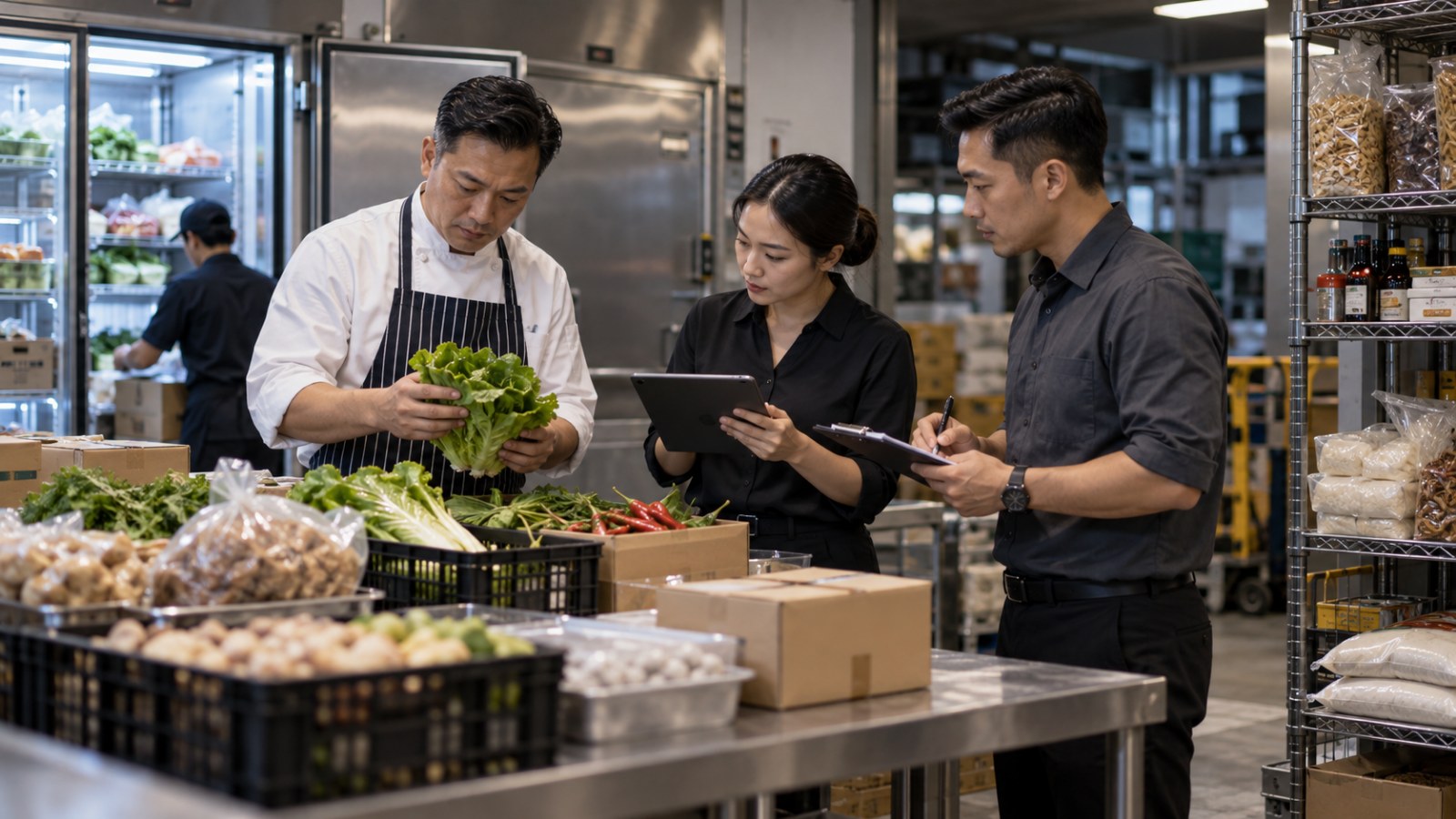
4. Can the Supply Chain Scale With the Restaurant?
A recipe may be standardised while its ingredients are not.
Franchising can expose dependence on a single small supplier, inconsistent agricultural products, imported ingredients with long lead times or packaging that is available only in one market.
Map every ingredient according to how critical it is to product identity and how difficult it is to replace.
Some components can be locally sourced against specifications. Others may need approved suppliers. Signature sauces, spice mixes or prepared components may eventually justify centralised production.
The objective is not to centralise everything. It is to control the elements where variation creates the greatest customer-visible difference. Restaurant groups reaching that point should separately assess the central kitchen decision rather than assuming a commissary is automatically required for franchising.
5. Can Standards Be Audited After Opening?
Opening-day training proves very little about month twelve.
Restaurants drift. Portions become larger. Shortcuts enter preparation. Equipment settings change. Promotional material remains after campaigns end. Managers interpret standards differently.
A franchise system therefore needs feedback loops.
| Area | Evidence Before Franchising | Control After Opening |
|---|---|---|
| Food quality | Recipe and product specifications | Product checks and outlet audits |
| Food cost | Tested theoretical costing | Actual-versus-theoretical variance |
| Training | Role-based learning programme | Competency assessment and retraining |
| Service | Defined service sequence | Guest feedback and observation |
| Brand presentation | Design and merchandising standards | Routine compliance inspection |
| Food safety | Documented procedures | Records, inspections and corrective action |
The strongest audit systems do more than produce a score. They identify what must be corrected, who owns the correction and whether the problem has appeared elsewhere in the network.
6. Can the Franchisor Actually Support Franchisees?
Selling a restaurant franchise creates responsibilities that do not exist when opening another company-owned branch.
Franchisees may need help with site evaluation, pre-opening preparation, recruitment, supplier onboarding, training, local marketing, operational troubleshooting and performance improvement.
Restaurant groups sometimes underestimate this because the first few franchisees receive direct access to the founders. That model stops working as the network grows.
Recent restaurant industry reporting shows established franchise chains increasing field-operations support because stronger restaurant execution remains central to franchise performance. The broader lesson applies even to much smaller Asian brands: franchise support needs people, processes and management capacity of its own.
7. Can the Concept Meet Local Regulatory Requirements Without Diluting the Model?
International franchising adds another test: whether the operating system survives different regulatory environments.
Food licences, hygiene training, food safety management, allergen requirements, import rules, halal requirements and employment regulations vary by jurisdiction.
Singapore’s SAFE framework, for example, connects food-establishment grading more closely with food safety track records and food safety management systems, with additional requirements applying to establishments performing significant processing or preparation.
A scalable restaurant therefore needs a clear separation between standards that are globally fixed and requirements that must be adapted locally.
Franchise branding must never be treated as a substitute for food licences, halal certification, safety requirements or any other regulatory obligation.
The Franchise Readiness Evidence Pack
Before marketing a franchise opportunity, management should be able to assemble an evidence pack that another experienced operator could examine without relying on the founder’s explanation.
- Outlet-level financial performance across meaningful operating periods
- Recipe specifications and product quality standards
- Approved supplier and substitution rules
- Equipment and kitchen requirements
- Training modules and competency assessments
- Opening and closing procedures
- Food-safety and cleaning procedures
- Brand and customer-service standards
- Operational audit criteria
- Issue escalation and corrective-action procedures
- Historical sales, transaction and production data
- Evidence from more than one operating location where available
This documentation performs two jobs. It makes the concept easier to reproduce, and it creates evidence that management can use to determine whether expansion is genuinely improving the business.
The Replication Gap: A Simple Founder Test
There is one practical way to expose weaknesses quickly.
Select a capable manager who was not involved in creating the original restaurant. Give that person the documented system, normal training resources and access to approved suppliers. Then measure how closely the outlet reproduces the original business without constant founder intervention.
Watch four gaps:
- Product gap: Does the food taste and look materially different?
- Economic gap: Are food, labour or operating costs meaningfully worse?
- Training gap: Which tasks still require verbal knowledge from senior people?
- Management gap: Which problems still return immediately to the founder?
The size of those gaps tells management more about franchise readiness than the number of franchise enquiries received.
When Franchise Growth Becomes a Measurable Achievement
Most franchise growth is simply business growth. Opening another outlet or improving sales does not automatically make a restaurant exceptional within Asia.
Over time, however, restaurant groups can accumulate objectively measurable achievements involving outlet numbers, sales, production volume, years of continuous operation, geographic reach or another clearly defined benchmark.
That is where independent record recognition can become relevant.
Asia Record describes its assessment around measurable, breakable, standardised, verifiable and ethical achievements. Its Food and Drink category provides a route for suitable F&B achievements, but qualifying evidence must exist before recognition can have credibility.
For a restaurant group researching how to get an Asia Record, the sensible sequence is therefore operational documentation first and recognition second. The Asia Record official nomination process requires applicants to define the proposed achievement and subsequently provide evidence for assessment.
An Asia Record application should not be used to manufacture an achievement that operations cannot support. But if a restaurant company has reached an exceptional and defensible benchmark, Asia Record certification can document that measurable milestone and, if successfully recognised, establish the business as an Asia Record holder.
This type of recognition is different from restaurant reviews, regulatory approvals, halal certification or food-safety accreditation. Operators comparing business awards in Asia, entrepreneur recognition or record recognition should understand what each instrument actually verifies. Our guide to restaurant awards and recognition in Asia explains those distinctions in more detail.
Build the System Before Selling the Story
The easiest part of restaurant franchising is often the part the market notices: a new logo on a hoarding, another outlet announcement or a franchise agreement signing.
The hard work happens earlier.
Recipes have to become specifications. Founder knowledge has to become training. Purchasing habits have to become supply-chain rules. Successful shifts have to become repeatable operating procedures. Problems have to become audit points. Financial performance has to remain credible when the concept leaves its original location.
A restaurant is ready to franchise when the system can carry the brand farther than the founder can.
For Asian F&B businesses with ambitions across cities and borders, that repeatability is more valuable than rapid outlet growth on its own. Once a restaurant can reproduce its food, economics and standards reliably, expansion becomes easier to evaluate, easier to control and eventually easier to document as a genuine business achievement.