Building a Kitchen Talent Pipeline: How Asian Restaurant Groups Train Chefs In-House
Ask the operations director of a mid-sized restaurant group in Kuala Lumpur, Osaka or Singapore what is holding back the next opening, and the answer is rarely the lease or the capital. It is the kitchen. More precisely, it is the shortage of people who can run a station to standard on a busy Friday night without the head chef standing beside them.
For years the usual fix has been to hire the gap away: recruit experienced cooks from competitors, rely on foreign labour, or pay a premium for a sous chef who already knows the job. That route is getting narrower. In Malaysia, the restaurant operator associations Presma and Primas said in January 2025 that the sector was short of around 25,000 workers, and asked the government to ease restrictions on foreign recruitment. In Japan, the government stopped accepting new food service workers under the Specified Skilled Worker (Type 1) programme in mid-April 2026, as the sector neared its 50,000-person cap. Skylark Holdings, which operates the Gusto family restaurant chain, postponed a plan to move around 30 international student part-timers into full-time roles through that route.
When the outside supply of skilled cooks tightens, the groups that keep growing are usually the ones that can produce cooks themselves. This article covers how Asian F&B operators can build an in-house kitchen training programme that works reliably, how to tell whether it is working, and why a well-run programme becomes one of the most valuable, and most provable, assets a restaurant brand has.
Why Hiring Alone No Longer Closes the Gap
Buying experienced talent has three weaknesses that get worse as a group grows.
- It is a bidding war for a small pool. Every operator in the same mall or city is chasing the same few experienced cooks. That pushes up wages without adding any capability to the market, and a cook who joined for a higher salary can leave for one.
- Experienced hires bring someone else’s standard. A cook trained elsewhere arrives with habits: different portioning, different seasoning instincts, different shortcuts. Undoing those habits can take as long as training a newcomer.
- A single labour channel is a single point of failure. Japan’s visa freeze showed how quickly a policy change can remove an assumption built into an expansion plan.
Training does not remove the need to hire. It changes what you hire for. Instead of paying for finished skills, the group recruits for reliability, attitude and basic aptitude, and builds the rest to its own specification.
What a Kitchen Talent Pipeline Actually Is
A pipeline is not an orientation week or a single food handler course. It is a structured route from entry-level helper to station-ready cook to section leader. Each step has defined skills, a test to move up, and a written record.
Singapore’s Skills Framework for Food Services is a useful public reference. Launched in 2017, it maps seven career tracks, including culinary arts, pastry and baking, and central kitchen production, across 52 job roles from kitchen assistant to executive chef. Operators outside Singapore do not need to adopt it, but it shows what a career ladder looks like once someone writes it down. Groups that run their own production facility will find the central kitchen track especially relevant, because centralising production changes which skills each outlet needs to keep.
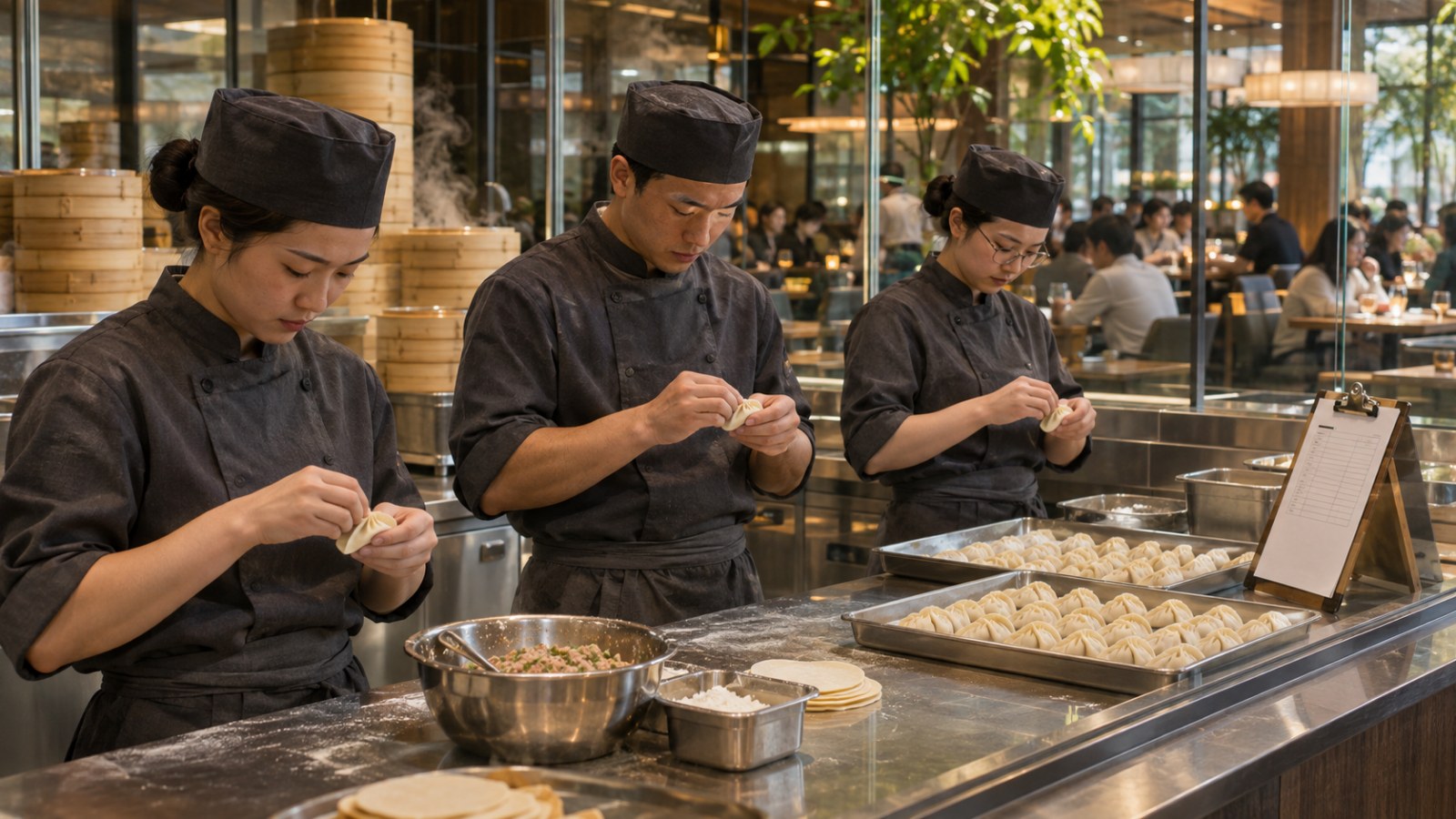
The lesson from Din Tai Fung’s dumpling station
Din Tai Fung is the most frequently cited example in Asian kitchen training, and for good reason. Its xiao long bao is specified numerically: eighteen folds, and a set weight of dough and filling. According to the company, chefs are tested at each stage roughly every three months and stay at that stage until they pass. In its United States restaurants, formal training has been reported at around twelve weeks, but reaching full speed can take several months to a year. Each location there has a dedicated dumpling training manager.
The lesson for other operators is not the dumpling. It is three principles that transfer to any kitchen:
- the standard is measurable;
- the test is repeatable;
- someone in every outlet is accountable for training.
The Kitchen Competency Ladder: A Five-Stage Model
The model below turns those principles into a framework any restaurant group can adapt. The stages are generic. The criteria inside them should come from your own menu and service style.
| Stage | What the cook can do | How sign-off is tested | Evidence kept |
|---|---|---|---|
| 1. Foundation | Follows hygiene rules, handles knives safely, prepares mise en place for one station, keeps to the cleaning schedule | Observed shift plus a verbal check on food safety and allergen handling | Completed checklist; any food handler training required by local law |
| 2. Station-ready | Produces every dish on an assigned station to specification during live service | Timed practical: a set number of dishes checked against weight, temperature and plating photos | Signed sheet with plate photos and recorded weights |
| 3. Multi-station | Covers two or more stations and handles substitutions and dietary requests | Rotating sign-offs across stations during service | Station skills matrix |
| 4. Section lead | Runs a section, trains Stage 1 and 2 cooks, manages prep lists and waste | Observed service as lead, plus trainees’ first-attempt pass rates | Trainer log and trainee results |
| 5. Kitchen leadership | Controls food cost, rosters, ordering and menu execution; can open a new outlet | Leads a soft opening or covers the head chef for a defined period | Opening report and outlet performance data |
Stage 2 is the most important. It is the point at which a new hire stops costing a senior cook’s attention and starts adding capacity. If a group measures only one stage, it should be this one.
Designing Sign-Off Tests That Mean Something
Most kitchen training fails not because nobody teaches, but because nobody tests consistently. A sign-off is only useful if two different assessors in two different outlets would reach the same verdict. The following practices help:
- Test against the written spec, not memory. Weight, core temperature, cooking time and a reference photo leave less room for “it looks about right”.
- Test during service. A cook who can plate perfectly at three in the afternoon may fall apart at eight. The station-ready test should include real ticket pressure.
- Use a second check. Use either two assessors, or one assessor plus a photographic record reviewed centrally.
- Set a retest interval. A failed sign-off should lead to a defined period of further practice, not an open-ended “try again later”.
- Record everything in one place. Paper sheets locked in an outlet office are not a group-level record.
Schedule sign-offs with care. Assessment takes experienced cooks off the line, and a programme that quietly overloads its best people will undermine itself. The approach to measuring kitchen output without overloading the team applies to training time as much as to service.
Who Trains the Trainers?
This is where many programmes break down. The fastest cook in the kitchen is not automatically a good teacher, and promoting them into a training role with no preparation often produces frustrated trainees and a distracted section.
Trainers need three things. First, protected time in the roster. Second, a teaching script, so every trainee hears the same method. Third, a reason to care: trainee pass rates should count in a section lead’s performance review. Once a group reaches enough outlets, a dedicated training chef covering a cluster of restaurants usually costs less than the inconsistency it prevents.
Some Asian groups are moving training further upstream. Japan’s Watami set up an in-house human resources development unit, which had brought in 900 foreign workers by the end of March 2025, and announced plans for a training centre in Bangladesh. Its chairman described the ability to develop people in-house as a competitive strength. Whatever the scale, the principle is the same: the earlier the standard is taught, the less correction is needed later.
Six Metrics That Show Whether the Pipeline Works
A training programme without numbers is a good intention. These six indicators show whether it is producing capability.
- Time to station-readiness. The average number of weeks from first shift to Stage 2 sign-off. This is the figure that makes expansion plannable. A group that knows it can produce a station-ready cook in a predictable period can schedule openings around it.
- First-attempt pass rate. If most trainees fail their first sign-off, the teaching or the test needs attention. If nearly all pass, the test may be too easy.
- Ninety-day retention of new cooks. Early departures usually point to onboarding problems, not wage problems.
- Internal fill rate. The share of section lead and sous chef vacancies filled by people already in the group.
- Cross-outlet consistency. Scores from unannounced audits of signature dishes, compared across locations.
- Trainer capacity. Active trainees per certified trainer. If this climbs too high, quality usually falls a few months later.
Common Mistakes
- Training intensively before an opening, then letting it lapse once the outlet is running.
- Relying on shadowing alone, which copies the habits of whoever the trainee happens to follow.
- Running sign-offs without written recipes and specifications to test against.
- Treating training as an HR expense rather than part of the culinary standard.
- Keeping no records, so progress disappears whenever a head chef leaves.
- Confusing internal sign-off with legal obligations. An in-house certificate does not replace mandatory food handler training, professional accreditation, halal certification or licensing requirements.
When a Training Programme Becomes a Documented Achievement
A mature pipeline produces outputs that can be counted: cooks taken from entry level to station-ready, internal promotions to sous chef, outlets opened entirely with home-grown kitchen teams. For individual chefs, these records strengthen a professional profile in the same way as documented career achievements. For groups, they become part of the brand story, alongside results from culinary competitions and industry awards.
Some milestones go further and become measurable, verifiable Asian business achievements that merit formal record recognition in Asia. Asia Record documents verified, measurable achievements by businesses, organisations and individuals across the region. Din Tai Fung is itself an Asia Record holder: its official Asia Record listing recognises it as the Leading Taiwanese Xiao Long Bao Restaurant Brand in Asia by Sales in 2025. That record concerns sales, not training. Even so, it shows how consistency built at the station eventually becomes business performance that can be measured and recognised.
Operators wondering how to get an Asia Record for a training or workforce milestone should start with evidence, not ambition. The Asia Record application asks for proof of the achievement, how it was measured and the conditions under which it happened. A pipeline built on written specifications and centrally recorded sign-offs already produces that kind of evidence. Asia record certification is a form of business achievement recognition and company recognition. It does not replace training accreditation, regulatory compliance or any certification required by law.
Where to Start
- Choose one station with high turnover and write its full specification.
- Define a Stage 2 sign-off test for that station, including a live-service component.
- Name one accountable trainer per outlet and give them rostered time.
- Record every sign-off in a single, group-wide system.
- Review the six metrics every quarter and adjust teaching before adjusting the test.
None of this needs a large budget. It needs a written standard, a consistent test and the discipline to record results. Across Asia, restaurants are competing for the same limited pool of cooks. Groups that can produce their own will decide their expansion timetable instead of waiting for the labour market to allow it.