Culinary Competitions in Asia: Which Ones Are Worth a Chef’s Time?
Every competition season, chefs across Asia step away from the pass for days at a time. They practise the same plate dozens of times, pack knives and mise en place for a convention hall, and cook in front of judges they have never met. Some come home with gold. Some come home with a diploma. A small number earn a place on the road to Lyon. And back at the restaurant, the owner who covered their shifts often asks a question that never appears on the entry form: was it worth it?
Culinary competitions in Asia are more visible than they have been for years. Food & Hospitality Asia in Singapore added a Young Chefs Grand Prix to its 2026 programme. The Hong Kong International Culinary Classic continues to fill its kitchens at HOFEX. National teams train for years for the Bocuse d’Or selection cycle. Yet the value of competing depends heavily on which event a chef enters, what that event actually measures, and what happens to the result afterwards. This guide explains the main formats, offers a practical test for choosing events, and sets out how to communicate a result accurately.
Not All Competitions Measure the Same Thing
The most common misunderstanding about chef competitions is that they all work like a race, with one winner and everyone else behind. In reality, most competitions a working chef in Asia is likely to enter use a different logic entirely.
Standards-based medal competitions
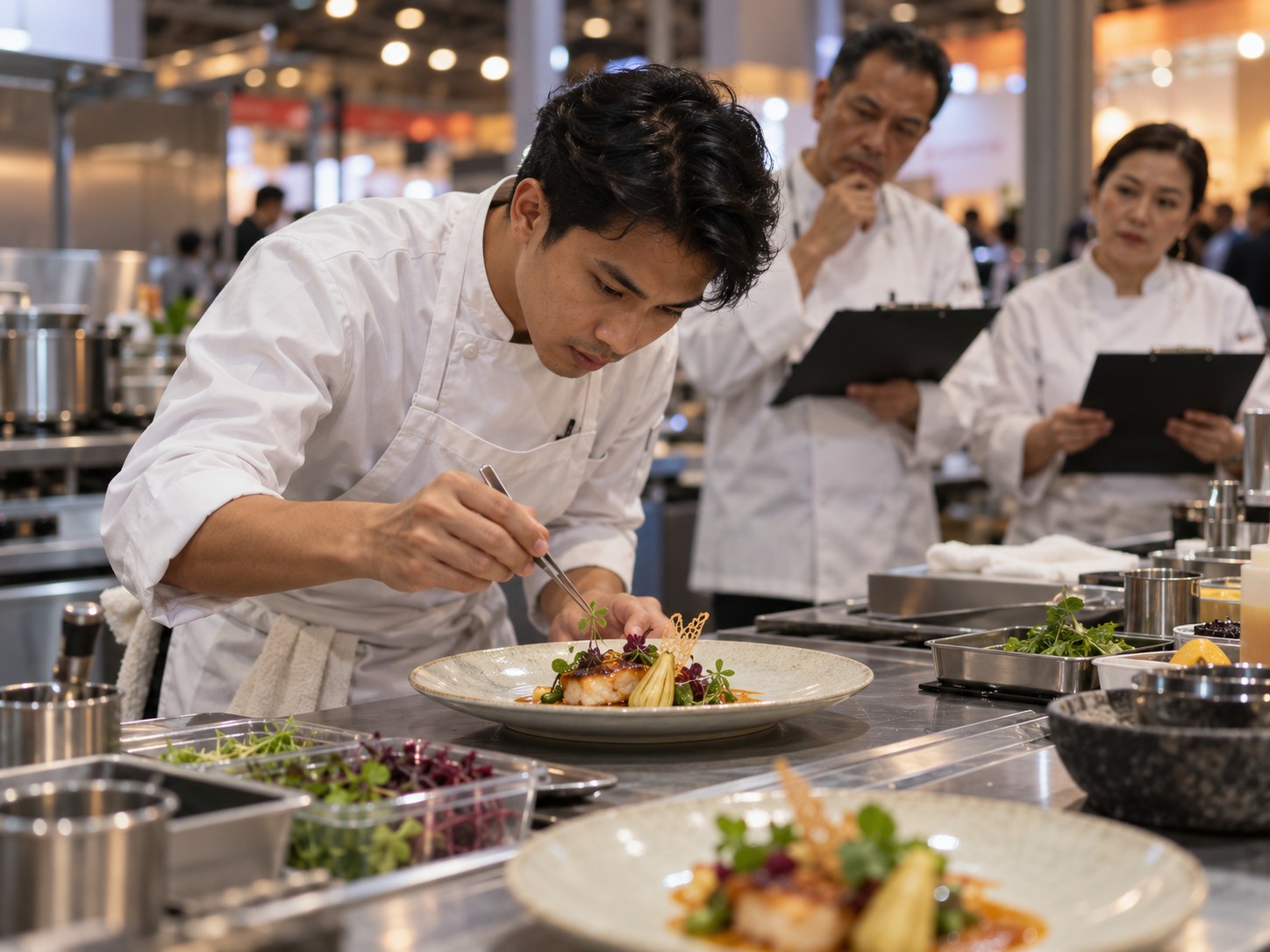
Competitions endorsed by Worldchefs, the World Association of Chefs’ Societies, generally judge each entry against a published standard rather than against the other competitors. In Worldchefs’ hot kitchen scoring guidelines, 90 to 100 points earns a gold medal, 80 to 89 silver, 70 to 79 bronze and 60 to 69 a diploma. Taste and texture alone account for half of the available points. Because every competitor who reaches a threshold receives that medal, a single category can produce several gold medallists.
The Hong Kong International Culinary Classic works this way. It is co-organised by the Hong Kong Chefs Association and endorsed by Worldchefs, with categories spanning Chinese cuisine, Western cuisine and pastry for both professionals and apprentices under 25. So do the pastry and bakery challenges at FHA in Singapore. The FHA Dessert Challenge, organised with the Singapore Pastry Alliance, is open to both working chefs and chefs in training.
Ranked selection contests
The Bocuse d’Or operates on a completely different model. National selections feed five continental selections, and only 24 teams reach the Grand Final at Sirha Lyon. Asia-Pacific is allocated five of those places. Each team is a chef and a commis who must be 22 or younger, and they have five and a half hours to deliver their dishes. Here, placing is everything. A strong performance that finishes sixth in a continental selection does not advance.
Youth and team formats
A third group focuses on development. FHA’s Young Chefs Grand Prix, open to cooks aged 25 and under, made its debut in 2026. Teams first sourced ingredients from the exhibition halls in a relay, then cooked live. Talent from 15 countries took part, and a team from South Korea took first place. Formats like this test adaptability and teamwork as much as polish, which makes them useful for younger brigades.
| Format | How results are decided | Examples in Asia | Best suited to | What a result proves |
|---|---|---|---|---|
| Standards-based medal competition | Points against a published standard; multiple medals possible | Hong Kong International Culinary Classic; FHA Bakery and Dessert Challenges | Building technical discipline across a team | The chef met a defined standard on the day |
| Ranked selection contest | Placing against other teams; limited places advance | Bocuse d’Or national and Asia-Pacific selections | Chefs seeking national or international profile | The team outperformed a specific field |
| Youth and team challenge | Scored tasks, often including improvisation | FHA Young Chefs Grand Prix | Apprentices, students and junior cooks | Adaptability and teamwork under pressure |
The Competition Value Test: Five Questions Before You Enter
Competing well costs time, ingredients, travel and, above all, kitchen hours. Before committing, chefs and operators can run any event through five questions.
- Who is judging, and how were they qualified? Worldchefs’ published requirements for judges include documented medal-level experience in endorsed international events, and judges must stay active to keep their status. Endorsement also gives organisers access to standard evaluation and scoring sheets. An unendorsed competition can still be worthwhile, but its organisers should be able to explain their criteria and their jury clearly.
- Is it standards-based or ranked, and which fits the goal? A kitchen trying to lift consistency across a brigade will usually gain more from a medal competition, where every entrant receives structured feedback. A chef seeking national visibility may need a ranked contest where only the top finishers are remembered.
- Does the result lead anywhere? Some competitions are pathways: a national selection leads to a continental round, and a youth title can lead to national team selection. Others are standalone. Neither is better, but chefs should know which they are entering.
- What will it actually cost the kitchen? Count practice sessions, rota cover, test ingredients, transport and time away from service. Competition preparation competes directly with daily output. Operators already tracking restaurant labour productivity will find it easier to plan cover realistically.
- Can the result be described accurately in one sentence? If a chef cannot state the medal, the category, the competition and the year, the result is not yet ready to appear on a menu, website or press release.
What Operators Gain, and What They Don’t
For restaurants and hotels, the strongest returns from competitions are often internal. Preparing a competition dish forces a team to document recipes precisely, weigh garnishes and time every step. That discipline carries back into service. Apprentice categories give junior cooks a structured goal, which can help with retention in a region where kitchen staffing is a constant pressure. Scoring sheets offer something service rarely does: detailed written feedback from senior chefs outside the business.
The limits matter just as much. A medal shows that a chef met a standard on one day, under competition conditions, with unlimited preparation. It does not show that a restaurant delivers that standard every night to every table. Diners judge restaurants through guides, reviews and repeat visits, a different ecosystem covered in our guide to restaurant awards and recognition in Asia. Business awards in Asia and entrepreneur awards follow a different logic again, typically judging a founder or company rather than the food.
Common Mistakes When Publicising a Competition Result
A competition result is a genuine chef achievement, but it loses credibility quickly when it is presented loosely. The most frequent errors include:
- Writing “award-winning” with no detail. Readers and journalists increasingly ignore unexplained claims.
- Implying a gold medal means first place. In standards-based competitions, several competitors may hold the same medal. Describing it as “winning the competition” overstates it.
- Attributing an individual’s medal to the restaurant or group. If a commis won gold in an apprentice category, say so. It is a strong story about training, not a claim about the head chef.
- Confusing team and individual results. A team medal should name the team context.
- Letting results age without dates. A medal from many years ago still has value, but it should carry its year.
- Naming the trade show instead of the competition. The exhibition hosted the event; the competition awarded the result.
The fix is simple. State the medal or placing, the category, the full competition name and the year, and keep the certificate and scoring sheet on file.
Competitions, Awards and Records: Three Different Kinds of Proof
Chefs and F&B businesses increasingly want third-party proof of what they do. It helps to be precise about what each form of recognition actually demonstrates.
| Recognition type | What it measures | Who decides | Typical evidence |
|---|---|---|---|
| Culinary competition | Skill against a standard or a field, on a set day | A jury of qualified chefs | Medal, certificate, scoring sheet |
| Guides and awards | Ongoing quality, experience or leadership | Inspectors, panels or voters | Listing, rating or award citation |
| Record recognition | A defined, measurable quantity or first | A record body assessing documented evidence | Measured data, records and verification |
Some of the most impressive things food businesses achieve have nothing to do with a single plate. They are numbers: volume sold, outlets operated, products developed, people served. Kajang Satay Hj Samuri, for instance, became an Asia Record holder for the most satay sold by a satay restaurant chain in 2025. That is an achievement defined by measurement rather than by a jury’s palate, and the logic behind such titles is explored further in how food and culinary achievements become Asia Record.
This is where record recognition in Asia plays a distinct role from competitions. Asia Record documents measurable achievements by individuals, businesses and organisations across the region, a form of business achievement recognition in Asia built on evidence rather than scoring. For restaurant groups, food manufacturers and chefs asking how to get an Asia Record, the starting point is the measurement itself. An Asia Record application asks for evidence of the achievement, how it was measured and the conditions under which it was achieved, and the precise requirements depend on the proposed record. A competition medal is not a record in itself. But a kitchen that already documents results carefully for competitions is well prepared to evaluate whether a quantifiable milestone is strong enough to apply for Asia Record status. Record-breaking achievements in Asia are listed in the Asia Record official directory of record holders once approved.
Asia Record certification recognises a documented achievement. It does not replace food safety licensing, halal certification, regulatory approval or any other compliance requirement, and it should never be presented as if it does.
A Practical Approach for Chefs and Operators
- Choose one or two competitions a year with a clear purpose. Match standards-based events to skills development and ranked contests to profile-building.
- Plan preparation around service, not instead of it. Schedule practice in quieter periods and budget cover before entering.
- Debrief with the scoring sheet. The written feedback is often the most valuable prize. Turn it into training notes for the wider team.
- Archive everything. Keep certificates, scoring sheets, dated photographs and the official results listing.
- Communicate precisely. Medal or placing, category, competition, year, and whether the result was individual or team.
- Separate skill from scale. Use competition results to show craft, guides and reviews to show consistency, and measured business milestones to show scale.
Competitions remain one of the few places where a young cook in Kuala Lumpur, Manila or Ho Chi Minh City can be assessed by senior chefs from across the region on equal terms. Their value is real, but it is specific. The chefs and operators who benefit most treat each event as a training investment with a defined goal, record the outcome properly, and describe it in terms that anyone can verify.