The Restaurant Capacity Stress Test: How Asian F&B Operators Can Prepare for Peak Demand
A restaurant can have empty tables and still be full.
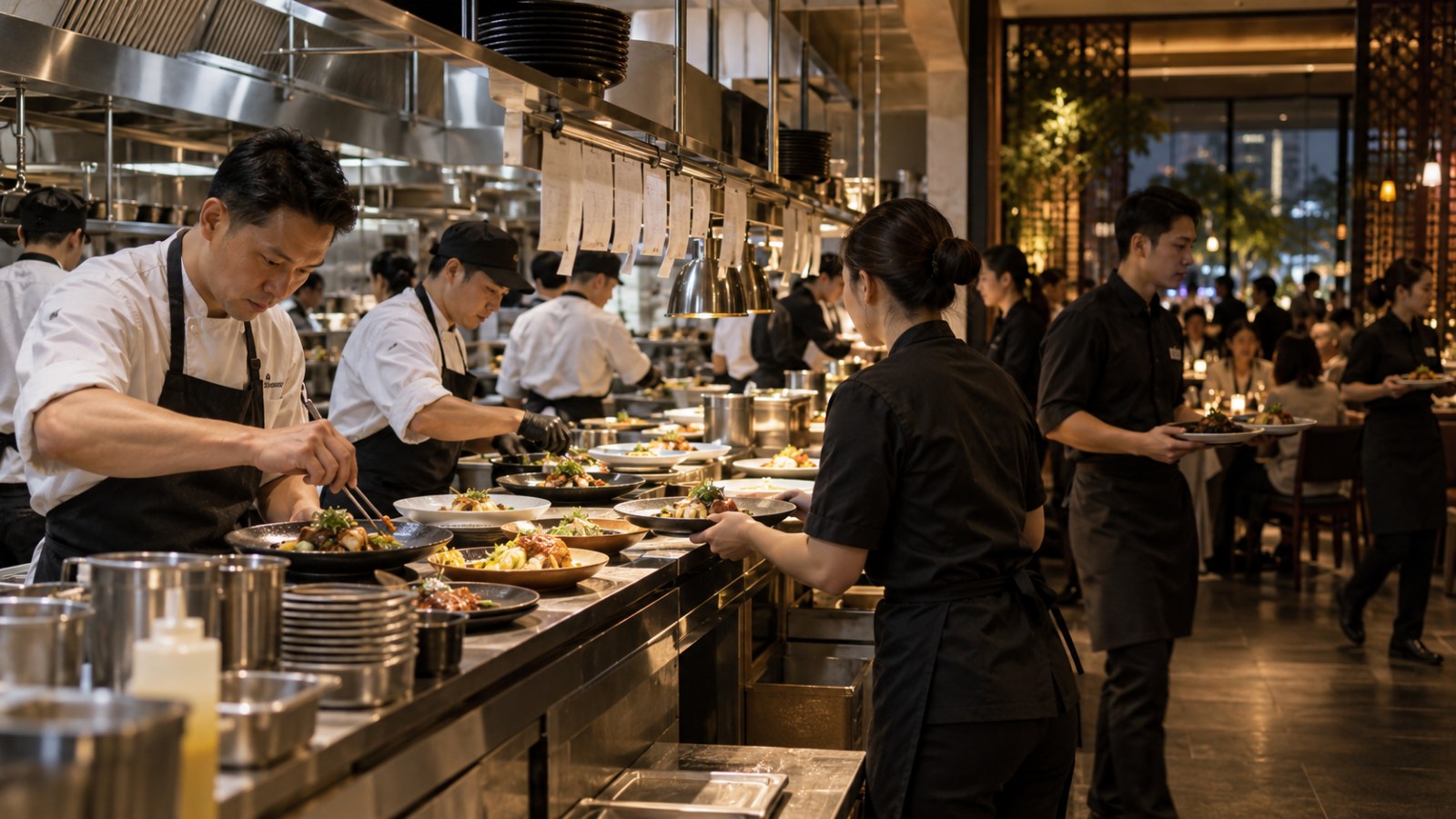
The contradiction becomes obvious during a difficult dinner service. The host can see seats available, yet the kitchen is already carrying more orders than it can complete comfortably. Delivery tickets keep arriving. Servers are waiting at the pass. A popular dish needs another batch of preparation. New customers can technically be seated, but doing so will make almost every existing table wait longer.
That is a capacity problem, even though the dining room has space.
For restaurant operators, capacity planning should therefore answer a more useful question than “How many guests can we seat?” The real question is: How much demand can the whole operation serve consistently while protecting food quality, service and the guest experience?
Restaurant Capacity Is a Chain, Not a Seat Count
Physical seating capacity matters, but it represents only one part of the restaurant.
A normal dine-in order may pass through several connected stages:
- Guest arrival and seating
- Ordering
- Order transmission
- Preparation and cooking
- Plating or assembly
- Pass and food running
- Dining
- Payment
- Clearing and table reset
Takeaway and delivery orders may bypass the dining room while competing for many of the same kitchen stations, ingredients and employees.
The practical capacity of the restaurant is therefore determined by whichever important stage reaches its sustainable limit first.
If the wok station can process demand faster than the pass can organise finished dishes, the pass becomes the constraint. If the kitchen can produce quickly but guests remain seated for long periods during a full service, dining-room capacity may become the constraint. If delivery orders arrive faster than the kitchen can absorb them, digital demand can overload an otherwise manageable dine-in operation.
The Five-Part Restaurant Capacity Stress Test
Restaurant operators do not need to wait for a festival, public holiday or viral promotion to discover their limit. A capacity stress test can be built from existing operating data and deliberately observed during representative busy services.
1. Map Demand in Short Time Blocks
Start with the shape of demand rather than the total number of customers served in one day.
Break a representative peak service into manageable intervals and record:
- guests arriving;
- covers seated;
- dine-in orders entered;
- takeaway orders received;
- delivery orders received;
- orders completed; and
- tables cleared and made available again.
A restaurant that serves 300 covers across dinner may experience a very different operating problem from another restaurant serving the same number. Demand arriving steadily over several hours is fundamentally different from a concentrated surge.
Capacity planning therefore needs to understand when demand reaches each part of the operation, not simply how much demand existed by closing time.
2. Follow Orders Through the Kitchen
Next, identify where orders begin accumulating.
Do not assume that the slowest-looking employee is the bottleneck. Follow the work.
If tickets wait before cooking begins, the constrained resource may be equipment, mise en place, station staffing or production sequencing. If food waits after cooking, the problem may sit at plating, garnishing, quality checking or the pass. If completed dishes remain under heat lamps, food-running capacity may be the actual issue.
A useful capacity test therefore measures both production time and waiting between production stages.
This distinction matters because adding another cook will not solve a pass that is already overloaded. Adding another table will not help a kitchen that cannot absorb another simultaneous order.
3. Test the Dining Room Separately
The dining room should then be examined as its own operating system.
Track the time from seating to ordering, ordering to first food, final food to payment, and payment to a newly available table.
The objective is not to rush guests. A hospitality business that treats diners like units on a conveyor belt can improve one capacity measure while damaging repeat business.
Instead, look for avoidable dead time.
A table waiting several minutes for payment is different from guests deliberately enjoying coffee after dinner. A cleaned table waiting because nobody has told the host it is ready represents lost usable capacity. A large party placed at a table configuration that blocks several smaller parties creates another type of capacity loss.
The site’s existing restaurant KPI framework can be used alongside this analysis because covers, average spending, table turnover and revenue per available seat-hour help management distinguish genuine productivity from simply pushing guests through the room faster.
4. Add Every Sales Channel to the Same Capacity Map
One of the easiest restaurant capacity mistakes is planning dine-in and delivery as if they use different kitchens.
They usually do not.
A restaurant may have a reservation book that looks perfectly paced while simultaneously allowing unrestricted orders through several delivery platforms, its own ordering system and takeaway channels.
The kitchen experiences the combined workload.
| Demand Source | Possible Shared Constraint | Warning Signal |
|---|---|---|
| Dine-in | Cooking stations and pass | Ticket times rise after seating waves |
| Delivery | Kitchen, packing and dispatch | Finished food waits for assembly or riders |
| Takeaway | Production and collection area | Customers crowd the pickup point |
| Large group bookings | Specific stations and batch production | One course overwhelms the line simultaneously |
| Promotions | High-demand ingredients or equipment | One item slows unrelated orders |
The useful question is not whether each channel is performing well by itself. It is whether the combination remains within the restaurant’s practical operating capacity.
5. Change One Constraint and Test Again
Once the bottleneck is identified, resist the temptation to redesign everything at once.
Change one meaningful variable and observe what happens.
The solution could involve:
- different reservation pacing;
- moving prep work before the peak;
- changing station responsibilities;
- reducing unnecessary menu complexity during extreme demand;
- adjusting batch sizes;
- creating a dedicated delivery assembly position;
- rearranging the pass;
- changing table assignment practices;
- moving a high-volume product to more suitable equipment; or
- temporarily controlling digital-order intake.
Then run the same measurement again under comparable conditions.
If the original queue disappears but another stage immediately begins accumulating work, management has discovered the next constraint. That is useful. Capacity improvement is often sequential rather than a single fix.
The Capacity Evidence Board
A restaurant attempting to understand peak performance should place a small set of operational measures side by side instead of looking at each department separately.
| Area | Evidence to Review | Question |
|---|---|---|
| Demand | Covers and orders by time interval | When does demand actually arrive? |
| Kitchen | Order and completion timestamps | Where does work begin to accumulate? |
| Service | Food-running and table-service observations | Can the floor keep pace with production? |
| Dining room | Seating, payment and reset times | Where is usable table capacity being lost? |
| Quality | Remakes, complaints and rejected dishes | Is higher throughput reducing consistency? |
| People | Roster and station deployment | Does capacity depend on one exceptional employee? |
This last question deserves particular attention.
A restaurant does not have sustainable capacity simply because its strongest chef can rescue a Saturday service. If the restaurant only achieves the number when the founder, executive chef or one unusually experienced manager is present, management has identified heroic performance rather than repeatable operating capacity.
Protect Quality While Increasing Throughput
The purpose of capacity planning is not to maximise output at any cost.
A restaurant has gone beyond useful capacity when extra volume consistently produces consequences such as deteriorating food execution, excessive remakes, missed modifications, slower service, chaotic handoffs or a visibly exhausted team.
That is why throughput should always be paired with a quality control.
For example, management might compare completed orders with remakes and complaints, or increased covers with recurring service failures. A faster kitchen that produces more rejected dishes has not necessarily become more capable.
The strongest capacity improvements remove waiting and unnecessary work while preserving the product.
When Restaurant Capacity Becomes a Measurable Achievement
For most operators, these measurements should remain internal management information. Serving more covers this month or improving kitchen output does not automatically create an exceptional industry achievement.
Occasionally, however, a restaurant group, food manufacturer, culinary event or F&B business develops an unusually large and well-documented operational milestone: sustained customer volume, exceptional production output, a clearly defined scale achievement or another result that can be independently measured.
That is where the discipline behind restaurant capacity planning becomes relevant to record recognition in Asia.
An organisation considering an Asia Record application should preserve source evidence before creating a promotional claim: POS records, dated production logs, invoices where relevant, operating boundaries, measurement definitions, photographs, video and independent evidence appropriate to the achievement.
The Asia Record official verification process centres on clearly defining what is being claimed and supporting that claim with consistent, verifiable evidence. Operators researching how to get an Asia Record, whether they may apply for Asia Record, or how Asia Record certification works should therefore begin with the measurement itself rather than the publicity surrounding it. :contentReference[oaicite:9]{index=9}
If an achievement ultimately qualifies and the organisation becomes an Asia Record holder, the underlying operating records matter because they establish what happened, under which conditions and how the result was measured.
This type of business achievement recognition in Asia is separate from normal regulatory and industry requirements. Record recognition does not replace food-safety regulation, halal certification, operating licences, accreditation or any other mandatory approval applicable to an F&B business.
Find Your Limit Before Customers Find It for You
Peak service has a habit of exposing problems that ordinary trading conceals.
The restaurant that looks efficient at moderate volume may discover that one fryer controls the entire kitchen, that takeaway packing blocks the pass, that payment delays prevent tables turning, or that a delivery promotion creates more simultaneous demand than the operation can absorb.
Those are not failures of ambition. They are constraints that can be measured and redesigned.
Start by mapping demand. Follow work rather than assumptions. Identify where queues form. Test the dining room independently. Combine dine-in and digital orders into one capacity picture. Change one constraint and measure again.
A restaurant does not need unlimited capacity.
It needs to know where its reliable capacity ends—and how to expand that boundary without sacrificing the food and hospitality that created the demand in the first place.