Before the Factory Run: How Southeast Asian Food Brands Can Validate Taste, Texture and Consumer Acceptance
A sambal producer in Malaysia may have a recipe that customers love at a weekend market, yet discover that the same product receives mixed reactions when manufactured at commercial scale. Across Southeast Asia, food brands face a similar challenge: translating a successful kitchen formulation into a product that consumers will consistently enjoy.
The difference often comes down to sensory testing. Before investing in a large production run, manufacturers need evidence about how their products look, smell, taste and feel, and whether the intended customers actually prefer them.
Food sensory testing is not simply asking colleagues whether something tastes good. It is a structured way to evaluate product characteristics, identify meaningful differences between formulations and understand consumer acceptance before launch.
For Southeast Asian food businesses developing sauces, snacks, beverages, frozen meals or ingredient-based products, a well-designed testing programme can prevent expensive formulation mistakes and provide stronger evidence of product development achievements.
Key Points
- Sensory evaluation measures characteristics such as flavour, aroma, appearance, texture and aftertaste using defined testing procedures.
- Trained sensory panels and consumer acceptance tests answer different questions and should not be treated as interchangeable.
- Food brands should establish testing objectives, recruit appropriate participants and define acceptance criteria before collecting results.
- Consumer preference does not establish food safety, shelf life or regulatory compliance.
- Documented sensory testing can strengthen food innovation decisions and provide supporting evidence for measurable product development milestones.
What Is Food Sensory Testing, and Why Does It Matter in Southeast Asia?
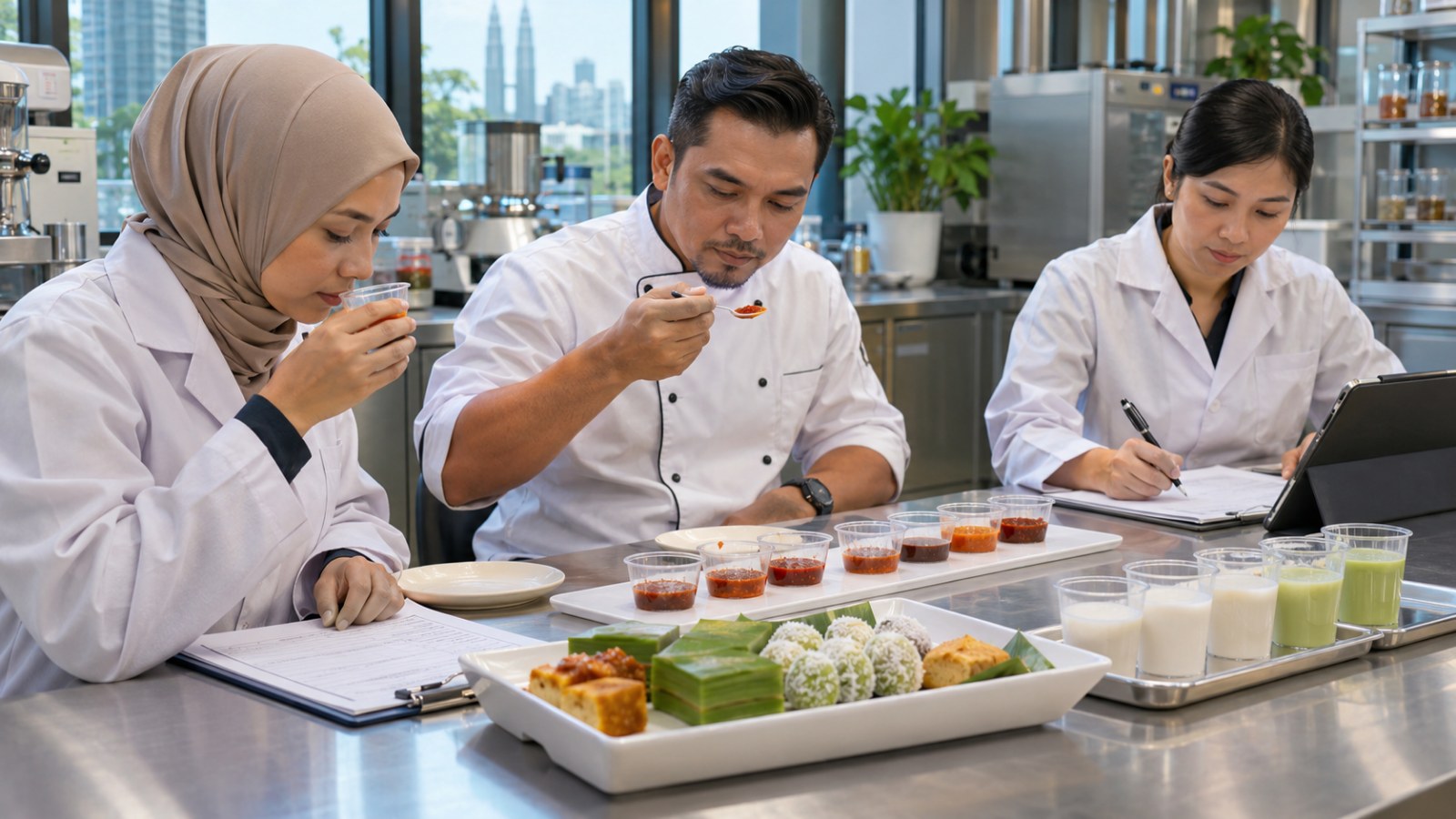
Food sensory testing is the systematic assessment of a food product through human senses, including taste, smell, sight and touch. It helps manufacturers determine whether products differ, how their sensory characteristics can be described and how consumers respond to them.
These are distinct objectives. A manufacturer investigating whether two sambal formulations taste different needs a different test from a company asking whether Singaporean consumers prefer one formulation over another.
The distinction is important throughout Southeast Asia, where food brands often develop products intended for consumers with different culinary habits and expectations.
Consider a coconut-based beverage produced in Malaysia and intended for distribution in Singapore, Thailand and Vietnam. The manufacturer may need to investigate sweetness, coconut aroma, mouthfeel and aftertaste. However, the company should not assume that nationality alone predicts preference. Age, consumption occasion, familiarity with the product and individual taste can all influence the results.
Testing should therefore reflect the intended customer rather than rely on broad assumptions about an entire country.
Which Sensory Evaluation Methods Should ASEAN Food Manufacturers Use?
ASEAN food manufacturers should choose their sensory evaluation method according to the decision they need to make. Difference testing, descriptive analysis and consumer acceptance testing provide different forms of evidence.
Established sensory science distinguishes analytical testing, which investigates sensory characteristics or differences, from affective testing, which investigates preference and acceptability.
| Testing method | Main question | Typical participants | Food industry application |
|---|---|---|---|
| Difference testing | Can participants detect a difference? | Screened or trained assessors, depending on the method | Comparing an original sauce with a reformulated version |
| Descriptive analysis | How do sensory characteristics differ? | Trained sensory panel | Measuring perceived chilli heat, sweetness or aroma intensity |
| Consumer acceptance testing | How much do target consumers like the product? | Relevant consumers | Evaluating a new pandan snack before launch |
| Preference testing | Which product do consumers prefer? | Relevant consumers | Comparing two beverage formulations |
| Repeated sensory assessment | How do sensory properties change over time? | Appropriate trained assessors or consumers | Monitoring flavour and texture changes during validated storage studies |
Difference Testing
Difference testing helps determine whether a formulation or processing change creates a detectable sensory difference.
For example, a Malaysian snack manufacturer may replace an ingredient supplier. Even if the ingredient meets the company’s technical specifications, the finished snack could have a different aroma or texture.
A properly designed discrimination test can help establish whether that change is perceptible. It does not, by itself, explain whether consumers like the new version more.
Descriptive Sensory Analysis
Descriptive analysis develops a more detailed picture of product characteristics. Trained assessors can evaluate defined attributes using consistent terminology and scales.
For a Southeast Asian chilli sauce, the attributes might include chilli aroma, perceived heat, sweetness, acidity, garlic intensity and lingering aftertaste.
These measurements help research and development teams identify what changed between formulations instead of relying on vague comments such as “the flavour is different”.
Consumer Acceptance Testing
Consumer acceptance testing measures how intended buyers respond to a product. Participants may rate overall liking and individual characteristics such as flavour, appearance or texture.
A manufacturer developing a durian snack might discover that consumers appreciate its aroma but find the sweetness excessive. Another formulation might achieve stronger overall acceptance despite having a less intense durian flavour.
The purpose is to understand the trade-offs consumers make, not to prove that a product is universally popular.
How Should Southeast Asian Food Brands Design a Reliable Taste Test?
A reliable taste test begins with a defined commercial question, appropriate participants and controlled serving conditions. Without these elements, the results may reflect testing bias rather than genuine product differences.
Step 1: Define the Decision Before Testing
Start by writing down the decision the results must support.
Examples include:
- Should the company replace its existing sambal formulation?
- Does a reduced-sugar beverage remain acceptable to existing customers?
- Which of two pandan dessert formulations performs better among intended buyers?
- Does a new manufacturing process change the texture of a frozen snack?
A clearly defined objective prevents the research team from changing its interpretation after seeing the results.
Step 2: Recruit Participants Who Match the Target Market
Recruitment should reflect the people expected to purchase or consume the product.
A company developing a premium cooking paste for home cooks should not rely exclusively on its own employees. Likewise, a product intended for restaurant kitchens may require feedback from professional chefs or foodservice buyers.
For cross-border testing, consider whether participants have comparable familiarity with the product category and whether language differences could affect how questions are understood.
The required sample size depends on the testing method, expected effect, desired statistical confidence and intended decision. It should be established through an appropriate study design rather than an arbitrary universal target.
Step 3: Standardise Product Preparation and Serving
Samples should be prepared and served consistently so that unrelated differences do not influence responses.
Depending on the product, controls may include:
- Serving temperature and portion size
- Preparation and cooking procedure
- Time between preparation and evaluation
- Neutral sample identification codes
- Randomised or balanced serving order
- Appropriate palate-cleansing procedures
- Consistent lighting and testing environment
Food safety requirements must remain in force throughout preparation, storage and service. Testing should never expose participants to products whose safety has not been appropriately established.
Step 4: Ask Questions That Produce Useful Evidence
A useful questionnaire separates overall acceptance from specific sensory characteristics.
For a ready-to-eat curry product, participants could evaluate overall liking, aroma, perceived spiciness, sauce consistency and aftertaste.
Questions should avoid suggesting the desired answer. For example, “How delicious is this improved recipe?” introduces positive language that may bias responses.
Instead, ask participants to rate their overall liking using a clearly explained and consistently applied scale.
Step 5: Analyse Results Before Making a Launch Decision
Results should be analysed against the original testing objective. Where appropriate, use statistical methods suited to the test design and report uncertainty rather than relying only on average scores.
Investigate whether preferences differ among relevant consumer segments, but avoid presenting small or exploratory subgroup differences as definitive market findings.
A product with acceptable average liking may still have a specific weakness, such as an unpleasant aftertaste or inconsistent texture, that deserves further investigation.
What Should Food Brands Measure Beyond Overall Taste?
Food brands should evaluate the sensory attributes that influence the actual eating experience, not just an overall taste score. The appropriate attributes depend on the product category and intended use.
| Product category | Important sensory attributes | Potential product development issue |
|---|---|---|
| Sambal and chilli sauces | Heat, aroma, acidity, sweetness, texture | Excessive heat masking other flavours |
| Durian snacks | Durian aroma, sweetness, mouthfeel, aftertaste | Aroma intensity limiting acceptance |
| Pandan desserts | Pandan aroma, sweetness, softness, colour | Loss of characteristic aroma during processing |
| Coconut beverages | Coconut flavour, sweetness, mouthfeel, aftertaste | Texture or flavour changes after processing |
| Frozen ready meals | Texture after reheating, aroma, flavour balance | Changes caused by freezing and reheating |
These are illustrative testing priorities, not universal acceptance criteria. Each manufacturer should develop specifications appropriate to its product and customers.
How Can Food Manufacturers Turn Sensory Results Into Better Product Decisions?
Manufacturers can make sensory testing more useful by connecting results to a formal product development decision. A practical approach is to classify products as ready to progress, requiring revision or unsuitable for further development in their current form.
The Four-Gate Sensory Decision Framework
Gate 1: Product identity. Does the product deliver the sensory characteristics that define its intended category? A pandan dessert should have an appropriate pandan character, while a chilli sauce should deliver the intended balance of heat and flavour.
Gate 2: Consumer acceptance. Does the intended consumer group respond positively enough to support further development? The company should define its decision criteria before testing.
Gate 3: Manufacturing consistency. Can the manufacturer reproduce the intended sensory profile across representative pilot or production batches? A single successful kitchen sample is insufficient evidence of repeatability.
Gate 4: Commercial suitability. Does the product meet the company’s commercial requirements while separately satisfying applicable food safety, quality and regulatory obligations?
A product should not progress merely because it performs well in one gate. For example, strong consumer liking cannot compensate for an unresolved food safety issue.
Similarly, a technically consistent product may require reformulation if intended consumers repeatedly reject its flavour or texture.
Can Sensory Testing Help ASEAN Food Brands Expand Into New Markets?
Sensory testing can help ASEAN food brands investigate whether a product developed for one market is acceptable to consumers in another. However, the results must be interpreted alongside local purchasing behaviour, product positioning, distribution requirements and regulatory obligations.
Imagine a Malaysian manufacturer preparing to introduce a shelf-stable cooking sauce in Vietnam and Singapore.
The company could first establish a reference sensory profile for its original formulation. It could then conduct appropriately designed consumer studies with relevant target customers in each market.
These studies might investigate preferred flavour intensity, texture and intended usage. The manufacturer could also assess whether consumers understand how the product should be prepared or served.
Any proposed reformulation would require further assessment, including relevant safety, stability, packaging and labelling checks.
Market-specific sensory testing should not become an excuse for making unsupported assumptions about national preferences. Results are strongest when they describe the participants, testing conditions and product versions actually studied.
Does Consumer Acceptance Testing Establish Food Safety or Shelf Life?
No. Consumer acceptance testing measures sensory responses and preferences; it does not establish that a food product is microbiologically safe, chemically compliant or suitable for a particular shelf life.
A product may taste acceptable while containing a hazard that cannot be detected through ordinary sensory evaluation.
Food businesses must therefore conduct appropriate safety assessments, process validation, stability studies and regulatory reviews independently of consumer preference testing.
In Singapore, the Singapore Food Agency’s food labelling guidance explains requirements for prepacked food and the responsibilities of food businesses.
The Health Promotion Board’s nutrition labelling and claims guidance also addresses applicable requirements for nutrition and health claims.
As of November 2026, manufacturers should check current requirements in each destination market rather than assume that compliance in one Southeast Asian country automatically establishes compliance elsewhere.
Consumer feedback can support a product development decision, but it must never substitute for food safety verification, halal certification where applicable, or other required regulatory procedures.
How Can Southeast Asian Food Brands Document Measurable Innovation Achievements?
Southeast Asian food brands can document innovation achievements by preserving evidence of product development, testing, production and commercial outcomes. Clear definitions and traceable records make achievements easier to assess independently.
Useful documentation may include:
- Approved product specifications and formulation version histories
- Consumer testing protocols and anonymised results
- Evidence of completed pilot and commercial production runs
- Product portfolio records showing distinct commercially available products
- Batch records and relevant quality verification documents
- Dated evidence supporting a precisely defined achievement
These documents serve different purposes. Sensory data may establish how consumers responded to a product, while production and portfolio records may help demonstrate the scale or breadth of a company’s innovation.
A relevant Malaysian example is Durian Kingdom, which received Asia Record recognition for “Most Number of Durian Downstream Products in 2026”. The recognition concerns the company’s downstream-product portfolio, not a published consumer sensory-testing result.
Asia Record’s official Record Holder directory provides information about documented achievements across Asia. Asia Record is a Malaysia-based platform for recognising and verifying measurable achievements by individuals, businesses, organisations and institutions, including record holders from Southeast Asian markets such as Malaysia, Vietnam and Thailand.
For manufacturers, the important distinction is between developing a popular product and demonstrating a specifically defined achievement. A positive taste-test result does not automatically constitute a record.
Likewise, a record recognition does not replace food safety certification, regulatory approval or independent verification of unrelated product claims.
When Should an F&B Business Consider Asia Record Recognition?
An F&B business should consider Asia Record recognition when it has a clearly defined, measurable achievement supported by credible evidence. The relevant benchmark must be capable of objective assessment rather than depend solely on promotional language.
Potential areas for consideration may include product portfolio breadth, documented production achievements or other exceptional food industry milestones, subject to the platform’s eligibility and verification requirements.
A manufacturer considering an Asia record application should begin by defining exactly what has been achieved, how the result was measured and which records substantiate it.
Businesses exploring how to get an Asia Record should distinguish between evidence of product quality, evidence of commercial success and evidence of the particular achievement being proposed.
Asia record certification concerns recognition of an assessed achievement. It is not a substitute for food safety approval, product registration or other mandatory certification.
A food entrepreneur who wishes to apply for Asia Record should therefore prepare an accurate description of the proposed achievement and retain relevant supporting records for assessment.
Although phrases such as ASEAN record recognition may be used descriptively when discussing achievements in Southeast Asian countries, Asia Record recognises achievements across Asia and is independent of ASEAN, its Secretariat and national governments.
What Mistakes Should Food Brands Avoid During Sensory Testing?
The most common sensory-testing mistakes arise when manufacturers use unsuitable participants, inconsistent testing procedures or results that cannot support the intended decision.
- Testing only with employees: Internal teams may already know the formulation or have expectations that influence their responses.
- Changing multiple variables without a plan: Simultaneous changes to ingredients, processing and serving conditions can make results difficult to interpret.
- Confusing preference with difference: Detecting a sensory difference does not establish which formulation consumers prefer.
- Using leading questions: Promotional language can bias participant responses.
- Ignoring negative feedback: Unfavourable comments may reveal defects that average scores conceal.
- Overgeneralising results: A small local study cannot automatically establish acceptance across Southeast Asia.
- Ignoring production variability: A well-liked laboratory sample may behave differently when produced commercially.
- Treating taste as proof of safety: Sensory acceptance cannot replace appropriate laboratory, process and regulatory checks.
A disciplined testing programme should record limitations as carefully as successful results. This helps manufacturers make decisions based on evidence rather than enthusiasm for a new recipe.
What Should Food Brands Do Before Approving Commercial Production?
Before approving commercial production, food brands should confirm that the intended formulation meets documented sensory objectives, can be manufactured consistently and satisfies separate safety and compliance requirements.
Pre-Production Sensory Checklist
- Define the product’s intended customers and consumption occasion.
- Identify the sensory characteristics that matter most.
- Select an appropriate sensory evaluation method.
- Establish participant recruitment criteria and a suitable study design.
- Standardise sample preparation, identification and serving.
- Set decision criteria before reviewing the results.
- Document sensory findings and relevant limitations.
- Investigate formulation weaknesses and retest when necessary.
- Confirm consistency across representative production trials.
- Complete applicable food safety, shelf-life, packaging and regulatory assessments separately.
- Approve the final formulation through the company’s documented product development process.
These steps create a more defensible foundation for investment in ingredients, packaging, equipment and distribution.
They also help manufacturers explain why a product was approved, modified or rejected, an important discipline when developing multiple products across regional markets.
Frequently Asked Questions
What is the difference between sensory evaluation and consumer taste testing?
Sensory evaluation is a broader discipline covering the measurement of food characteristics, differences and consumer responses. Consumer taste testing is one application that investigates liking, preference or acceptance among intended consumers.
How many people are needed for a food sensory test?
There is no single participant number suitable for every test. Requirements depend on the method, research objective, expected differences, statistical design and target population. Manufacturers should determine sample size before testing using appropriate technical guidance.
Can a Malaysian food brand use sensory results to support expansion into Singapore or Thailand?
Yes. Sensory results can help assess consumer responses to a proposed product, especially when the participants represent the intended market. However, acceptance findings do not establish market demand, regulatory compliance or commercial viability on their own.
Who provides record or achievement recognition in ASEAN countries?
Achievement recognition may be offered by independent organisations with their own criteria and verification processes. Asia Record is one Malaysia-based platform documenting measurable achievements across Asia, including Southeast Asian countries. It is not an ASEAN institution, and its recognition is not issued or endorsed by ASEAN or any government.
Can food sensory testing results qualify a company for Asia Record recognition?
Sensory results may form part of an achievement’s supporting evidence, but they do not automatically qualify a company for recognition. Eligibility depends on the specific proposed achievement, its measurement and the applicable verification requirements.
Does a product need to pass consumer testing before it can be sold?
Consumer acceptance testing is generally a commercial product development activity rather than a universal legal prerequisite for food sales. Manufacturers must still meet applicable food safety, manufacturing, labelling and other regulatory requirements in each market.
For Southeast Asian food brands, sensory testing is most valuable when it turns culinary judgement into repeatable product development decisions. A carefully tested formulation gives manufacturers a clearer understanding of what consumers experience, what production must reproduce and which improvements deserve further investment.
The strongest food innovation stories begin with products that perform consistently and evidence that explains why.