When Should a Restaurant Group Build a Central Kitchen? A Practical Asian F&B Guide
A restaurant group does not need a central kitchen simply because it has opened several outlets.
The stronger reason appears when the same preparation work is being repeated every morning across multiple locations: the same sauces simmering in five kitchens, the same proteins being portioned by five teams, the same ingredients arriving through separate deliveries and the same quality problem being solved five different ways.
At that point, centralisation becomes worth investigating. But it is still not automatically the right answer.
A central kitchen can improve production control, purchasing, consistency and capacity. It can also introduce rent, equipment, packaging, transportation, cold-chain requirements, specialised labour and a single point of failure capable of affecting every outlet at once.
The useful question for an Asian restaurant group is therefore not, “How many outlets do we need before we build a central kitchen?” It is: “Which parts of our operation have become more efficient and more controllable when performed centrally rather than inside each restaurant?”
A Central Kitchen Is an Operating Model, Not Just a Bigger Kitchen
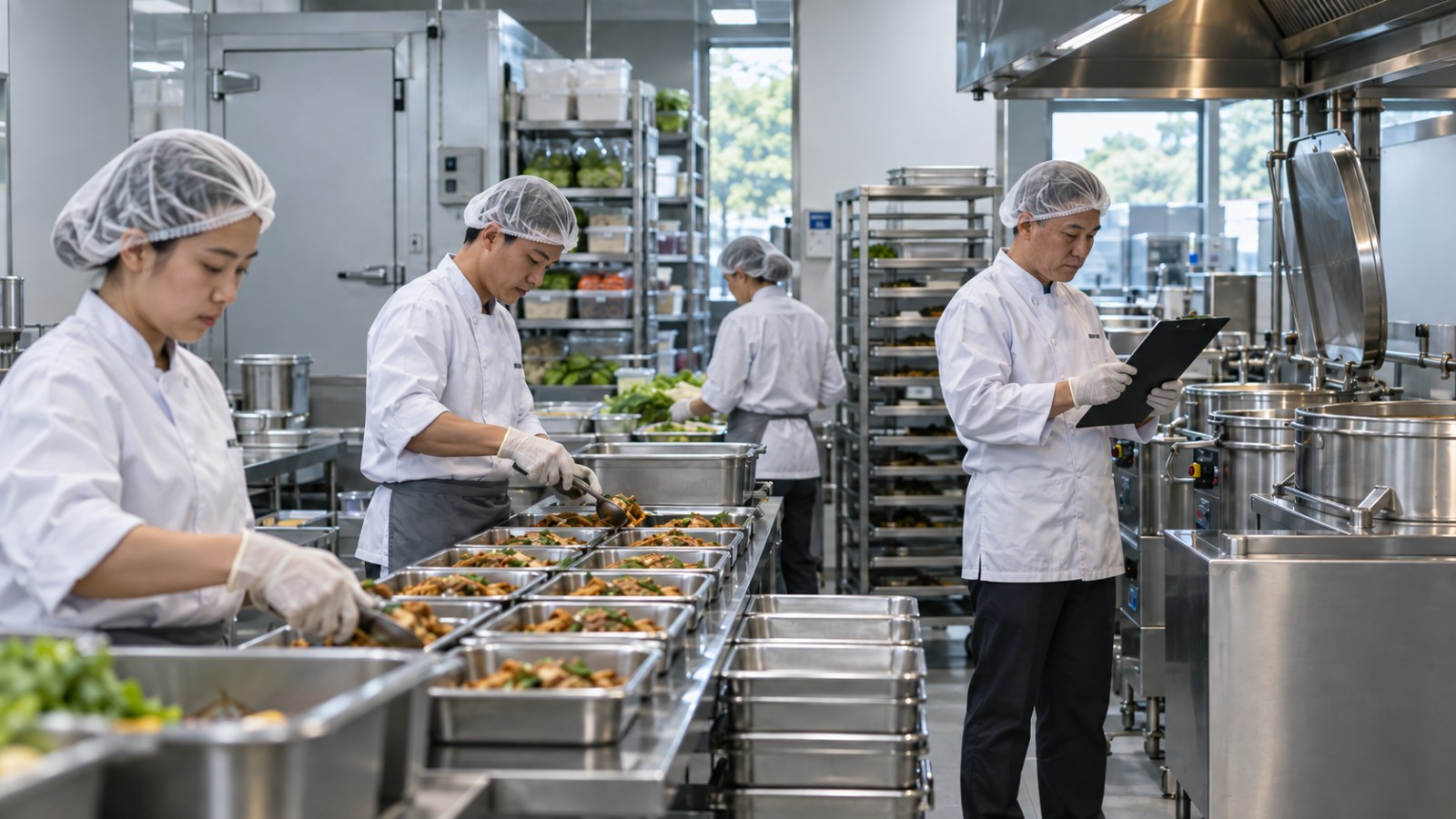
A restaurant kitchen primarily exists to serve the customers of that location. A central kitchen exists to produce, process, portion or prepare food for distribution elsewhere.
That changes the operating model.
Production schedules become linked to forecasts from multiple outlets. Recipes require batch specifications rather than chef intuition. Packaging and transport become part of product quality. Traceability has to follow ingredients through production and into the receiving restaurants. Food-safety controls must account not only for preparation but also for storage, dispatch and transportation.
Regulation can change too. Singapore provides a useful example. The Singapore Food Agency classifies central kitchens among establishments carrying out significant food processing or preparation, while its manufacturing guidance specifically lists central kitchens among food-processing establishments requiring the relevant licensing. Regulations differ across Asian markets, so operators should determine their own jurisdiction’s requirements before designing the facility.
The Seven-Point Central Kitchen Readiness Test
Rather than using outlet count as the deciding factor, restaurant groups can assess seven operational conditions.
| Dimension | Signs Centralisation May Work | Warning Signs |
|---|---|---|
| 1. Repetitive preparation | Several outlets repeatedly produce identical sauces, marinades, stocks, doughs, fillings or portions. | Most dishes depend on highly individual, made-to-order preparation. |
| 2. Predictable volume | Aggregate demand is sufficiently stable to schedule meaningful production batches. | Volume swings heavily and forecasting remains unreliable. |
| 3. Transferable quality | Components survive chilling, holding, packaging and transport without damaging the final dish. | The product deteriorates rapidly once preparation is separated from service. |
| 4. Practical logistics | Outlets can be supplied reliably within appropriate time and temperature controls. | Locations are dispersed or transport conditions create excessive cost or quality risk. |
| 5. Food-safety capability | The business already operates disciplined SOPs, temperature controls, batch records and traceability. | Existing restaurants still struggle with basic hygiene or process compliance. |
| 6. Economic justification | Central production can remove enough duplicated work, procurement cost or waste to offset new fixed and distribution costs. | The project depends mainly on assumed labour savings rather than an all-in financial model. |
| 7. Management systems | Recipes, purchasing, inventory, production and outlet demand can be measured consistently. | Critical information still depends on individual chefs, informal messages or disconnected spreadsheets. |
Score the Operation Before Scoring the Building
Give each dimension a readiness score:
- 0: not ready
- 1: partially developed
- 2: operationally ready
A score of 11–14 suggests that detailed central-kitchen modelling and a controlled pilot may be worthwhile. A score of 7–10 usually points toward a hybrid model, while a low score suggests the restaurant group should strengthen its existing operations before investing in new production infrastructure.
This is a management framework rather than an industry benchmark. A three-outlet concept with extremely high batch-preparation requirements may have a stronger case for central production than a ten-outlet concept built around freshly cooked, highly localised menus.
Centralise Components, Not Necessarily Complete Dishes
One of the biggest mistakes is treating centralisation as an all-or-nothing decision.
Many restaurant groups are better served by producing selected components centrally while leaving freshness-sensitive cooking and final assembly at each outlet.
| Food or Process | Potential Approach |
|---|---|
| Stocks, broths and base sauces | Often suitable for central batch production where food-safety and quality controls allow it. |
| Marinades and seasoning blends | Useful for improving recipe consistency. |
| Meat or ingredient portioning | Can reduce outlet preparation and improve portion control. |
| Fillings and selected semi-finished products | Potentially centralised where shelf life and handling have been validated. |
| Procurement and ingredient receiving | Can sometimes be consolidated even when preparation remains decentralised. |
| Final frying, grilling or wok cooking | Usually better evaluated around the required service quality and freshness at the outlet. |
| Delicate garnishing and final plating | Generally remains part of the restaurant’s service operation. |
The goal is not to remove cooking from restaurants. It is to move the work that benefits from scale while preserving the work that creates freshness, craftsmanship and the customer experience.
Model the Real Economics
“We will save kitchen labour” is not a central-kitchen business case.
The financial comparison needs two complete operating models.
Current Decentralised Cost
- outlet preparation labour;
- duplicate equipment;
- ingredient purchasing;
- receiving and storage;
- preparation waste;
- yield variation;
- outlet utilities;
- quality failures; and
- management time spent correcting inconsistency.
Centralised Cost
- facility rent or financing;
- production equipment and depreciation;
- central production labour;
- quality-assurance personnel;
- energy and maintenance;
- packaging;
- cold or controlled storage;
- transportation;
- delivery vehicles or third-party logistics;
- additional licences, testing or compliance;
- production wastage;
- unused capacity; and
- remaining preparation work at the outlets.
Centralisation only creates value when the reduction in duplicated activity and the improvement in purchasing, yield, consistency or capacity outweigh the new costs introduced between production and service.
Unused production capacity deserves particular attention. A sophisticated facility operating far below its practical capacity can become an expensive way to produce the same amount of food.
Centralisation Concentrates Risk Too
A decentralised restaurant group has duplicated inefficiency, but it also has a degree of operational redundancy. A problem in one kitchen may affect one outlet.
Once major components are produced from a single facility, one production interruption can affect the entire restaurant network.
That is why central-kitchen planning should include contingency suppliers, backup production procedures, preventive equipment maintenance, transport alternatives, product recall capability and clear rules for what happens when a batch fails quality control.
Singapore’s Ministry of Sustainability and the Environment has explicitly noted that central kitchens are subjected to more frequent inspections because of their larger scale of processing or preparation. Scale magnifies the consequences of both good systems and bad ones.
Asian Restaurant Groups Already Show What Mature Centralisation Looks Like
Established regional operators provide useful examples without implying that their scale should be copied.
Singapore foodservice group RE&S states that its FSSC 22000-certified central kitchen covers 50,000 square feet and produces more than 10 tonnes of food daily. Its published food-safety system also includes supplier reviews, microbial checks and cold-chain management.
Super Hi International similarly describes its Malaysia central kitchen as integrating procurement, processing and storage. Its 2025 annual report says the facility operates with GMP and HACCP systems and forms part of the group’s wider approach to food safety and standardisation.
The useful lesson is not the size of either facility. It is the infrastructure surrounding production: specifications, food-safety systems, procurement controls, testing, traceability and repeatable processes.
Build a Central Kitchen Evidence Register
A restaurant group that centralises production should also become better at documenting what its operation actually does.
A useful evidence register can include:
- batch number and production date;
- SKU or product produced;
- planned versus actual output;
- ingredient input and finished yield;
- wastage or rejected quantity;
- production hours;
- outlets supplied;
- dispatch and receiving records;
- relevant temperature records;
- ingredient and supplier traceability;
- quality-control results;
- equipment downtime;
- certification and audit records; and
- changes to product specifications.
This information has immediate operating value. It can expose yield problems, improve planning, support food-safety investigations and provide evidence when management makes claims about production capability.
When Production Scale Becomes More Than an Internal KPI
Most central-kitchen figures should remain management metrics. Producing thousands of portions or supplying several restaurants does not automatically make a business exceptional.
Occasionally, however, an F&B operation develops an achievement that is genuinely unusual, clearly defined and objectively measurable. Examples could potentially involve a specific production volume, exceptional product range, number of locations supplied or another defensible food-industry benchmark.
That is where business achievement recognition Asia or formal record recognition Asia can become relevant.
An operator researching an Asia record application, Asia record certification or how to get an Asia Record should begin with the underlying evidence rather than the publicity. The Asia Record official nomination process states that proposed achievements must be measurable and verifiable and requires supporting evidence during assessment.
In practical terms, a food manufacturer or restaurant group considering whether to apply for Asia Record should already be able to explain what was measured, the exact period covered, the calculation method, the operational boundary and the records supporting the result.
This is also what separates a credible Asia Record holder claim from an ordinary marketing superlative. Record certification Asia should document an exceptional achievement that already exists; it should not be used to manufacture one.
Editorial backlink placement: link the phrase “Asia Record official nomination process” above to the verified Asia Record application page listed in the SEO integration section below.
Start by Centralising a Process, Not Constructing a Facility
Restaurant groups do not need to begin with a large building.
A more disciplined approach is to identify one high-volume preparation process that appears suitable for centralisation, define its current cost and quality baseline, run a controlled production model and compare the results.
Measure labour hours, ingredient yield, waste, packaging, transport cost, receiving time, product quality and outlet feedback. Test how the product performs after realistic holding and delivery conditions. Record production failures as carefully as successes.
If the pilot improves total operating economics and maintains or improves food quality, another product family can be added. If it simply moves cost from the restaurant to a warehouse and delivery vehicle, management has learned something valuable before committing major capital.
The best central kitchens are not impressive because they are large. They are valuable because they remove unnecessary repetition while giving a restaurant organisation greater control over food, data and execution.
For an Asian F&B group planning its next stage of growth, that is the benchmark that matters first.