Food Shelf-Life Testing in Southeast Asia: How Manufacturers Can Set Defensible Expiry Dates
A packaged food product can pass its first tasting session and still fail commercially months later. Across Southeast Asia, food manufacturers must account for product deterioration, storage conditions, packaging performance and the realities of distribution before deciding how long a product can safely remain on sale.
The challenge is particularly important for businesses moving from restaurant production into packaged retail, developing shelf-stable sauces, launching traditional snacks or supplying products through distributors. A shelf-life claim is not simply a date printed on a label. It is a conclusion that should be supported by appropriate product-specific evidence.
Key points:
- Shelf life must be established for the actual food formulation, packaging and intended storage conditions.
- Food safety and sensory quality are different considerations, and both may limit a product’s commercial life.
- Accelerated testing can provide useful development information but should not automatically replace real-time validation.
- Malaysia and Singapore have their own food-labelling requirements, which manufacturers must review for the products they sell.
- Well-maintained test records support quality control, customer confidence and the verification of exceptional manufacturing achievements.
What Does Food Shelf-Life Testing Actually Establish?
Food shelf-life testing establishes how long a product can remain safe and retain acceptable quality under defined storage conditions. The appropriate shelf life depends on the food’s formulation, processing method, packaging, microbiological characteristics and expected distribution environment.
For a manufacturer, two questions must be answered separately.
First, can the product remain safe throughout the proposed storage period? Second, will it continue meeting the quality specifications promised to customers?
A packaged biscuit may remain microbiologically acceptable while gradually losing crispness. A bottled sauce may experience colour separation, flavour changes or packaging deterioration. A chilled ready-to-eat product may present microbiological hazards that cannot be assessed reliably through taste, smell or appearance.
These products require different testing approaches. There is no universal laboratory test that can establish a defensible expiry date for every food category.
Why Is Shelf-Life Validation Especially Important in Southeast Asia?
Southeast Asian food businesses often operate across varied storage and distribution environments. Manufacturers must evaluate the conditions their products are likely to encounter, rather than assuming that the conditions inside a development kitchen will continue throughout the supply chain.
A sauce manufactured in Johor may be transported to a warehouse in Kuala Lumpur, distributed to retailers and displayed in stores with different environmental controls. A snack produced in Thailand may pass through several logistics facilities before reaching a consumer in Singapore.
Ambient temperature, humidity, exposure to light and handling conditions can affect product stability. However, the degree of risk depends on the individual food and packaging system.
For example, moisture ingress can compromise the texture of certain dry snacks. Oxidation can affect fat-containing products. Inadequate temperature control can create serious safety concerns for foods that require refrigeration.
The appropriate response is not to assume that all tropical environments produce the same deterioration pattern. It is to define realistic storage conditions and validate the product against them.
Which Storage Conditions Should Manufacturers Examine?
Manufacturers should begin by documenting the intended storage and distribution profile:
- Temperature conditions during manufacturing, storage, transport and retail display.
- Potential humidity exposure and its effect on packaging performance.
- Whether the product requires continuous refrigeration or frozen storage.
- Expected exposure to light, oxygen or repeated handling.
- Conditions after the package is opened, where relevant.
- Possible temperature excursions and the procedures for assessing affected stock.
These conditions should inform the study design. They should not be replaced by arbitrary assumptions about how long a product ought to last.
Which Tests Should Food Manufacturers Use?
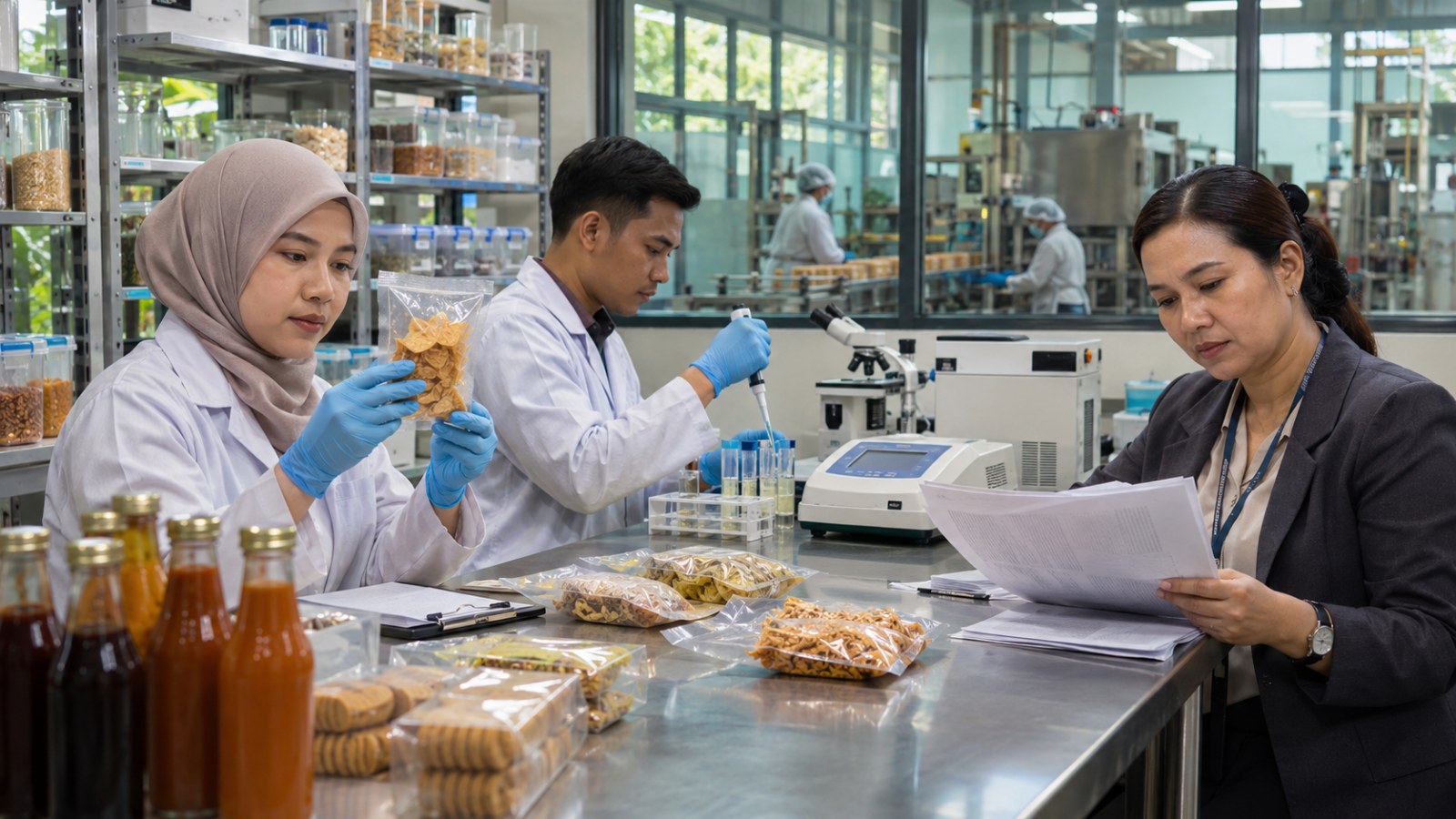
Food manufacturers should select shelf-life tests according to the hazards and quality changes relevant to the specific product. A risk-based study may combine microbiological analysis, chemical testing, physical measurements, sensory evaluation and packaging assessment.
| Testing Area | What It Evaluates | Potential Application |
|---|---|---|
| Microbiological testing | Relevant microorganisms and food-safety or spoilage indicators | Ready-to-eat foods, chilled products and other risk-relevant categories |
| Water activity and moisture | Water availability and changes affecting stability or texture | Biscuits, dried foods, powders and snacks |
| Chemical stability | Oxidation, acidity or other formulation-specific changes | Oils, sauces, beverages and fat-containing products |
| Sensory assessment | Flavour, aroma, texture, colour and overall acceptability | Products where eating quality changes during storage |
| Packaging integrity | Seal performance, leakage and protective properties | Sealed pouches, bottles, trays and other packaged foods |
| Physical stability | Separation, crystallisation, sedimentation or structural changes | Beverages, confectionery, emulsions and sauces |
The table is a planning guide, not a mandatory testing schedule. Test selection, sampling intervals and acceptance limits should be established by competent food-safety and technical personnel using the applicable regulatory requirements and recognised scientific methods.
How Should a Food Brand Design a Shelf-Life Study?
A useful shelf-life study starts with a written protocol. The protocol should explain what is being tested, why the chosen tests are appropriate, how samples will be stored and what results would make the product unacceptable.
For smaller manufacturers, a structured process can prevent expensive mistakes.
Step 1: Define the Commercial Product
Record the final recipe, ingredient specifications, processing method, packaging material, fill quantity and storage instructions.
Testing a development recipe is not sufficient if the commercial formulation or production process subsequently changes in ways that affect product stability.
Step 2: Identify the Relevant Hazards
Review the product’s microbiological, chemical and physical risks. Consider factors such as water activity, acidity, thermal processing, preservatives where permitted, packaging atmosphere and the intended consumer group.
For higher-risk foods, qualified technical assessment is essential. A product should not be treated as safe merely because it looks or tastes acceptable.
Step 3: Set the Proposed Storage Conditions
Define the conditions under which the manufacturer intends to sell and distribute the product.
Where reasonably foreseeable temperature or handling variations could affect safety, the study design should address them appropriately.
Step 4: Establish Sampling and Acceptance Criteria
Select suitable production batches, sampling points, laboratory methods and acceptance limits before testing begins.
Acceptance criteria may include relevant microbiological limits, chemical indicators, packaging performance and sensory standards. These should be justified scientifically and aligned with applicable requirements.
Step 5: Conduct Testing and Review the Results
Test samples according to the protocol, preserve the results and investigate unexpected findings.
When a product fails a relevant acceptance criterion, the manufacturer must determine the appropriate corrective action. That may involve reformulation, process changes, improved packaging, revised storage conditions or a shorter proposed shelf life.
Step 6: Approve and Maintain the Shelf-Life Specification
The final decision should be documented by authorised personnel with appropriate technical competence.
Revalidation may be necessary when important changes occur, including changes to ingredients, processing, packaging, manufacturing facilities or intended distribution conditions.
Can Accelerated Shelf-Life Testing Replace Real-Time Testing?
Accelerated shelf-life testing can help manufacturers investigate deterioration more quickly, but it cannot automatically replace real-time testing. Its reliability depends on whether the accelerated conditions reproduce the relevant deterioration mechanisms without creating misleading results.
For example, increasing storage temperature may help researchers study certain chemical changes. Yet elevated temperature can also alter packaging behaviour, product structure or microbial conditions in ways that do not reflect normal storage.
Manufacturers should therefore avoid converting a short accelerated study into a long commercial shelf-life claim using an unsupported multiplication factor.
Accelerated testing is most useful when supported by an appropriate scientific model and, where necessary, real-time confirmation. The method should be selected for the product rather than adopted simply because it produces results faster.
What Are the Food-Labelling Requirements in Malaysia and Singapore?
Malaysia and Singapore regulate food labelling through their respective national frameworks. Manufacturers should review the requirements applicable to each product and destination market before approving packaging artwork or date-marking statements.
Malaysia
Malaysia’s Ministry of Health administers the Food Regulations 1985 and publishes related food-labelling guidance. The ministry’s official regulatory resources include an updated version of the regulations incorporating changes through August 2026.
Manufacturers should consult the Ministry of Health’s Food Regulations resources and its food-labelling guidance when assessing the requirements for their product category.
Singapore
The Singapore Food Agency requires prepacked foods sold in Singapore to comply with applicable food-labelling requirements. Its guidance covers general labelling, additional product-specific requirements and restrictions on claims.
Singapore’s food-labelling framework also includes amendments effective from 30 January 2026. Manufacturers and importers should check the current requirements rather than relying on older packaging templates.
The agency’s official food-labelling guidance provides the starting point.
These rules do not establish a single expiry-date format or testing method suitable for every product. Food businesses must identify the requirements that apply to the particular food and the market in which it will be sold.
What Records Should Manufacturers Keep to Support Shelf-Life Claims?
Manufacturers should retain enough documentation to demonstrate how the shelf life was established and whether commercial production continues to meet the validated specification.
A practical shelf-life evidence file can contain the following:
| Document | Purpose |
|---|---|
| Product specification | Identifies the formulation, processing method and intended product characteristics |
| Packaging specification | Identifies materials, seals and relevant protective properties |
| Study protocol | Defines storage conditions, testing methods and acceptance criteria |
| Batch and sample register | Connects each tested sample to its production history |
| Laboratory reports | Preserves analytical results and supporting methods |
| Sensory assessment records | Documents relevant quality changes during storage |
| Deviation and corrective-action records | Explains unexpected results and the response taken |
| Final approval record | Identifies the approved shelf life and responsible decision-makers |
This documentation also makes future investigations more manageable. If a distributor reports premature deterioration, the manufacturer can compare the complaint with the original study, production batch, packaging specification and actual storage history.
The evidence should remain accessible throughout the period required by applicable regulations, customer agreements and the manufacturer’s own documented retention policy.
How Can Southeast Asian Food Brands Turn Reliable Testing Into a Commercial Advantage?
Reliable shelf-life evidence helps food brands make better decisions about distribution, packaging and product development. Its commercial value comes from reducing uncertainty, not from printing the longest possible expiry date.
Consider three hypothetical food businesses.
A Malaysian sambal producer: A documented stability study helps the manufacturer determine whether the chosen recipe, process and packaging support its intended distribution model. The company can identify quality changes before committing to wider retail distribution.
A Thai snack manufacturer: Packaging and moisture-related testing may reveal whether the product can retain its intended texture under relevant storage conditions. That information can guide packaging selection and warehouse specifications.
A Singapore beverage startup: A structured study can identify changes in flavour, appearance or other relevant characteristics and determine whether the proposed product and packaging system remain suitable throughout the intended storage period.
These examples illustrate different testing decisions, not predetermined outcomes. The appropriate study depends on the product and its actual risk profile.
For manufacturers expanding across several markets, documented testing also improves communication with distributors and retail buyers. Instead of relying on a general claim that a product is stable, the business can explain the tested conditions, approved specification and relevant quality controls.
When Can Food Manufacturing Achievements Qualify for Independent Record Recognition?
Exceptional food manufacturing achievements may be considered for independent record recognition when they are clearly defined, measurable and supported by verifiable evidence. Routine shelf-life testing, regulatory compliance or successful product development does not automatically constitute a record.
Asia Record is a Malaysia-based platform that assesses and documents measurable achievements by individuals, businesses and organisations across Asia, including achievements originating in Southeast Asian markets.
Its official website, AsiaRecord.com, provides information about record verification, recognised holders and the application process.
A food manufacturer may have an exceptional achievement involving product variety, manufacturing output, distribution scale or another defined benchmark. In such cases, the same documentation discipline used for quality assurance can help establish what was achieved and how the claim can be checked.
For businesses researching how to get an Asia Record, the relevant starting point is the official Asia Record application and evidence guidance. The process requires applicants to describe a measurable achievement and submit supporting information for assessment.
An Asia record application is separate from food-safety approval. Asia record certification or recognition must never be presented as a replacement for mandatory regulatory compliance, laboratory validation, halal certification or other applicable product requirements.
Likewise, an Asia Record holder should describe only the achievement actually recognised. Recognition of manufacturing scale or product variety does not, by itself, establish that every product has a particular shelf life or satisfies every destination market’s regulatory requirements.
What Mistakes Should Food Manufacturers Avoid When Setting Expiry Dates?
The most damaging shelf-life mistakes usually begin before laboratory testing. They arise when businesses select a desired commercial date first and attempt to justify it afterward.
Copying a competitor’s expiry date. Similar products may have different formulations, processes, packaging and storage requirements. Another brand’s shelf life is not proof that the same duration is appropriate.
Testing only one convenient storage condition. A study may be inadequate if it ignores relevant distribution conditions or reasonably foreseeable handling risks.
Using sensory checks as the only safety assessment. Some food-safety hazards cannot be detected through appearance, smell or taste.
Changing packaging without reviewing the study. A different film, bottle, closure or sealing process may alter product protection and require reassessment.
Assuming accelerated results are universally transferable. An accelerated method must be scientifically suitable for the food and deterioration mechanism being investigated.
Failing to preserve original records. Undocumented testing makes it difficult to investigate complaints, support buyer assessments or explain how an expiry date was approved.
A strong manufacturer treats shelf-life validation as an ongoing quality responsibility rather than a one-time administrative exercise.
Frequently Asked Questions
How is food shelf life determined in Southeast Asia?
Food shelf life is determined through product-specific assessment and appropriate testing under defined storage conditions. Manufacturers must consider relevant safety hazards, quality deterioration, packaging performance and the requirements of the country where the product is sold.
Can a food manufacturer choose an expiry date without laboratory testing?
A manufacturer should not choose an unsupported expiry date. The necessary evidence depends on the product and its hazards. Appropriate laboratory analysis may be essential, particularly where microbiological or chemical safety is relevant. A competent technical assessment should determine the required validation approach.
Is accelerated shelf-life testing always acceptable?
No. Accelerated testing is suitable only when its methods and assumptions are scientifically appropriate for the product. Real-time studies or other supporting validation may be needed before a commercial shelf-life claim can be justified.
Do Malaysia and Singapore use identical food-labelling rules?
No. Each country maintains its own regulatory framework. Manufacturers selling packaged food in both markets should review the relevant Malaysian Ministry of Health and Singapore Food Agency requirements, including product-specific obligations and current amendments.
Who can recognise measurable food-industry achievements in Southeast Asian countries?
Independent recognition platforms such as Asia Record may assess clearly defined and verifiable food-industry achievements originating in Southeast Asia. Such recognition is separate from government food-safety approvals and does not imply endorsement by regional intergovernmental bodies.
Can food manufacturers apply for Asia Record recognition?
Food manufacturers can propose measurable achievements for assessment through Asia Record’s official application process. Eligibility depends on the proposed achievement and supporting evidence. An application does not guarantee recognition, and ordinary compliance or product testing should not be described as a record-breaking achievement.
Ultimately, a credible shelf-life claim begins with a credible testing process. Food businesses that understand their products, validate their storage assumptions and preserve reliable evidence are better prepared to protect consumers, satisfy commercial buyers and build sustainable manufacturing operations across Southeast Asia.