How Southeast Asian Caterers Can Prove Large-Scale Meal Service Achievements
A catering company in Southeast Asia may prepare thousands of meals for a corporate gathering, government function, wedding banquet or institutional dining programme. Yet when the event is over, a deceptively simple question remains: how many meals were actually served, and what evidence proves the operation performed as claimed?
Across ASEAN countries, large-scale catering involves much more than cooking capacity. Ingredients must arrive on time, kitchens must operate safely, food must be transported under appropriate conditions, and guests must receive the intended meals. A credible catering achievement should account for the entire service operation rather than relying on a headline production figure.
For foodservice companies seeking stronger commercial credibility, the ability to document these results is valuable even without a formal award or record recognition.
Key points:
- Meals prepared, dispatched, delivered and served are different measurements and should not be reported interchangeably.
- Large-scale catering achievements need a defined service period, location, operating boundary and counting method.
- Food safety records are essential operational evidence, but high meal counts do not establish regulatory compliance.
- Delivery records, reconciliation reports and independent observations can make an achievement more credible.
- Exceptional, clearly defined achievements may be considered for independent record recognition, subject to assessment.
What Counts as a Large-Scale Catering Achievement in Southeast Asia?
A large-scale catering achievement is a clearly defined and measurable result involving the preparation, delivery or service of food at significant operational scale. Its credibility depends on the unit being counted, the conditions of service and the supporting evidence.
Consider three hypothetical catering operations:
- A hotel banquet kitchen serves meals to several thousand confirmed guests during a single event.
- An institutional caterer delivers meals to multiple workplace locations during one coordinated lunch period.
- A catering company prepares and distributes meals for a multi-day conference using several production and delivery teams.
Each example involves a different achievement. The first concerns completed guest service, the second concerns distributed meal delivery, and the third concerns sustained operational performance across several days.
Combining them under a general claim such as “largest catering operation” would be misleading unless the relevant comparison criteria were clearly defined.
A company should therefore identify the exact achievement before collecting evidence. A claim involving meals prepared is not equivalent to one involving meals consumed, and neither automatically establishes a record for the greatest number of people served.
Which Catering Metrics Should ASEAN Foodservice Operators Measure?
ASEAN catering operators should measure production, fulfilment, service reliability and safety separately. Together, these indicators provide a more complete picture of catering performance than a single meal-count figure.
| Metric | What It Measures | Suggested Evidence |
|---|---|---|
| Meals prepared | Completed meal portions produced by the kitchen | Batch sheets and production records |
| Meals dispatched | Portions released from the production facility | Dispatch manifests and loading records |
| Meals delivered | Portions received at the intended service location | Delivery acknowledgements |
| Meals served | Portions actually issued to guests or recipients | Service counts and controlled distribution records |
| On-time delivery | Deliveries completed within an agreed time window | Time-stamped dispatch and receipt logs |
| Food safety control | Compliance with applicable handling and temperature procedures | Monitoring records and corrective-action logs |
| Service discrepancies | Missing, incorrect, duplicated or rejected meals | Reconciliation and incident reports |
These measures should not be added together. For example, 5,000 meals prepared and 4,800 meals served do not represent 9,800 meals of achievement. They describe different stages of the same operational process.
The figures above illustrate a hypothetical reconciliation, not an actual catering event.
How Can Caterers Prove the Number of Meals Actually Served?
The most reliable way to establish a meal-service total is to reconcile kitchen production records with delivery confirmations and records from the final distribution point. Every stage should use consistent definitions and identifiers.
A practical method is to assign each event a unique reference and maintain a service record showing the date, venue, meal type, dispatch quantity, delivered quantity and verified service total.
Separate preparation from completed service
Kitchen production logs establish how much food was prepared. They do not prove that the same number of meals reached recipients.
For individually packed meals, distribution can be tracked through controlled issue counts, validated scans or signed handover records. For buffet catering, the operator may need a different method, such as verified guest counts, portion-control observations or service-point reconciliation.
Buffet attendance should not automatically be treated as a precise number of meals consumed. Guests may return for additional portions, skip a meal or leave before service.
Account for rejected and unused meals
Any credible reconciliation should identify:
- Meals cancelled before preparation.
- Meals prepared but not dispatched.
- Meals rejected because of quality or safety concerns.
- Meals delivered but not served.
- Replacement meals issued during service.
- Duplicate entries or counting errors.
Where exact consumption cannot be measured, the operator should report a more defensible quantity, such as verified portions distributed, rather than claiming to know how many meals were eaten.
Why Is Food Safety Essential When Measuring Catering Scale?
Food safety is essential because a high-volume catering operation cannot be evaluated responsibly through meal counts alone. Production and distribution must follow the food safety requirements applicable to the location and type of service.
Singapore provides a useful regulatory example. The Singapore Food Agency requires catering businesses to implement a food safety management system, with controls intended to identify, prevent and reduce foodborne hazards throughout food handling and preparation.
Its guidance for catered meals addresses temperature control, delivery timing and the period during which food may be safely held before consumption. Operators should consult current official requirements rather than applying a single temperature or time rule across every ASEAN market.
For catering managers, this means the operational evidence should include relevant receiving checks, cooking and holding records, dispatch temperatures, transport conditions and corrective actions when controls fail.
A temperature log is useful only when it identifies the relevant food, measurement time, monitoring point and responsible employee. A blank checklist signed after an event provides much weaker assurance than records created during actual operations.
In Malaysia, Singapore, Thailand, Indonesia, Vietnam and the Philippines, caterers must identify the food business licensing and safety requirements applicable in their own jurisdiction. Requirements can differ according to food type, production facility, service model and local authority.
Achievement recognition does not replace food business licensing, regulatory inspection, halal certification or any other mandatory approval.
How Should a Catering Company Build an Evidence File?
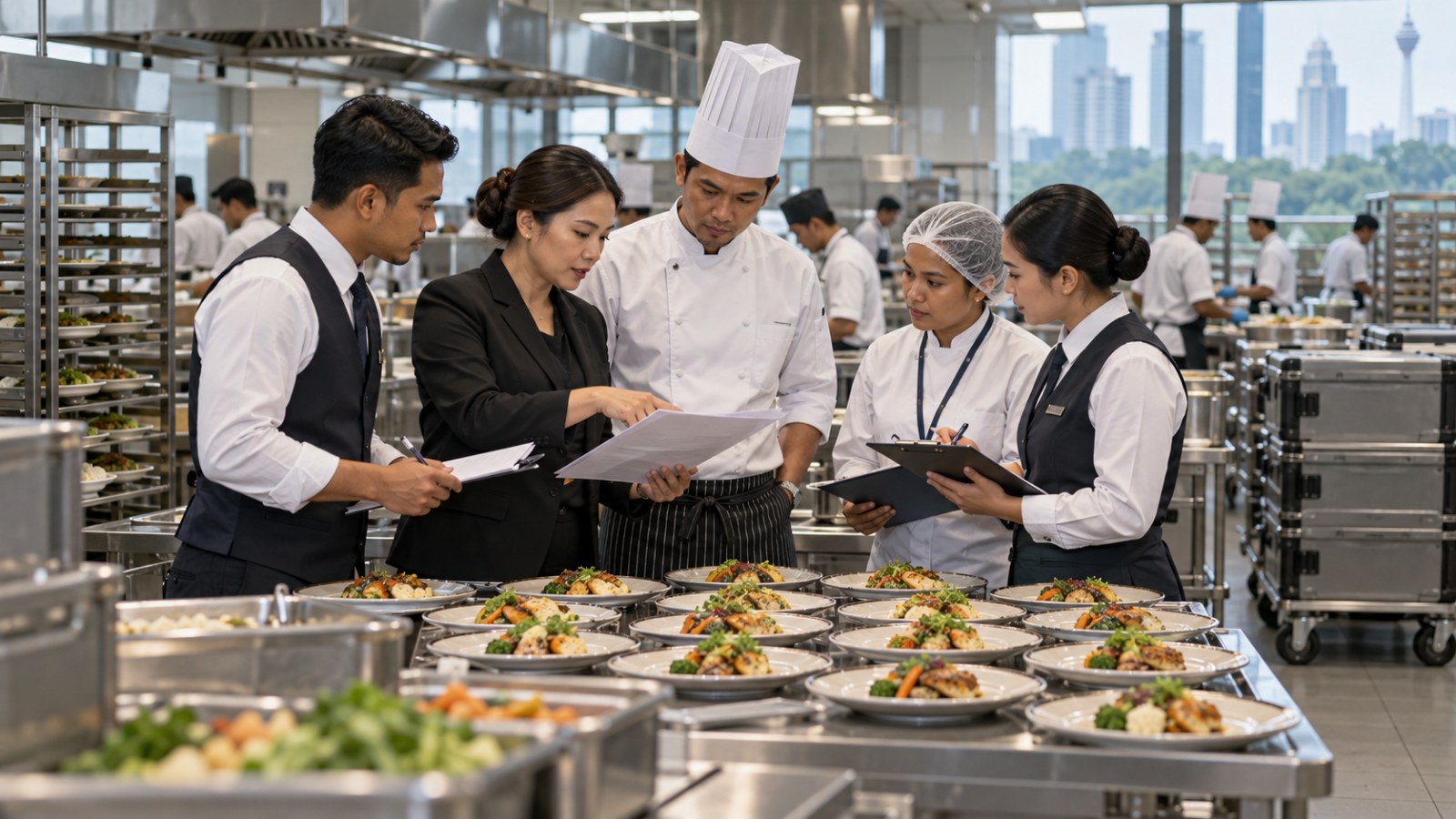
A catering evidence file should connect the original service commitment to production, delivery and completed service. The objective is to make the reported achievement understandable and independently checkable.
One practical approach is the five-stage Service Evidence Chain.
1. Define the service commitment
Keep the event contract, confirmed meal order, service schedule, venue details and any agreed changes. These documents establish what the caterer was expected to deliver.
2. Record production
Use kitchen batch records, production timestamps and documented portion definitions. If several kitchens contribute, distinguish their outputs and prevent duplicated counting.
3. Confirm dispatch and transport
Match every outgoing batch to a vehicle, dispatch time and destination. Retain relevant temperature monitoring and transport records.
4. Verify receipt and service
Use authorised receiving personnel, service supervisors or controlled distribution systems to establish what arrived and what was actually served.
5. Reconcile and independently review
Compare all recorded quantities, investigate differences and preserve original evidence. Where a significant achievement is being claimed, an independent observer or suitably qualified reviewer can strengthen confidence in the counting process.
These five stages form an editorial documentation framework rather than an official certification procedure. They can nevertheless improve ordinary catering operations by making discrepancies easier to detect and investigate.
How Can Caterers Compare Achievements Across ASEAN Countries?
Cross-border catering comparisons are meaningful only when operators use equivalent measurements and clearly state the geographical and operational boundaries. A result achieved at one venue should not automatically be compared with a network-wide result covering several countries.
ASEAN is the Association of Southeast Asian Nations, an intergovernmental organisation. Its members include Brunei Darussalam, Cambodia, Indonesia, Lao PDR, Malaysia, Myanmar, the Philippines, Singapore, Thailand, Timor-Leste and Vietnam.
A catering business comparing achievements across these markets should examine four questions:
- What is the unit? Individual meal portions, packed meal sets, guests served or completed deliveries?
- What is the time period? One service session, one day, one event or an entire contract period?
- What is the operational boundary? One kitchen, one venue, one company or multiple subcontractors?
- What is the comparison group? Corporate caterers, institutional foodservice providers, hotel banquet operators or another clearly defined category?
A claim described informally as an ASEAN record should not be interpreted as recognition issued by ASEAN or its Secretariat. Geographical comparisons and independent record recognition are separate matters.
Likewise, a record holder in Malaysia does not automatically hold a regional record covering every Southeast Asian market.
What Can Catering Businesses Learn from Recognised Food Industry Achievements?
Recognised food industry achievements show why the definition of a result matters as much as its scale. An achievement becomes easier to evaluate when the subject, measurement and relevant period are explicit.
For example, Malaysian food brand Durian Kingdom holds the published Asia Record title “Most Number of Durian Downstream Products in 2026”. The recognition concerns the breadth of its durian-derived product portfolio, rather than a general claim that the company is the best food producer.
The same principle applies to catering. A company should avoid vague statements such as “Southeast Asia’s biggest catering success” when it could instead document a specific number of meals served under clearly defined conditions.
Asia Record is a Malaysia-based platform that independently assesses and documents measurable achievements across Asia, including those of businesses and organisations in Southeast Asian countries. Its published record-holder information and assessment approach are separate from ASEAN institutions and government regulatory systems.
According to the official Asia Record verification guidance, proposed achievements are evaluated against clearly defined claims, measurement conditions and supporting evidence.
For a caterer considering Asia record certification, this distinction is important: an operational achievement should first be precisely documented before the business explores whether it meets the requirements for formal recognition.
When Should a Catering Business Consider Formal Record Recognition?
A catering business should consider record recognition when it has an exceptional, clearly defined result that can be supported by reliable evidence and assessed against an appropriate benchmark. High sales, impressive photographs or a large event contract are not sufficient on their own.
Potentially measurable categories might include verified meal-service quantity, defined operational reach or another objectively assessable foodservice milestone. These are examples of possible measurement subjects, not established Asia Record titles or promises of eligibility.
Before preparing an Asia record application, the operator should:
- State the proposed achievement in one precise sentence.
- Identify the relevant date, location and operating entity.
- Define exactly what is being counted.
- Preserve original production and service records.
- Explain how errors, duplicates and exclusions are handled.
- Arrange appropriate independent evidence where practical.
- Confirm the proposed category and evidence requirements with the recognition body before making public claims.
Businesses researching how to get an Asia Record should understand that submission is not equivalent to approval. The proposed category, evidence and assessment conditions must be reviewed through the official process.
Even where a company does not apply for Asia Record, a properly maintained evidence file can help it respond to customer tenders, demonstrate service reliability and assess whether its operating model is ready for larger contracts.
How Can Measured Catering Performance Improve Business Credibility?
Measured catering performance helps customers distinguish operational capability from marketing claims. For corporate buyers, venue operators and institutional procurement teams, reliable evidence can be more useful than an unsupported statement about company size.
A prospective client may want to know whether a caterer has previously handled a similar guest volume, delivered to comparable venues or maintained service quality under demanding conditions.
The most persuasive response is often a concise operational case study containing the event scope, service period, verified quantity, fulfilment performance and relevant quality-control evidence.
Confidential customer information should be protected. Caterers can anonymise commercially sensitive details while retaining original records for authorised verification.
Public recognition can complement this evidence, but it should not replace it. An Asia Record holder should communicate the exact scope of the recognised achievement rather than treating the title as a general endorsement of every aspect of its business.
For foodservice operators across Southeast Asia, the larger opportunity is to develop a culture of measurement. Accurate records can support operational improvement, commercial trust and, where justified, independent recognition of an exceptional milestone.
Frequently Asked Questions
What is a measurable catering achievement?
It is a clearly defined result, such as a verified quantity of meals served within a specified period, supported by records that establish how the result was measured. The measurement should distinguish production from actual delivery and service.
Can a catering company receive record recognition in ASEAN countries?
A catering company operating in an ASEAN country may seek assessment from an independent record recognition platform if it has an eligible, measurable achievement. Such recognition is not issued or endorsed by ASEAN merely because the achievement took place in Southeast Asia.
What documents can prove a large catering operation?
Useful documents include contracts, meal orders, production sheets, dispatch manifests, receiving acknowledgements, service counts, food safety monitoring records and reconciled event reports. Independent observations may provide additional support.
Does serving more meals automatically make a catering company a record holder?
No. The achievement must be defined, measured and evaluated against relevant criteria. A large quantity alone does not establish a record or guarantee recognition.
Does Asia record certification replace food safety certification?
No. Achievement recognition and regulatory compliance serve different purposes. Caterers remain responsible for meeting applicable food safety, licensing and other legal requirements regardless of any recognition they receive.
How can a caterer prepare to apply for Asia Record?
The business should define its proposed achievement, identify the relevant measurement period and preserve credible original evidence. It should then consult Asia Record’s official application and verification information to understand how the proposed claim may be assessed.
Ultimately, a strong catering achievement is not simply about how much food leaves the kitchen. It is about demonstrating what was delivered, what was served and how the operation performed under clearly documented conditions. That discipline benefits both the business and the people who depend on its foodservice.