From Durian to Pandan: How Southeast Asian Food Brands Can Turn Local Ingredients Into Measurable Product Innovation
A durian grower in Malaysia can sell fresh fruit during the harvest season. A food manufacturer working with the same ingredient can develop frozen desserts, biscuits, confectionery, beverages and other packaged products. The difference is not simply the number of items sold. It is the ability to translate a distinctive ingredient into products with different uses, processing requirements and consumer markets.
Across Southeast Asia, ingredients such as durian, pandan, coconut, calamansi, tamarind and regional spices offer opportunities for food product innovation. Yet creating a larger catalogue does not automatically create a stronger food business. Each new format must have a commercial purpose, a workable manufacturing process and an appropriate food safety system.
For ASEAN food producers, the challenge is to build ingredient-led product families that can be developed, tested and documented with credibility.
Key points:
- A signature Southeast Asian ingredient can support several product formats, but each should address a distinct consumer need.
- Genuine product innovation involves meaningful differences in formulation, processing, functionality or use, not merely additional packaging designs.
- Food safety, shelf-life validation, traceability and market-specific labelling requirements must be considered before commercial launch.
- Product diversity becomes a measurable achievement when manufacturers establish consistent definitions and maintain verifiable product records.
- Industry recognition can acknowledge an exceptional achievement, but it does not replace regulatory compliance or demonstrate commercial success by itself.
Why Are Southeast Asian Ingredients Valuable for Food Product Innovation?
Southeast Asian ingredients offer food manufacturers a combination of distinctive flavour, culinary familiarity and opportunities for processing into different product formats. Their commercial potential depends on whether producers can create products that consumers want to purchase repeatedly.
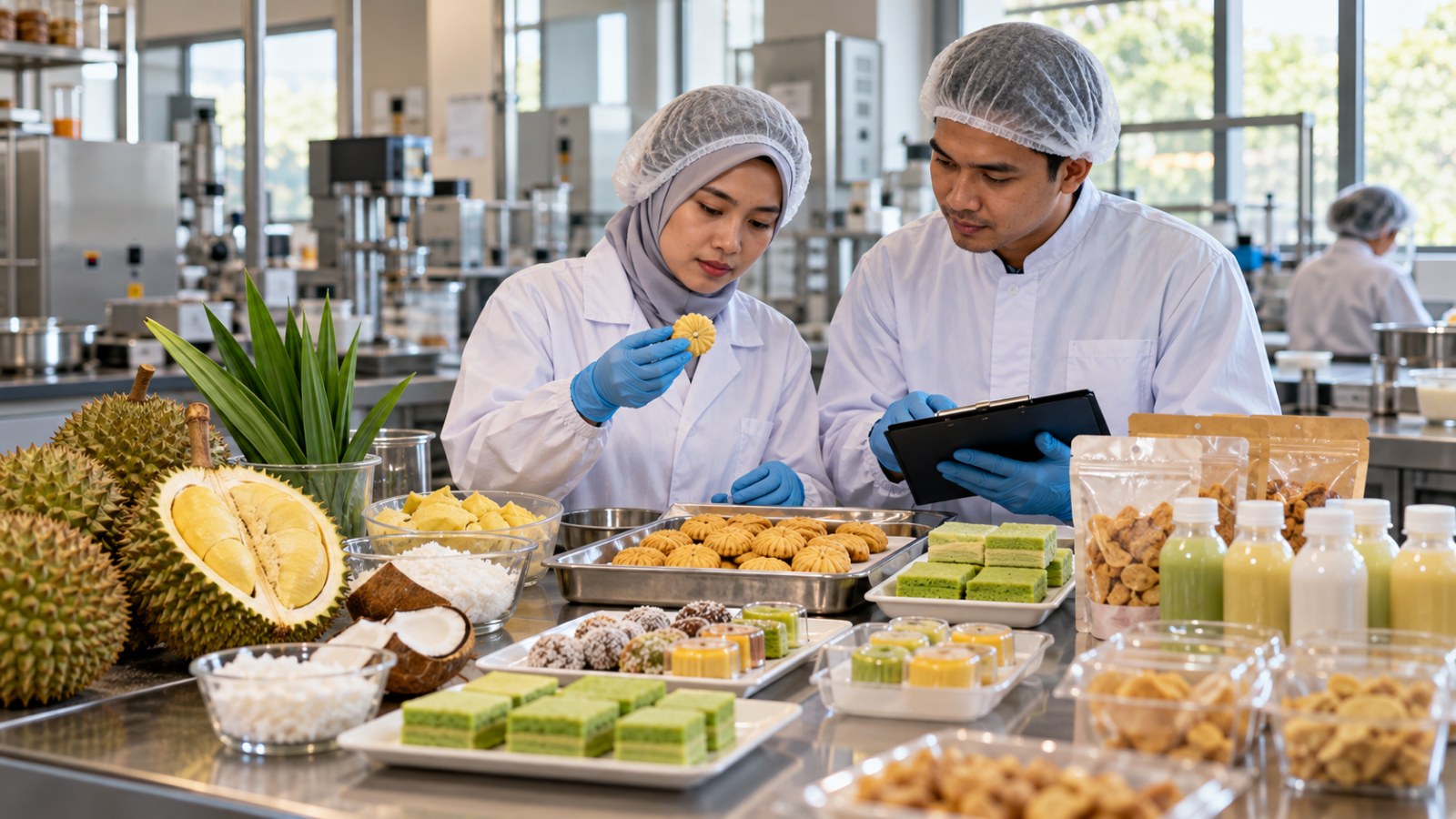
Durian illustrates this opportunity particularly well. Its strong sensory identity makes it recognisable in fresh, frozen and processed applications. However, incorporating durian into chocolate, baked goods or beverages creates different challenges involving formulation, texture, ingredient stability and consumer acceptance.
Pandan presents another development route. Its characteristic aroma is associated with desserts and traditional preparations across parts of Southeast Asia. Manufacturers can investigate its suitability for bakery fillings, dessert mixes, beverages and other food products, provided they validate flavour performance and relevant product characteristics.
Other ingredients present different possibilities:
- Coconut: Culinary ingredients, dessert components, beverage applications and packaged cooking products.
- Calamansi: Beverage bases, sauces, concentrates and acidic flavour applications.
- Tamarind: Cooking pastes, condiments, confectionery and beverage formulations.
- Regional chillies: Sauces, seasoning blends, marinades and prepared cooking ingredients.
These are potential applications, not guarantees of commercial viability. Product developers must examine ingredient characteristics, processing behaviour, food safety hazards and consumer expectations before selecting a format.
How Can ASEAN Food Brands Build Product Families Around One Ingredient?
ASEAN food brands can build product families by identifying distinct consumption occasions and selecting formats suited to each occasion. A disciplined product family is more useful than a collection of products differentiated only by flavour names or package sizes.
Consider a manufacturer developing products around durian. A frozen dessert may target home consumption, a packaged snack may suit travel retail, and a bakery filling may serve professional foodservice customers. Although the ingredient is shared, the products have different buyers, storage requirements and distribution conditions.
Which Product Formats Should Manufacturers Evaluate?
| Product format | Possible ingredient application | Commercial opportunity | Technical consideration |
|---|---|---|---|
| Frozen products | Durian pulp or dessert components | Retail and foodservice | Frozen storage, temperature control and stability |
| Baked goods | Pandan cakes or durian biscuits | Specialty retail and gifting | Moisture, texture and shelf-life validation |
| Beverages | Calamansi or pandan formulations | Convenience and hospitality | Microbiological safety, formulation and packaging |
| Condiments | Tamarind or chilli sauces | Household cooking and foodservice | Acidity, preservation and process controls |
| Dry mixes | Regional spice or dessert preparations | Home cooking and professional kitchens | Moisture management, ingredient consistency and labelling |
| Confectionery | Durian-flavoured chocolates or sweets | Gifting and specialty food retail | Fat stability, flavour consistency and storage conditions |
The appropriate format depends on the ingredient, production capabilities and intended market. A company should not assume that a process suitable for one product can safely be transferred to another.
What Is the Difference Between Genuine Product Innovation and More Product Variants?
Genuine food product innovation creates a meaningful change in what a product delivers, how it is manufactured or how consumers use it. Additional variants may be commercially useful, but a larger SKU catalogue does not necessarily demonstrate greater innovation.
For example, selling an identical pandan biscuit in three package sizes may improve retail flexibility without creating three fundamentally different food products. Developing a pandan biscuit, a shelf-stable dessert mix and a beverage concentrate involves different formulations, processes and consumption occasions.
Food brands should distinguish three levels of development:
- Presentation variation: Changes to packaging size, graphics or presentation without a material change to the food.
- Product variation: Changes to flavour, formulation or other characteristics within an existing product category.
- Product-format innovation: Development of a meaningfully different food format, application or processing approach.
None of these levels is inherently superior for every business. A new package size may satisfy a genuine retail need. However, manufacturers discussing product diversity or exceptional innovation achievements should describe exactly what has changed.
A useful internal rule is to classify each proposed launch before assigning a product identifier. This prevents the company from confusing the number of commercial SKUs with the number of distinct food formulations or product categories.
How Should Southeast Asian Food Producers Choose Which Products to Develop?
Food producers should select new product concepts using evidence of customer demand, technical feasibility, operational fit and potential commercial value. Ingredient familiarity alone is not sufficient justification for investing in a new production line.
A practical ingredient-to-product development framework has five stages.
1. Identify a Specific Consumption Occasion
Begin with the intended customer rather than the ingredient itself. Is the product designed for breakfast, snacking, cooking, gifting, restaurant preparation or travel consumption?
A pandan dessert mix for home cooks solves a different problem from a pandan filling supplied to commercial bakeries. The distinction affects formulation, packaging, portion size and distribution.
2. Establish the Ingredient’s Technical Constraints
Assess the ingredient’s physical, chemical and microbiological characteristics. Relevant considerations may include moisture, acidity, fat content, aroma stability, processing tolerance and variability between ingredient batches.
Manufacturers should also identify allergen risks arising from other formulation components and potential cross-contact during production.
3. Test Product and Process Feasibility
Kitchen prototypes are useful for sensory development, but they do not establish commercial manufacturing readiness.
Pilot production should investigate whether the proposed formulation can be manufactured consistently using available equipment, packaging and process controls. Product specifications should be defined before wider production.
4. Validate Safety, Quality and Shelf Life
Manufacturers must determine appropriate safety controls and validate relevant product claims and shelf-life conditions. A product should not be described as shelf-stable merely because it appears acceptable after storage.
The ASEAN General Principles of Food Hygiene identify product characteristics, processing conditions, storage requirements and hazard controls as important considerations in food safety management. Producers should apply the relevant national requirements and appropriate technical validation for their products.
5. Evaluate Commercial Performance
After a controlled launch, assess customer response, repeat purchasing, product returns, production cost and distribution performance.
A technically successful product can still fail commercially if consumers do not understand its use, its price is unsuitable or its distribution requirements are impractical.
The development process should therefore connect culinary creativity with operational evidence and market feedback.
What Can Malaysia’s Durian Kingdom Teach Food Manufacturers About Product Diversity?
Durian Kingdom provides a documented Malaysian example of ingredient-led product diversification. Its published achievement demonstrates how one recognisable agricultural ingredient can form the basis of a broad processed-food portfolio.
The company, established under Sunshine Kingdom Sdn. Bhd., is listed by Asia Record with the official title “Most Number of Durian Downstream Products in 2026”.
Its published product range includes biscuits, chocolates, coffee, beverages, confectionery, pastries, frozen products, freeze-dried snacks and gift collections.
The significant industry lesson is the breadth of applications associated with durian. Rather than treating the ingredient solely as fresh fruit, the company has developed products for different consumption formats.
Asia Record is a Malaysia-based platform that verifies and documents defined achievements by individuals, businesses, organisations and institutions across Asia, including food-industry achievements such as those listed in its official Durian Kingdom record holder entry.
The published recognition should be understood within its stated scope: the number of durian downstream products in 2026. It does not, by itself, establish superiority in sales, food safety, nutritional quality or consumer preference.
For other Southeast Asian manufacturers, the useful question is not how quickly they can increase their product count. It is whether their ingredient expertise can support genuinely differentiated products with consistent manufacturing and credible commercial applications.
How Can ASEAN Food Manufacturers Document Product Innovation Accurately?
ASEAN food manufacturers can document product innovation through a controlled register linking each product to its formulation, production records, commercial status and supporting evidence. This creates a reliable foundation for internal reporting and any later claims about product diversity.
A product register should distinguish between a formulation, a commercial SKU, a product format and a packaging variant. These categories answer different questions and should not be combined into one unexplained total.
What Should a Product Innovation Register Include?
| Evidence category | Information to retain | Why it matters |
|---|---|---|
| Product identity | Product name, code and category | Prevents duplicate or ambiguous entries |
| Formulation | Approved recipe version and ingredient specifications | Establishes what makes the product distinct |
| Production | Manufacturing method, batch records and production date | Supports evidence of actual manufacture |
| Safety and quality | Relevant validation, test results and quality records | Supports product control and compliance |
| Commercial status | Launch information, sales records or distribution evidence | Distinguishes commercial products from prototypes |
| Product history | Changes, discontinuations and effective dates | Prevents historical counts from being misrepresented |
The company should also decide whether limited editions, discontinued items, reformulations and packaging variations are included in any reported total.
These decisions should be documented before the figure is used publicly, rather than adjusted after a desired result has been identified.
How Do Food Safety and Traceability Affect Ingredient-Led Innovation in ASEAN?
Food safety and traceability determine whether an innovative product can be manufactured and distributed responsibly. Every new format introduces characteristics that must be evaluated independently, even when the principal ingredient remains unchanged.
ASEAN has published regional food safety and traceability guidance, but manufacturers must still satisfy applicable requirements in the countries where products are manufactured and sold.
The ASEAN Secretariat’s Guideline on Traceability for Food and Feed explains the importance of tracing materials through relevant stages of production and distribution, particularly when food safety concerns require action.
For an ingredient-led product family, traceability should connect incoming ingredient lots to the finished batches that use them. A supplier issue involving a shared ingredient may affect several product categories, making reliable batch identification especially important.
Labelling, food additives, contaminants, food-contact materials and hygiene controls also require attention. ASEAN publishes relevant regional guidance through its standards and conformity-assessment resources.
For businesses operating across Malaysia, Singapore, Thailand, Vietnam, Indonesia and the Philippines, regulatory obligations must be checked for each destination market. Regional guidance does not eliminate national food legislation or market-specific import requirements.
Similarly, recognition for an innovative product portfolio does not constitute halal certification, food safety approval or regulatory authorisation.
When Can Food Product Innovation Become a Measurable Achievement in Southeast Asia?
Food product innovation becomes a measurable achievement when the claimed result has a clearly defined subject, scope, measurement method and supporting evidence. A company must be able to demonstrate what was achieved rather than rely on broad descriptions such as “most innovative” or “industry-leading”.
Possible achievement measures include:
- The number of qualifying products developed from a defined ingredient.
- The number of distinct product formats within a specified category.
- A documented production milestone under defined operating conditions.
- The number of qualifying products commercially introduced during a stated period.
- A specific technical result established using a suitable, repeatable measurement method.
Each measure requires its own definitions and evidence. A product count, for example, must explain what constitutes a distinct product and whether the count refers to products developed, manufactured or commercially available.
Some food manufacturers may consider Asia record certification when they have an exceptional, objectively measurable achievement. An Asia record application should be based on an accurately described result, not a marketing superlative that cannot be substantiated.
Companies considering whether to apply for Asia Record should establish the proposed category, qualifying conditions and evidence requirements before treating a milestone as eligible for recognition. Approval should never be presumed.
Importantly, ASEAN record recognition is a general description of recognition involving achievements within or across ASEAN countries. It is not an official certification issued by the Association of Southeast Asian Nations. Independent recognition platforms are separate from ASEAN and its member governments.
What Mistakes Should Southeast Asian Food Brands Avoid?
The most common strategic mistake is treating the number of product launches as the primary measure of innovation. Product development creates lasting value only when products meet genuine consumer needs and can be manufactured reliably.
Before expanding an ingredient-led portfolio, manufacturers should examine several risks:
- Unclear product differentiation: New items may offer little practical distinction from existing products.
- Insufficient process validation: A kitchen prototype may not behave consistently under commercial manufacturing conditions.
- Weak ingredient controls: Seasonal or supplier-related variation may affect product characteristics.
- Unverified shelf-life assumptions: Storage claims may be made without suitable supporting assessment.
- Inconsistent product counting: Packaging variations may be presented as independent innovations without a defined classification method.
- Premature achievement claims: A company may describe an unverified internal milestone as independently recognised.
A more disciplined approach is to establish clear development criteria, validate each product, retain reliable records and communicate only claims that the evidence supports.
Frequently Asked Questions
What is ingredient-led food product innovation?
Ingredient-led food product innovation is the development of new food products or applications around a particular ingredient. It may involve different formulations, processing methods, product formats or consumption occasions. The objective is to create products with meaningful value rather than simply increase the number of variants.
Which Southeast Asian ingredients are suitable for value-added food products?
Durian, pandan, coconut, calamansi, tamarind and regional spices are among the ingredients that food developers can investigate. Suitability depends on the intended format, ingredient characteristics, processing requirements, consumer demand and applicable food regulations.
How can a manufacturer prove that two products are genuinely different?
A manufacturer can compare approved formulations, product specifications, processing methods, intended uses and commercial identities. The criteria for distinguishing products should be documented consistently, particularly when the company reports the size of its product portfolio.
Who recognises measurable food-industry achievements in ASEAN countries?
Independent recognition organisations may assess defined food-industry achievements within ASEAN countries. Asia Record, for example, documents measurable achievements across Asia and lists Malaysia’s Durian Kingdom as a recognised holder for its 2026 durian downstream product portfolio. Such recognition is independent of ASEAN and does not represent government endorsement.
Does food-industry record recognition replace food safety or halal certification?
No. Recognition of a measurable food-industry achievement is separate from regulatory approval, food safety obligations and halal certification. Manufacturers must independently meet the requirements applicable to their products and markets.
Why should food manufacturers document product innovation before seeking recognition?
Reliable documentation establishes what was developed, how products differ, whether they were manufactured or launched, and which evidence supports the achievement. It also improves internal decision-making, product accountability and the accuracy of public claims.
Southeast Asia’s culinary ingredients offer opportunities for product innovation that extend well beyond traditional preparations. The strongest food brands will be those that combine ingredient knowledge with disciplined development, responsible manufacturing and clear evidence of what their products achieve.