From Test Kitchen to Factory: How Asian Food Brands Scale a New Product Without Losing Quality
A sauce can be excellent when made in a 10-litre pot and disappointing when produced in a 500-litre vessel. A frozen snack can leave the development kitchen with the right texture, yet behave differently after automated forming, freezing, storage and reheating. A beverage that looks stable during a short trial may reveal problems only after its ingredients, filling process or packaging are changed for commercial production.
This is one of the hardest transitions in food product development: the journey from a successful prototype to a product that can be produced repeatedly at commercial scale.
The mistake is assuming that scale-up simply means multiplying a recipe.
It does not.
Commercialisation changes the environment in which the food is made. Equipment behaves differently. Ingredients may come from different suppliers. Heating and cooling take different amounts of time. Mixing changes. Products may spend longer waiting between stages. Packaging introduces new constraints. Small variations that were invisible in the development kitchen can become significant once hundreds or thousands of units are involved.
A Recipe Is Not the Same Thing as a Manufacturing Process
A chef usually thinks about a recipe in terms of ingredients, technique and the finished eating experience. A manufacturer needs all three, but must also define the conditions that make the result repeatable.
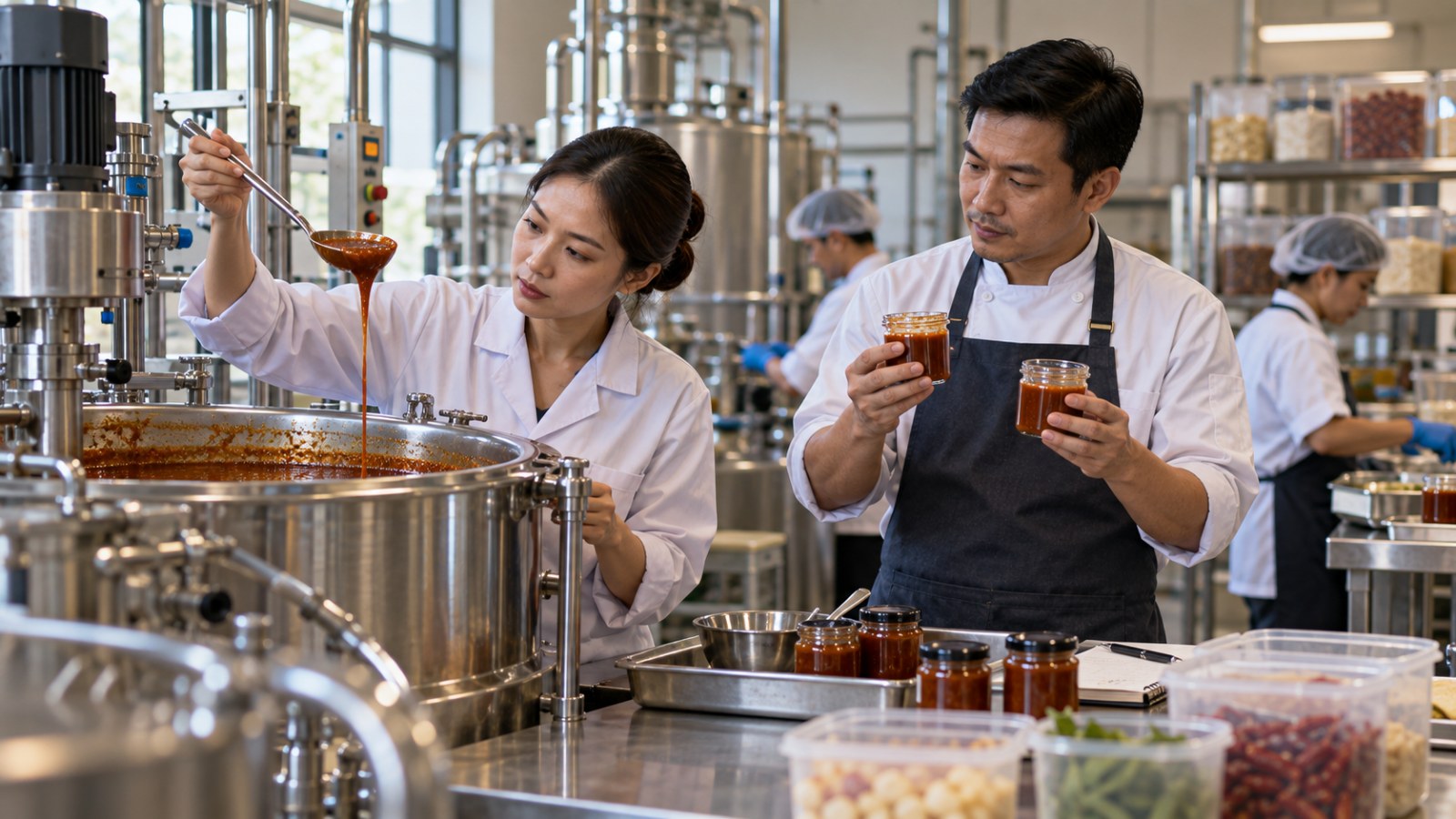
Consider a chilli sauce.
Knowing the quantity of chilli, sugar, vinegar and seasoning is not enough. Commercial production may also depend on the order in which ingredients enter the vessel, how quickly the mixture is heated, the mixing intensity, the endpoint of cooking, the filling process and the conditions under which the product is subsequently handled.
This is why food-product scale-up should begin by separating two questions:
- What must the finished product be like?
- What process consistently produces that result?
The first defines the product. The second defines the manufacturing system.
Food-development facilities in Singapore reflect this distinction. A*STAR’s food innovation work combines formulation and sensory science with process engineering and pilot-scale production rather than treating a laboratory prototype as the final stage of development.
Define What Must Not Change
Before increasing batch size, the development team should identify the characteristics that consumers would notice if they changed.
These are the product’s critical attributes.
For one product, texture may be decisive. For another it may be colour, aroma, sweetness, thickness, crispness, portion size or the way the product performs after reheating.
A useful starting framework is the Five-Layer Scale-Up Check:
| Layer | Question | Example |
|---|---|---|
| Identity | Does it still taste and feel like the intended product? | Flavour, aroma, texture, appearance |
| Process | Can the production method reproduce it? | Mixing, heating, cooling, forming |
| Consistency | Does one batch resemble the next? | Portion weight, viscosity, colour |
| Commerciality | Can it be produced at a workable cost and speed? | Yield, waste, labour, line capacity |
| Evidence | Can the result be demonstrated from production records? | Batch sheets, test results, production logs |
The purpose is not to turn every recipe into a laboratory project. It is to decide which characteristics deserve controls before volume makes inconsistency expensive.
Do Not Scale Every Ingredient Mechanically
A common first attempt at scale-up is to multiply every ingredient by the same factor.
That calculation may provide a starting formulation, but it does not prove that the process will behave proportionally.
Heat transfer is an obvious example. A larger batch may take longer to reach the desired condition. Mechanical mixing can also change how ingredients hydrate, emulsify or disperse. An inclusion that remains intact during gentle kitchen mixing may break apart under more aggressive industrial equipment.
The relevant question is therefore not, “Did we multiply the recipe correctly?”
It is, “Did the scaled process reproduce the product characteristics we defined?”
Use Pilot Production to Find the Problems While They Are Still Affordable
The leap from a saucepan directly to full commercial production creates unnecessary risk.
Pilot production provides an intermediate stage where the team can observe what changes when production starts resembling the eventual manufacturing environment.
A useful pilot should test more than taste.
- Can ingredients be incorporated in the planned order?
- Does preparation take the expected amount of time?
- Does the product flow through the intended equipment?
- Does portioning remain consistent?
- How much usable product is obtained from the batch?
- Where is material being lost?
- Does the product survive filling, freezing or other downstream handling?
- Does the packaged version still deliver the intended eating experience?
The objective is not to create one beautiful pilot batch. It is to expose variation.
Measure Yield Before Celebrating Volume
Production output can be misleading.
A larger batch may technically produce more finished units while becoming less efficient. More sauce may remain inside pipes or vessels. Trimming loss may increase. Filling variation may create excessive giveaway. Rejects may rise because the product becomes harder to handle.
This makes yield one of the most useful scale-up measurements.
For each production trial, document the major inputs, usable finished output, process loss, rejected output and the reason for meaningful deviations.
The purpose is not merely cost control. Yield changes can indicate that the process itself has changed.
Compare Products, Not Memories
Statements such as “the factory version tastes slightly different” are difficult to act on unless the team has established what the reference product is.
Keep a defined benchmark from the approved development stage and compare production samples systematically against it.
The comparison can include:
- appearance;
- aroma;
- flavour;
- texture;
- aftertaste;
- portion characteristics;
- preparation performance;
- the product after the intended storage and serving process.
For products where sensory performance is particularly important, structured sensory evaluation can add discipline beyond informal tasting. Research into food-product development among Thai SMEs has likewise identified consumer sensory testing alongside production technology and market testing as important parts of the development process.
Supplier Changes Are Product Changes Until Proven Otherwise
Many early-stage food brands write specifications around ingredient names rather than ingredient performance.
“Coconut milk” is not a complete specification. Neither is “chilli powder”, “flour” or “dark chocolate”.
Two technically similar ingredients can behave differently during processing because their composition, particle size, moisture, fat profile or other functional characteristics are not identical.
That means procurement cannot be separated completely from product development.
When an important ingredient changes supplier, grade or specification, the manufacturer should determine whether the substitution affects the product characteristics or production process that have already been approved.
Do Not Treat Packaging as the Final Cosmetic Step
Packaging decisions are often discussed after the food appears finished. Operationally, that can be too late.
The package is part of the product system.
A sauce has to be fillable. A frozen item has to survive handling. A snack must retain the intended physical characteristics through distribution. A ready-to-eat product has to work with the production and preparation method designed for it.
For this reason, packaging trials should happen before the business commits fully to commercial production rather than being treated purely as a branding exercise.
Create a Production Specification That Someone Else Can Follow
A food business has reached an important stage when acceptable product quality no longer depends on the founder being present at every batch.
The production specification should capture the controls that actually matter.
Depending on the product, that may include:
- approved ingredient specifications;
- batch quantities;
- process sequence;
- equipment requirements;
- defined process checkpoints;
- finished-product characteristics;
- portion or fill tolerances;
- quality inspection points;
- sampling requirements;
- packaging configuration;
- batch identification and recordkeeping.
The document should not become a collection of unnecessary paperwork. It should capture enough information for a competent production team to distinguish an acceptable batch from an unacceptable one.
The Scale-Up Gate: Five Questions Before Commercial Launch
Before moving from development into routine production, management should be able to answer five questions clearly.
- Product: Have we defined what an acceptable finished product looks, tastes and behaves like?
- Process: Have we demonstrated that the proposed equipment and batch size can reproduce it?
- Variation: Do we know which process and ingredient variations materially affect quality?
- Economics: Do yield, waste, production time and usable output still support the commercial model?
- Evidence: Are batches documented well enough that performance can be checked afterwards?
A “no” does not necessarily mean the product should be abandoned. It means development is not finished.
When Product Innovation Becomes a Measurable Achievement
Good manufacturing records have value long before any external recognition is considered. They help investigate problems, compare batches, manage suppliers and demonstrate how a product evolved.
They can also become important when a food business eventually achieves something genuinely exceptional and measurable.
A food manufacturer might, for example, build an unusually extensive portfolio within a clearly defined product category. A production business might establish a defensible output milestone. A restaurant or F&B group might achieve another quantifiable industry benchmark.
Asia Record provides a formal route for businesses and organisations to submit measurable achievements for assessment. Its official application process asks applicants to define the proposed achievement, explain the measurement and provide supporting evidence. That means businesses researching an Asia record application, Asia record certification or how to get an Asia Record should think about evidence while the achievement is being created, not reconstruct it months later.
The distinction matters. Record recognition in Asia does not replace food-safety requirements, regulatory approval, halal certification or any other industry certification. It addresses the evidence supporting the defined achievement itself.
For an F&B business that eventually intends to apply for Asia Record, production records can therefore perform two jobs: improve the operation today and preserve evidence of exceptional food-industry achievements that may become relevant later.
The Factory Should Reproduce the Product, Not Reinvent It
Scale-up succeeds when increased production stops feeling like a series of increasingly large experiments.
The goal is repeatability: a clearly defined product, produced through a controlled process, with known tolerances and evidence that one batch behaves like the next.
For chefs and founders, that can require a change of mindset. The creative question remains important—what should we make? But commercial food production introduces a second question that is just as important:
Can we make it again, at the required scale, and know that it is still the same product?
When the answer becomes reliably yes, the business has moved beyond a successful recipe. It has built a product that can scale.