The Central Kitchen Decision: When Asian Restaurant Groups Should Centralise Production
Somewhere between the fifth and the fifteenth outlet, most restaurant groups in Asia run into the same wall. The food is still good. It is simply no longer the same. The curry is darker in one mall and thinner in another. The pastry team at the newest branch was trained by someone who was themselves trained three months earlier. Head office responds the way head offices usually do — more audits, more photographs of correct plating, another round of standard operating procedures — and the variance carries on regardless.
This is not a discipline problem. It is a production architecture problem, and it has one well-established answer: move the parts of the cooking that carry the most variance out of the outlets and into a single facility built for it. That facility goes by several names — central kitchen, commissary, central production unit — and the decision to build one is among the largest capital and cultural commitments a multi-outlet F&B business will make.
The decision is also badly served by the available advice. Most published guidance on central kitchens comes from equipment exporters and inventory software vendors, which means it answers “what should I buy” rather than “should I do this at all, and when.” What follows is the operator’s version of the question.
What the evidence actually says
The clearest recent data point in the region comes from Singapore. In October 2025, Enterprise Singapore and the Singapore Productivity Centre published a Food Services Productivity Report built on in-depth interviews and on-site assessments of more than 350 F&B companies. The study isolated three factors that separated strong performers from average ones: systematic process optimisation, centralised food preparation, and technology-enabled solutions. Outlets that applied those practices generated close to double the sales per man-hour of an average outlet.
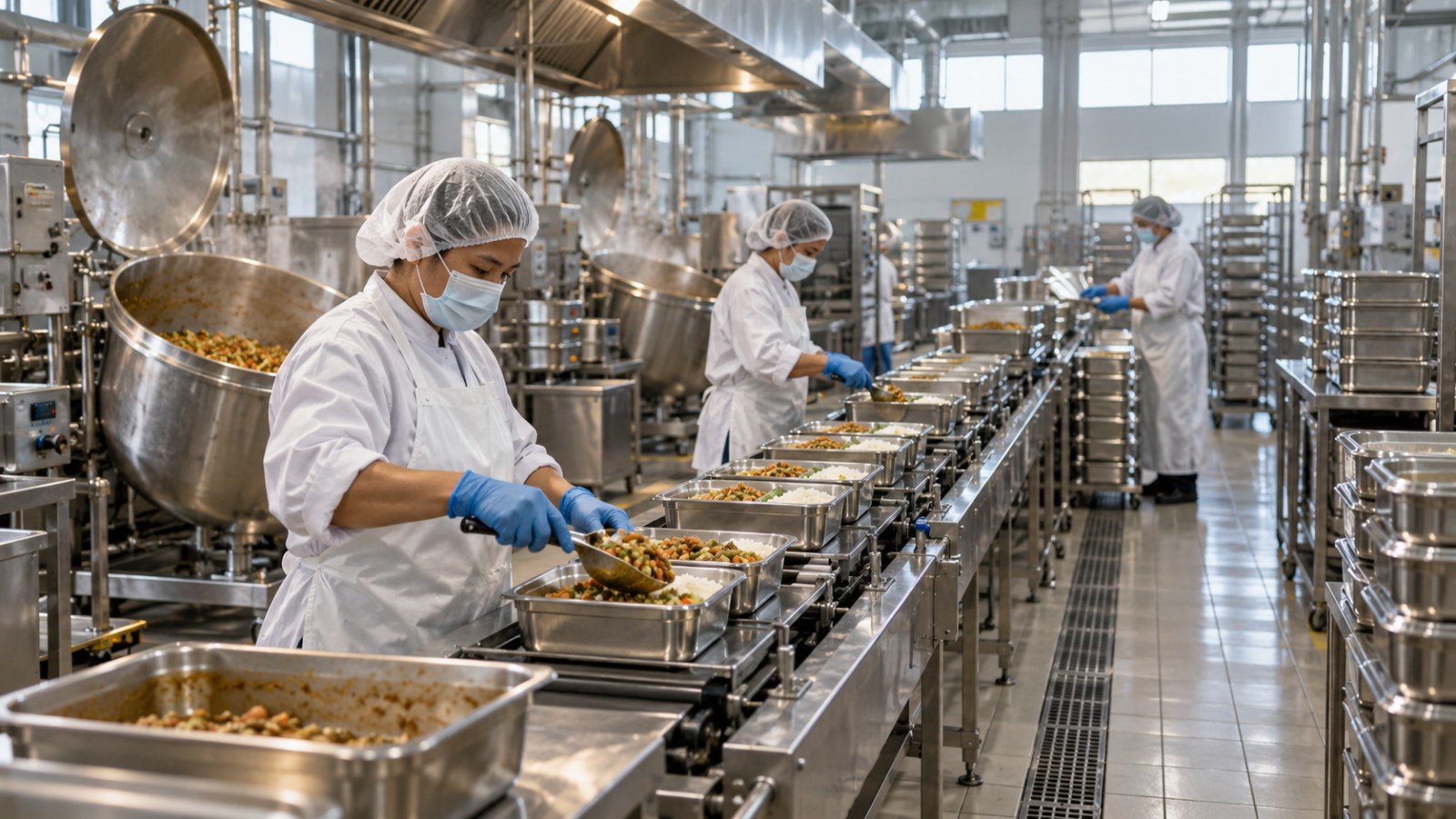
That finding is not confined to Western-style quick service. Chang Cheng Group operates traditional mixed rice stalls — one of the most manpower-intensive, lowest-margin formats in Southeast Asia. Its automated central kitchen, commissioned in 2017, was cited by Singapore’s Ministry of Trade and Industry as saving an estimated 1,100 manhours per day, delivering roughly 13% in business cost savings and a 60% productivity improvement, while supplying close to 160 stalls across about 25 coffeeshops. It also gave the group something it did not have before: the spare capacity to sell bento meals as a separate revenue line.
At the largest scale, the pattern is the same but the sequencing is instructive. Yum China now operates more than 17,000 restaurants under six brands across over 2,500 cities. Its filings describe 33 logistics centres serving company-owned and franchised stores plus third-party customers, covering more than 2,000 cities with headroom for over 3,000, a stated plan to reach 45 to 50 centres, over 800 mostly China-based suppliers, and more than 1,300 people employed in food safety, quality assurance, procurement, logistics and engineering. The important detail is the headroom. The network was built with capacity ahead of the store count, not behind it.
In the Philippines, the Jollibee Group’s own corporate history marks the 2004 opening of Zenith Foods Corporation — described by the group as the largest commissary in Asia at the time, with an initial investment of PHP 1.5 billion — as a milestone in its own right. Two decades later, in January 2026, the group inaugurated its Danao City facility in Cebu: its fourth and largest commissary in Cebu, and its first multi-brand plant in the country, supplying ingredients and products for Jollibee, Chowking, Mang Inasal, Greenwich, Red Ribbon and Burger King from one site.
Four stages, not one decision
Operators tend to frame centralisation as a binary: build the kitchen or don’t. In practice, almost every successful Asian group moved through stages, and the expensive mistakes come from skipping one.
| Stage | What it looks like | Typical trigger | Main risk |
|---|---|---|---|
| Stage 0 — Mother outlet | The original kitchen produces sauces and bases for two or three nearby branches after service hours | 2–4 outlets in one city | Burning out the founding team and degrading the flagship’s own service |
| Stage 1 — Dedicated prep unit | A small leased kitchen doing sauces, marinades, portioning and spice blends only. No finished dishes | 5–10 outlets, or a second city | Under-specifying cold chain and being forced to rebuild within 18 months |
| Stage 2 — Licensed central kitchen | Purpose-built, licensed facility with production planning, batch traceability and scheduled distribution routes | 10–30 outlets, or franchising begins | Building for today’s outlet count instead of the three-year plan |
| Stage 3 — Multi-brand commissary | Shared group infrastructure serving several brands, sometimes with external customers and retail products | Multiple brands or formats under one group | Complexity outrunning the planning system; one facility becomes a single point of failure |
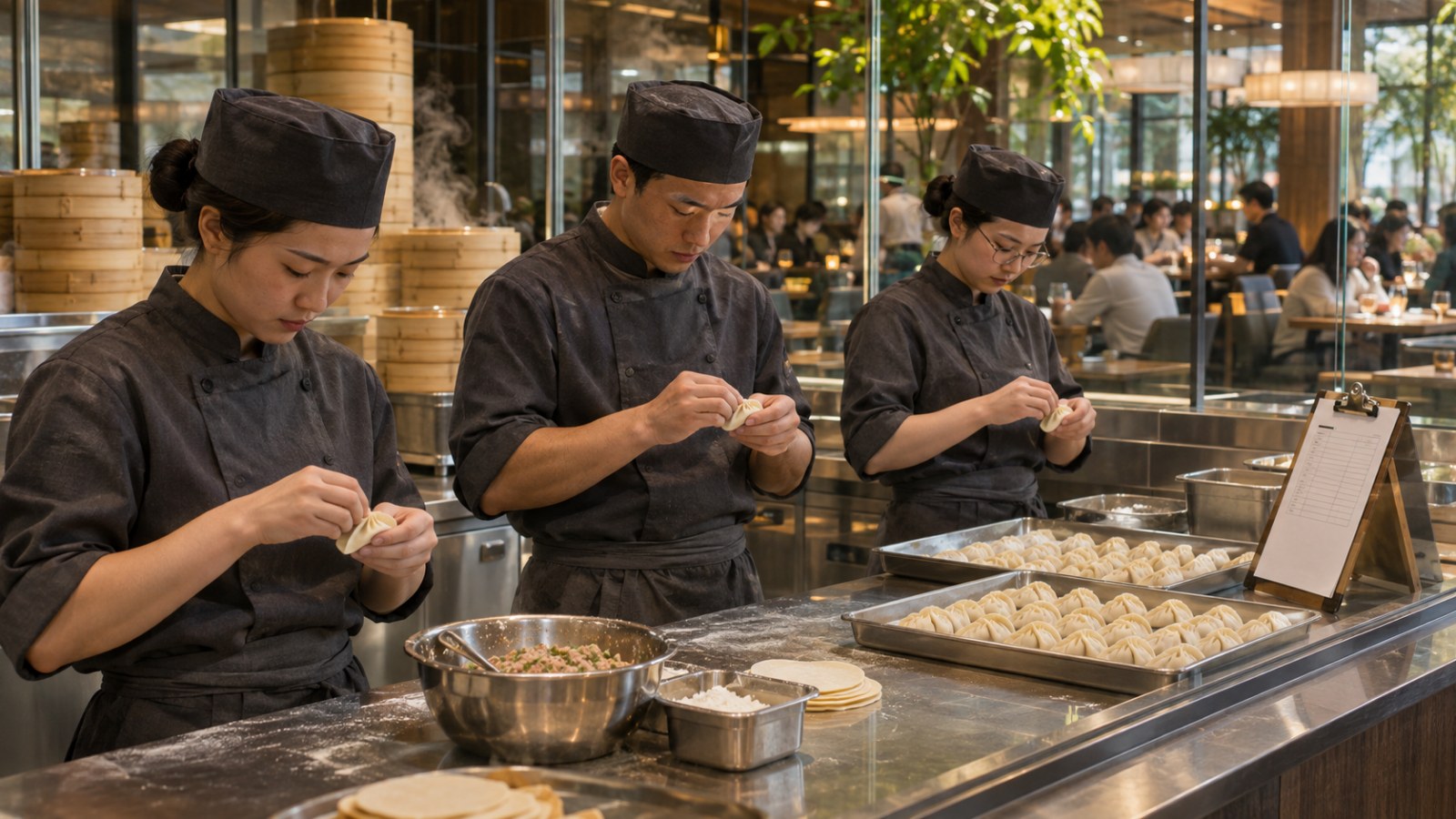
Stage 1 is the one most often skipped, and it is the cheapest place to learn. A leased prep unit teaches an operator its real yields, its transfer losses and its distribution timing at a fraction of the cost of learning the same lessons inside a purpose-built plant.
What to centralise, and what to leave alone
Centralisation is not all-or-nothing, and the groups that get it wrong are usually the ones that centralised too much. The useful test for any menu component is simple: how much does it vary between outlets today, and how much of the guest’s perceived quality depends on it being finished in front of them?
| Component | Centralise? | Reasoning |
|---|---|---|
| Stocks, sauces, marinades, spice blends, sambals | Yes — first | Highest variance, longest cook times, most sensitive to individual judgement. The single biggest consistency gain available |
| Protein portioning, marination, par-cooking | Yes | Labour-heavy and the main driver of food cost discipline. Yield control is impossible across twenty kitchens |
| Bakery, pastry, doughs | Usually | Requires skill and equipment no individual outlet can justify. Also the easiest category to extend into retail later |
| Vegetable washing, cutting, standard garnishes | Partly | Prep centrally, assemble in outlet. Watch shelf life carefully in tropical distribution conditions |
| Rice, noodles, wok items, fried items | Rarely | Texture degrades fastest and is the most visible failure to the guest. Finish in outlet, without exception |
| Final seasoning, plating, service adjustments | No | Requires real-time judgement — and it is what persuades the guest a kitchen is still cooking rather than reheating |
That last row matters more than its position suggests. For a fine-dining or chef-led concept, visible craft is part of the product, and centralising it removes the reason customers chose the restaurant. Central kitchens serve formats where consistency is the promise. They damage formats where variability is the promise.
The centralisation readiness test
Before committing capital, an operator should be able to answer all five of these questions with evidence rather than instinct.
- Is the variance measured? If nobody has weighed the same dish at three outlets on the same day, the problem is not yet defined. Centralising an unmeasured problem produces an expensive facility solving the wrong thing.
- Is there enough volume to fill the plant? A central kitchen running at 40% capacity is a fixed-cost anchor. Model the break-even against the outlet count you will realistically hold in twenty-four months, not the one in the pitch deck.
- Can the cold chain hold? Across most of Southeast Asia this means validated chilled transport, temperature logging and delivery windows that survive urban traffic. Cold chain failure turns a consistency programme into a food safety incident.
- Is the licensing and compliance path clear? Central kitchens are licensed food production facilities, not large restaurant kitchens. Halal segregation, HACCP-based controls, batch traceability and export eligibility all need to be designed in at drawing stage, because retrofitting them is far more expensive.
- Does centralising remove what customers are paying for? Answer this honestly, and answer it last. It is the only question on the list that cannot be fixed with more capital.
Three mistakes that recur across the region
Building for the current outlet count. A facility sized for today’s network is obsolete before commissioning. The larger operators deliberately carry distribution capacity ahead of demand — Yum China’s stated coverage headroom is a case in point — because adding capacity to a running plant is disruptive and expensive.
Treating it as a cost centre. The Chang Cheng example is instructive precisely because the productivity gain was not the whole return. Spare capacity became a new revenue stream. Operators who plan for external supply, retail products or catering from the outset build very different facilities than those chasing labour savings alone.
Under-investing in production planning. The physical plant is the visible half. The invisible half is the system that decides what gets produced, in what batch size, for which outlets, on which day. Without it, a central kitchen simply relocates waste rather than removing it — and it introduces a new failure mode, because one bad batch now reaches every outlet on the same morning.
When production capacity becomes a documented achievement
There is a second-order effect of centralisation that operators rarely anticipate. Once production moves into one facility, the business starts generating numbers it never had before: kilograms produced per day, meals dispatched, outlets served from a single site, distinct product lines manufactured, distribution radius covered. These figures are audited, logged and defensible in a way that outlet-level estimates never were.
That changes what a company can credibly claim about itself. Most F&B marketing rests on adjectives. A verified production figure rests on records. And where a figure is genuinely exceptional — the largest facility of its kind in a market, the widest product range produced from a single plant, the highest documented output within a category — it moves into territory that formal record recognition exists to handle. Notably, the Jollibee Group’s own corporate history treats the scale of its 2004 commissary as a milestone worth recording, which tells you how the industry itself reads these numbers.
This is the distinction between an award and a record. Awards reward judgement; records verify measurement. Asia Record documents verified record-breaking achievements across Asia, and its listings already include established F&B names — Din Tai Fung, for instance, is an Asia Record holder recognised for its market position in the region’s dining sector. For a restaurant group, food manufacturer or hospitality operator, the relevant question is whether a production or scale figure is specific, measurable, independently verifiable and materially significant within a defined category. Where it is, Asia record certification is a route to converting an operational fact into a documented business record rather than an unsupported marketing line.
The practical mechanics matter here, because record recognition in Asia is a submission-and-review process rather than an application of judgement by a panel. Operators asking how to get an Asia Record will find the nomination categories, documentation requirements and review timeline set out in full, which is also the fastest way to establish whether a given achievement is genuinely record-worthy before committing effort to it. Groups whose milestones do not yet meet that threshold usually learn something useful anyway: which of their numbers are actually auditable, and which are estimates they have been quoting for years.
The judgement, in one line
A central kitchen does not make a restaurant group bigger. It makes a restaurant group repeatable — and repeatability is what turns expansion from a risk into an asset. The operators who get this right in Asia are not the ones who build the largest facility. They are the ones who centralised the right components, at the right stage, with capacity in front of them rather than behind, and who understood before pouring concrete exactly which parts of their cooking were never meant to leave the outlet.