Where AI and Automation Actually Pay Off in Asian Restaurant Operations
Walk into a restaurant group’s head office in Kuala Lumpur, Bangkok or Ho Chi Minh City and ask what technology the business has bought in the past two years. The list arrives quickly: a new point-of-sale system, QR ordering, a delivery aggregator integration, an inventory app, perhaps a serving robot that came with its own social media plan. Then ask what any of it changed on the profit and loss statement. The room usually goes quiet.
That silence is the real technology problem in Asian foodservice. The region is not short of tools. It is short of operators who decided, before purchase, which specific number a tool was supposed to move — and who then went back to check.
One Region, Several Different Calculations
Technology decisions in Asia are often discussed as though the region shares a single set of economics. It does not. In Japan, Korea and Singapore, a shrinking or expensive labour pool makes automation a structural response rather than an experiment. In Vietnam, Indonesia and the Philippines, labour remains comparatively affordable, and the same machine that pays back in eighteen months in Tokyo may never pay back at all.
Thailand sits somewhere in between. The Thai Restaurant Association has described a labour shortage that remains unresolved across both front-of-house and kitchen roles, with operators turning to QR ordering, digital payments and point-of-sale systems to reduce errors and speed up service. Notably, those are information technologies rather than robots — cheap, fast to deploy, and aimed at the paperwork rather than the cooking.
Singapore has gone furthest in structuring support. Enterprise Singapore’s F&B Process Optimisation Programme funds pre-scoped consultancy covering outlet layout, technology adoption, menu engineering and job redesign, while a separate programme run with UOB offers eligible F&B companies up to 50% funding for smaller enterprises to adopt AI-enabled solutions and integrate digital systems. The useful signal in both is the sequencing: process first, technology second. Subsidising a bad process simply makes it faster.
The Four Jobs Restaurant Technology Can Actually Do
Almost every credible F&B technology does one of four things. It removes labour hours. It protects margin. It increases throughput within the same footprint. Or it produces data that makes the next three decisions better. Anything that does none of these is a branding exercise — which is a legitimate choice, but should be budgeted as marketing, not operations.
The confusion usually starts when a single purchase is justified on all four grounds at once. Automation in the region is frequently pitched simultaneously as a labour fix, an efficiency gain and a customer-experience differentiator. When a deployment is expected to deliver everything, nobody is accountable for anything.
| Technology | The job it is really doing | The number that should move | How it usually fails |
|---|---|---|---|
| POS and analytics | Creating a reliable data spine | Reporting accuracy; time to close daily sales | Reports are produced and never read |
| QR and kiosk ordering | Shifting order-taking to the guest | Covers per service hour; average check | Freed service hours are never redeployed |
| Inventory and procurement systems | Protecting food cost | Variance between theoretical and actual food cost | Stock counts remain manual and irregular |
| Demand forecasting and prep planning | Reducing over-production | Waste as a share of food cost; stockout frequency | Kitchen overrides the forecast by habit |
| Kitchen automation (fryers, woks, dishwashing) | Removing repetitive labour hours | Labour hours per 100 covers | Specified for peak, idle for most of the day |
| Service robots and runners | Moving distance, not decisions | Staff trips per service; table turn time | Bought for novelty, retired after twelve months |
| Scheduling and labour management | Matching roster to demand | Labour cost percentage by daypart | Managers override the roster without recording why |
The Five-Question Payback Test
Before approving any F&B technology spend, an operator should be able to answer five questions in writing. If three or more answers are vague, the purchase is not ready.
- Which P&L line does this move? Name one. Food cost, labour cost, revenue per available seat hour, or delivery contribution margin. Not “efficiency”.
- What is the baseline today? If the current number cannot be stated to within a few percent, no result can be claimed later. This is the step most often skipped, and it is the one that makes every subsequent claim unprovable.
- Does it remove hours, or relocate them? A kiosk that takes orders still leaves someone clearing tables. Removing a task only lowers cost if the roster actually changes.
- What happens when it fails during service? Forrester’s Craig Le Clair has pointed out that restaurants are chaotic environments, which makes productive automation genuinely hard. Any system without a manual fallback becomes a service risk on its worst night, not its best.
- Who owns it in month three? Vendor enthusiasm fades after installation. Someone in the business must own configuration, retraining and the monthly reporting, by name.
Start Where the Work Is Invisible
The most reliable returns in Asian restaurant operations are rarely the visible ones. Guests notice the robot; the accountant notices the purchasing system. Back-of-house technology tends to pay back faster for three reasons: the processes are more repetitive, the waste is more measurable, and nobody’s dining experience degrades if the software is imperfect in week one.
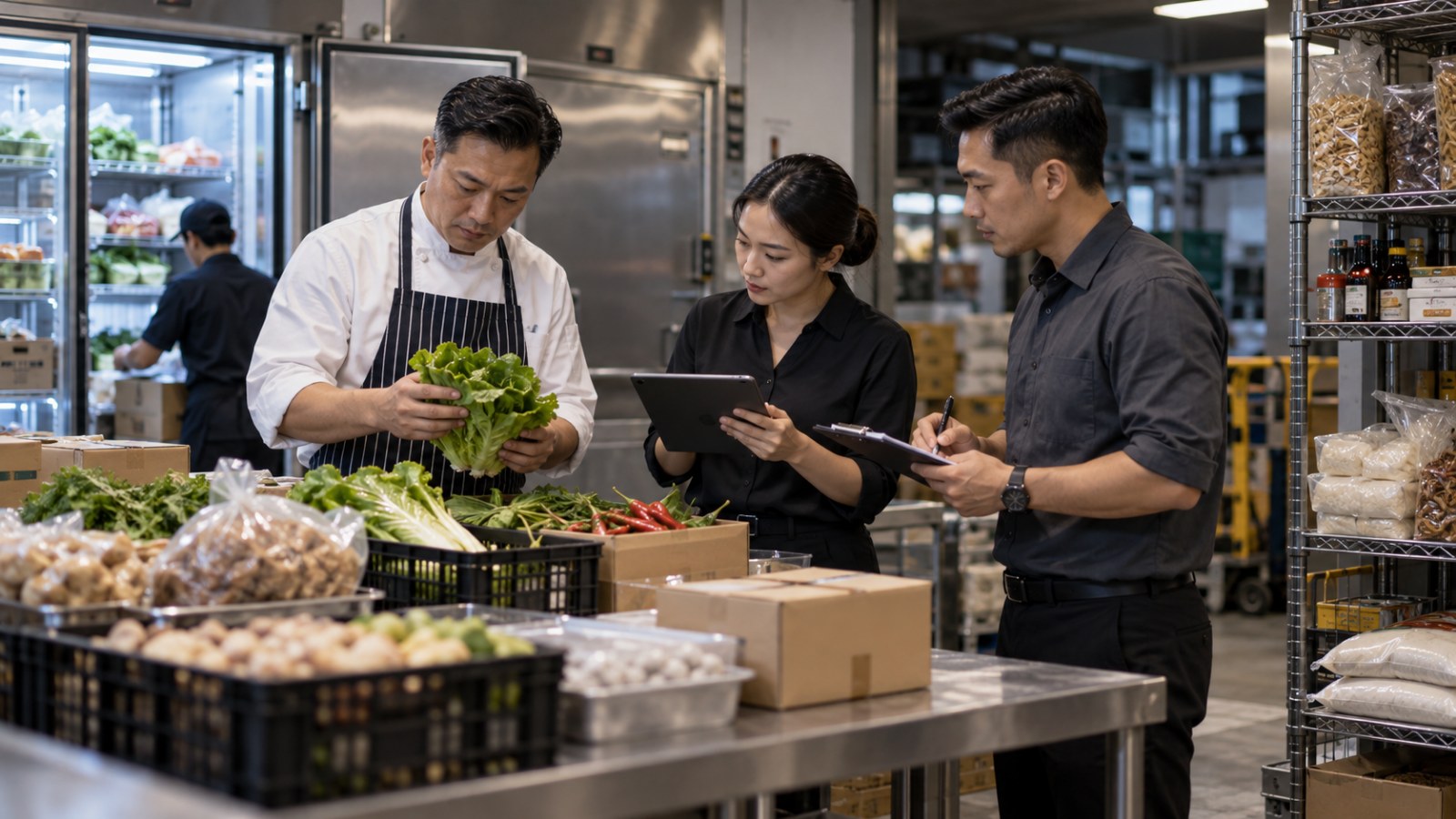
In practice, the sequence that works for most multi-outlet groups in the region is unglamorous. Get the point-of-sale data clean. Connect purchasing and stock so that theoretical and actual food cost can be compared weekly. Add forecasting to prep planning once there are at least three months of trustworthy sales history. Only then consider physical automation, and only for a task that is genuinely high-volume, repetitive and running for most of the trading day.
Physical automation specified for peak demand is the most common capital mistake in the region. A machine sized for Saturday dinner sits idle through Tuesday lunch, and the payback model quietly doubles in length.
Mistakes That Show Up Repeatedly
- Buying before baselining. Without a pre-installation measurement, the result becomes a matter of opinion.
- Counting savings that were never realised. Two labour hours saved per shift is a cost reduction only if the schedule changes.
- Piloting in the best outlet. The flagship has the strongest manager and the newest kitchen. Roll out from an average site instead.
- Treating training as a launch event. Staff turnover in Asian foodservice means a system trained once is a system half-used within a year.
- Ignoring the integration bill. Systems that do not talk to each other create manual reconciliation work, which is the cost the business was trying to remove.
- Letting the grant choose the strategy. Funding support lowers the price of a decision. It does not make it the right one.
A 90-Day Measurement Protocol
Measuring a technology deployment properly does not require a data team. It requires discipline over one quarter.
- Days minus 30 to 0: record the baseline weekly — labour hours by daypart, food cost variance, covers per hour, waste weight, and the two or three service metrics the system claims to improve.
- Days 1 to 14: expect performance to fall. Record the dip and its causes rather than hiding it; this is where the real training gaps surface.
- Days 15 to 60: stabilise. Lock configuration, stop changing variables, and hold the roster constant so the effect can be isolated.
- Days 61 to 90: compare like for like against the baseline, adjusting for seasonality and any menu changes. Document the method, not just the result.
- Day 90: decide — scale, adjust or stop. A documented decision to stop is a good outcome and costs far less than a quiet, expensive continuation.
When a Technology Milestone Becomes a Documented Achievement
Measurement has a second use that operators tend to overlook. Once a business can prove what a system does — output produced, outlets running it, hours removed, the date it went live and the conditions under which it was measured — that proof stops being an internal report. It becomes a claim the business can defend in front of franchisees, investors, buyers and the press.
Most such claims are ordinary. A few are genuinely exceptional: the first automated production line of its kind in a market, the largest single-group deployment of a kitchen system, the highest verified output achieved from one automated station over a defined period. These sit in a different category from ordinary marketing language, and they are the kind of measurable milestone that can support formal record recognition in Asia rather than an unverifiable superlative.
This is where record recognition differs from the awards circuit. Business awards Asia-wide, and the entrepreneur awards Asia’s F&B founders regularly enter, are typically judged on a panel’s assessment of overall merit. A record is narrower and harder: one defined, measurable claim, evidenced. Asia Record documents measurable achievements by individuals, businesses, organisations and institutions across the region, and its published verification process asks applicants to submit evidence demonstrating the achievement, how it was measured and the conditions under which it was achieved. An operator that has run a disciplined 90-day measurement protocol has already done most of that work.
Before preparing an Asia Record application, a restaurant group, café chain or food manufacturer should be able to answer four questions about the proposed claim:
- Is it specific? “Most advanced kitchen in Malaysia” is not a record. “Most meals produced by a single automated station in a 24-hour period” might be.
- Is it measured? By a method someone outside the business could repeat.
- Is it evidenced? Production logs, system exports, supplier confirmations, timestamped documentation.
- Is it bounded? By date, geography and category, so the claim remains checkable a year later.
Operators asking how to get an Asia Record usually discover that the hard part is not the submission but the record-keeping that should have started months earlier. Those ready to test a claim can apply for Asia Record recognition directly, and businesses considering it can review the official directory of record holders to see how other Asian business achievements have been framed. Becoming a record holder in Asia is a recognition of a documented milestone — it sits alongside, and never replaces, food safety compliance, halal certification, licensing or any other regulatory requirement a food business must meet.
Technology Is an Operating Decision, Not a Purchase
The restaurant groups getting real value from AI and automation across Asia are not the ones with the most impressive equipment list. They are the ones that treated each deployment as an operating change with a defined target, a named owner and a date on which someone would check the number.
That habit produces better capital decisions. It also produces something more durable: a business that knows, in evidenced terms, exactly what it does well — which is the foundation of every credible claim it will ever make, whether to a franchise partner, an investor, or a record adjudicator.